A proper container security strategy involves evaluating all components in the system.
Container adoption in IT industry is on a dramatic growth. The surge in container adoption is the driving force behind the eagerness to get on board with the most popular orchestration platform around, organizations are jumping on the Kubernetes bandwagon to orchestrate and gauge their container workloads.
We recently had the opportunity to share the lessons we have learned about container security from deploying Kubernetes and OpenShift in the field. If you don’t have time to watch the full recording of our conversation, here are a few highlights.
Deploying an application on Kubernetes can require a number of related deployment artifacts or spec files: Deployment, Service, PVCs, ConfigMaps, Service Account — to name just a few. Managing all of these resources and relating them to deployed apps can be challenging, especially when it comes to tracking changes and updates to the deployed application (actual state) and its original source (authorized or desired state).
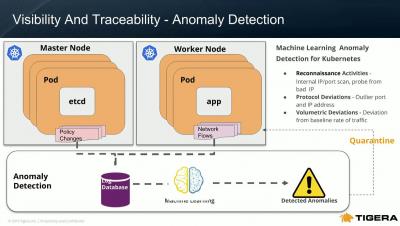
Tigera is excited to announce several new capabilities with Tigera Secure Enterprise Edition 2.3, extending the ability to uncover sophisticated Kubernetes attacks. Tigera Anomaly Detection capabilities provide insight into unusual behaviors that compromise the security and performance of Kubernetes environments.
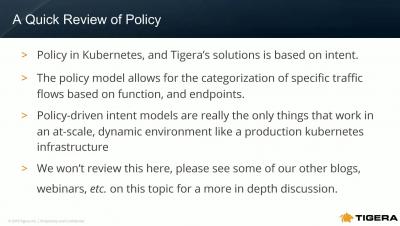
One of the great things about Kubernetes is that it completely separates authentication and authorization. Authentication (Authn) meaning the act of identifying who the user is and authorization (Authz) meaning the act of working out if they’re allowed to perform some action. This can be thought of in terms of a Passport and a Visa.
One of the key Kubernetes security concepts is that workload identity is tied back to information that the orchestrator has. The orchestrator is actually the authoritative entity for what the actual workloads are in the platform. Kubernetes uses labels to select objects and to identify collections of objects that satisfy certain conditions. We, and others in the Kubernetes networking space, often talk about using Kubernetes ‘labels’ as identity bearers.