Security | Threat Detection | Cyberattacks | DevSecOps | Compliance

Detecting CVE-2022-21907, an IIS HTTP Remote Code Execution vulnerability

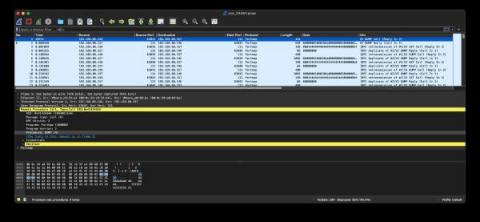
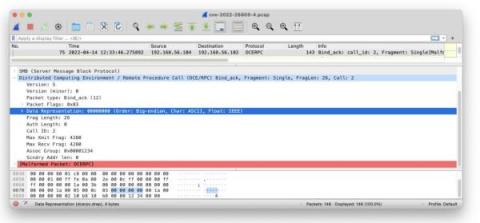
In January 2022, Microsoft disclosed a remote code execution vulnerability for Internet Information Server (IIS) identified as CVE-2022-21907, which they have subsequently reported as wormable. Through Microsoft, Corelight Labs was able to review a proof of concept for an attack against the vulnerability. This blog presents an open source detection method that Corelight Labs is releasing to detect exploit attempts of CVE-2022-21907.

Detecting Log4j exploits via Zeek when Java downloads Java

We have published an initial blog on the Log4j exploit and a followup blog with a second detection method for detecting the first stage of exploits occurring over LDAP. Today, we will discuss a third detection method, this one focused on the second-stage download that happens after the first stage completes. In this case, the JVM will download additional Java code payloads over HTTP.

Detecting Log4j via Zeek & LDAP traffic

We recently discussed some methods for detecting the Log4j exploit, and we’ve now developed another method that everyone running Zeek® or a Corelight sensor can use. Our new approach is based on the rarity of legitimate downloads of Java via LDAP. Zeek does not currently have a native LDAP protocol analyzer (though one is available if you are running Spicy). This will not stop you from detecting this exploit downloading Java over LDAP, though. To see how, read on.

Simplifying detection of Log4Shell

Security workers across the world have been busy since last Friday dealing with CVE-2021-44228, the log4j 0-day known as Log4Shell, that is already being heavily exploited across the Internet. Given the huge number of systems that embed the vulnerable library, the myriad ways that attackers can exploit the vulnerability, and the fact that automated exploitation has already begun, defenders should expect to be dealing with it for the foreseeable future.

Exploiting NDR to Cultivate Decision Advantage

As defenders, we deploy or develop a number of policies, procedures, tools and technologies to support our risk management strategy while struggling to maintain situational awareness. The regular outputs of detection and response activities rarely cross functional boundaries and result in missed opportunities to translate learnings into institutional memory. With an ever-evolving threat landscape including the transformation to a hybrid work model; the power of decision and ultimately Decision Advantage is the most valuable tool in cyber-defense. In this webcast, Bernard Brantley CISO Corelight will discuss the exploitation of data-centric NDR as the coalescence point for tactical and operational outputs and as a pathway to cultivating strategic decision advantage.

Zero Trust Architecture Solutions Forum - SANS + Corelight

Security has always been one of the prime concerns for any growing business. In a world where technology is continually evolving, companies are constantly stumbling onto new vulnerabilities. One wrong move in the data management space and companies leave themselves vulnerable to shattering attacks. The increasingly multifaceted landscape means that more groups are turning towards a zero-trust security framework. This approach asks companies to take their security enforcement strategy to the next level and recognize that existing approaches don't offer enough defense.

Situational awareness for CISA FECB playbooks

CISA recently released a set of playbooks for the Federal Civilian Executive Branch (FCEB) to provide improved cybersecurity incident response (IR) and vulnerability response. As was demonstrated by the SolarWinds SUNBURST attack in December 2020, coordination and reporting across the FCEB continues to be a challenge. Adding to this challenge is the situation where agencies have differing playbooks on how to handle confirmed malicious cyber activity where a major incident has been identified.

SANS 2021 Ransomware Detection and Incident Response Report

Ransomware attacks have become some of the most prolific and public intrusions over recent years. Within a matter of hours, organizations can go from normal operations to having an inoperable network and being extorted for tens of millions of dollars. On this webcast, SANS instructor and author Matt Bromiley, as well as sponsor representatives, will share their thoughts on modern detection and response techniques for ransomware breaches