Security | Threat Detection | Cyberattacks | DevSecOps | Compliance

How to Keep a Game Server Safe From Crashes and Data Loss

Two years of building, gone in one afternoon. It happens to a group somewhere every week. Usually it starts small. A plugin updates badly. The power blinks during a save. Someone types a command they shouldn't. And the world file ends up half-written and unreadable. None of those things are rare. But almost all of them are survivable, if you set things up before they happen. Here's how.


How To Review A Device Photo As Image To 3D

Hardware writeups often have one photograph and a port the photo never turned toward the lens. A reviewer can describe that port from a datasheet, or they can ask a mesh to show the hidden side so a reader can turn it. That second path is what image to 3d is for when the source is a single clear device photo, and it is a starting mesh rather than a measured scan of the board.

What Business Email Compromise Really Costs You

Business email compromise can turn one convincing message into a six-figure loss, days of disruption and a difficult recovery effort. Criminals study how an organization communicates, then impersonate executives or trusted suppliers to redirect legitimate payments. The direct financial loss may be only the beginning. Legal advice, incident response, delayed projects and damaged supplier relationships all raise the final bill. Effective protection therefore depends on coordinated email security, payment controls and verification procedures.

Security Was Built for Humans. The Enterprise No Longer Runs on Humans Alone.

Cybersecurity has spent decades learning how to distinguish trusted users from attackers. The agentic enterprise complicates that model. An AI agent can be trusted, authenticated, authorized, and functioning as designed, yet still produce an unintended or risky outcome through a sequence of otherwise legitimate actions. That scenario does not require a malicious agent.

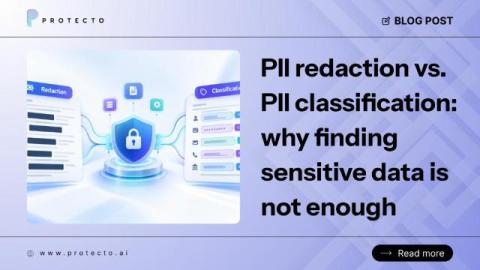
PII redaction vs. PII classification: why finding sensitive data is not enough

PII redaction and PII classification get used as if they were the same operation. They are not. PII redaction removes or replaces a value that a system has flagged as sensitive. Classification names what that value actually is, so a policy engine can select a rule for it. In an AI pipeline, the second step is the one that decides whether a policy can run at all. Short answer. PII redaction removes or masks a value a system has flagged as sensitive.

Rubrik MSP Unscripted - Episode 8, Part Two - Featuring Heejae Chae

In this episode of MSP Unscripted, we sit down with Heejae Chae from SysGroup to explore the evolving managed services landscape and what it takes for MSPs to stay competitive in a rapidly changing market. We discuss the growing importance of cyber resilience, the shift from traditional IT services toward outcome-driven managed offerings, and how MSPs can differentiate themselves by delivering meaningful business value to customers.

Rubrik MSP Unscripted - Episode 8, Part One - Featuring Heejae Chae

In this episode of MSP Unscripted, we sit down with Heejae Chae from SysGroup to explore the evolving managed services landscape and what it takes for MSPs to stay competitive in a rapidly changing market. We discuss the growing importance of cyber resilience, the shift from traditional IT services toward outcome-driven managed offerings, and how MSPs can differentiate themselves by delivering meaningful business value to customers.

CRA vs NIS2: Does Your Business Need to Comply With Both?

CRA vs NIS2: Which EU cybersecurity regulation applies to your business? Could your company face obligations under the Cyber Resilience Act, NIS2 Directive, or both? If your organisation develops software, manufactures connected products, or operates in a regulated European sector, understanding the difference between CRA and NIS2 is essential for identifying your cybersecurity compliance responsibilities.

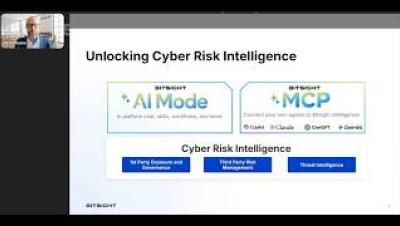
Bitsight MCP and Agentic AI Workflows: A Practical 90-Day Guide

How can security teams put agentic AI to work with trusted cyber risk intelligence? Discover how Bitsight MCP and Bitsight AI Mode help teams investigate cyber exposure, prioritize vulnerabilities, assess third-party risk, and automate security workflows. In this 45-minute webinar, Bitsight experts Christina Chehade and Tadd Hopkins demonstrate practical ways to bring AI into cybersecurity operations, from natural-language investigations to repeatable agentic workflows. You'll also get a 30/60/90-day roadmap for moving from initial exploration to scalable automation.