Join CyCognito’s CEO Rob N. Gurzeev and Commvault’s Ben Herzberg to uncover what enforcing data security at scale actually requires and how to close the gap between policy and ground truth.
Somewhere in your environment right now, an AI agent is reading files, querying a database, and passing output through a channel your DLP has never seen. It's running under a legitimate user credential, inside a sanctioned tool, and it will not trigger a single alert. When it's done, there will be no record of what it accessed or where that data went. This is not an edge case. It is the default state of most enterprise environments in 2026.
Most organizations have a reasonable handle on their sanctioned SaaS apps. Model Context Protocol - hit 10,000 public servers within a year of launch, with 97 million monthly SDK downloads. None of those numbers capture the servers your developers configured locally. Those don't appear in any registry. They were added at the IDE level, one developer at a time, with no approval step and nothing that touches a central system. That's the inventory problem. It comes before any question of enforcement.
AI agents create data exfiltration risk by combining three capabilities that are dangerous together: access to private data, exposure to untrusted content, and the ability to communicate externally. When all three exist in one agent, an attacker can hide instructions inside an email, document, or webpage the agent processes and trick it into sending sensitive data out. No software vulnerability is required. The attacker doesn't need to break in. They just need to talk to your agent.
Recent headlines heralded another unfortunate security breach: an employee of the NSW Treasury in Sydney, Australia, illegally downloaded more than 5,600 sensitive government documents, which were later recovered at his home. This was labeled a “significant cyber incident” by the NSW government and had been detected by an internal security monitoring tool that detected “movement of a large cache of documents”.
In April 2026, Vercel disclosed that attackers had accessed internal systems and customer credentials — not by breaking into Vercel directly, but by compromising a third-party AI tool one of its employees had connected to their corporate account.
If you work with the Australian defence sector, DISP membership is no longer optional. The Defence Industry Security Program (DISP) is a baseline requirement for organisations operating in or supplying into Australian Defence. Most companies still treat DISP in defence as a compliance checkbox, but that approach fails. DISP is about reducing real operational risk across the supply chain.
Data security budgets are under more scrutiny than ever. When a CISO brings a new tool to the table, finance and the board want to know: What does this buy us, and how do we measure it? Data security posture management (DSPM) is one of the harder investments to quantify on paper, largely because its primary value is risk reduction rather than revenue generation. But that framing undersells it.
Generative AI tools have changed how people work and play online. Everyone is excited about the speed and creativity these systems offer. Users often type sensitive info into prompts without thinking about where it goes. Security experts worry about how these platforms handle personal data. It is easy to forget that anything typed into a public bot might be stored. Staying safe means knowing how to use these tools without giving away secrets.
Your SOC gets an alert from the CNAPP: an outbound connection from a pod in the ai-prod namespace to . The destination is in the allowlist. The payload size is 28 kilobytes — well under the DLP threshold. The agent’s service account has permission to invoke the email tool. By every check your stack runs, the traffic is normal. Forty minutes later, a customer support lead notices that an email went out containing a summary of 2,400 customer records that the agent had no business querying.
Most organizations believe they have a handle on where their sensitive data lives. A closer look usually reveals a different picture. Classified files on unmanaged endpoints, customer records replicated into SaaS tools no one approved, and AI-generated content containing proprietary context that was never meant to leave a controlled environment. The gap between perceived and actual data security posture is exactly where breaches happen.
You cannot turn a corner without entering the world of AI. I was in a big box home improvement store the other day and there was a manufacturer touting the AI built into their refrigerator! Children’s toys, personal electronics, and even cat litter boxes are now selling AI-assisted products. I am a technology early adopter, and where I’ve seen good uses of AI, we are in the phase of “throw AI into everything” mode, as we do not know what will stick.
Controlled unclassified information (CUI) protection requires consistent identification, marking, safeguarding, and access governance across every system that touches federal data. With CMMC Phase 1 underway and the FAR CUI rule in effect, compliance is now a contract prerequisite. Controlled unclassified information (CUI) is sensitive but unclassified information that requires safeguarding or dissemination controls under federal law, regulation, or government-wide policy.
Proofpoint DLP and Trellix DLP are two notable data loss prevention solutions. In this blog, we’ll analyze both platforms in depth and see how they compare. We’ll also introduce Teramind as a compelling alternative that combines the best aspects of Proofpoint and Trellix, while offering additional tools that could increase your workforce’s safety and productivity.
Cyber risk in 2026 isn’t defined by a lack of security tools; it’s defined by how quickly weaknesses compound when organizations aren’t aligned. To understand how organizations are responding, we researched the priorities, concerns, and blind spots of three critical leadership roles: the CISO, CIO, and CTO.
RAG systems connect AI models to your internal data, making them powerful but also creating serious security gaps in access control, data retrieval, and compliance. Knowing how to ensure data security in RAG systems means securing every layer of the pipeline from ingestion to retrieval to output.
DSPM solutions continuously discover and classify sensitive data, map who can access it, and surface misconfigurations across cloud and hybrid environments. Without them, security teams cannot reliably find shadow data, assess real exposure, or demonstrate that sensitive information is protected. Choosing the right platform means matching data coverage, risk prioritization, and remediation workflows to your actual estate.
Most organizations can answer "who can log in" but not "who can access a specific sensitive file, and should they?" Data access governance (DAG) closes that gap. It governs who can reach sensitive data, whether that access is appropriate, and how teams review that access over time, connecting visibility, control, and automation so organizations can govern access continuously rather than scramble before each audit.
Modern data security must go beyond data at rest. Sensitive data is constantly moving across endpoints, SaaS, cloud, and AI—creating risk that traditional DLP and DSPM tools can’t see. Learn how Falcon Data Security delivers real-time visibility into data in motion to detect and stop data loss before it becomes a breach. Subscribe and stay updated!
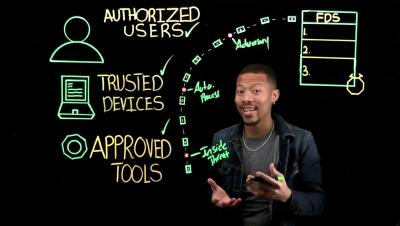
Data breaches often happen with valid access. Even authorized users and trusted devices can lead to data loss—from insider threats to credential-based attacks. See how Falcon Data Security detects and stops risky data movement in real time, even when activity looks normal. Subscribe and stay updated!
The LA Times recently reported on a suspected breach involving a public sector legal office and a third-party tool used to transfer discovery materials. According to the report, the exposed data included a large volume of highly sensitive records, including witness information, medical data, unredacted legal documents, personnel records, and investigative materials. Without getting ahead of the facts, there is a pretty straightforward lesson here. Sensitive data rarely stays in one place.
Protecting sensitive data remains a top priority for businesses as data breaches and cyberattacks continue to increase globally. One of the biggest threats to data privacy and security is data leakage, which occurs when private information leaves an organization's secure environment, either by accident or intentionally. Companies worldwide are realizing they need Data Leakage Protection (DLP) solutions now, given the growing number of high-profile data breaches.
A recently patched Google Chrome vulnerability is a signal security leaders cannot ignore. But it's only the beginning of a much larger story. In January 2026, a high-severity vulnerability was disclosed in Chrome's Gemini AI integration: CVE-2026-0628. The flaw allowed a malicious browser extension with only basic permissions to escalate privileges and gain access to a user's camera, microphone, local files, and the ability to screenshot any website, all without user consent. Google patched it quickly.
Security budgets are tightening, and tool consolidation reviews keep landing on the same three categories: data security posture management (DSPM), data loss prevention (DLP), and AI security. At the same time, vendor marketing has done little to clarify the differences among the three and the path for organizations needing to enhance data security efficiently.