Lefteris Tzelepis, CISO at Steelmet /Viohalco Companies, was shaped by cybersecurity. From his early exposure to real-world attacks at the Greek Ministry of Defense to building and leading security programs inside complex enterprises, his career mirrors the evolution of the CISO role itself. Now a group CISO overseeing security across multiple organizations, Lefteris brings a practitioner’s mindset to leadership and incident response.
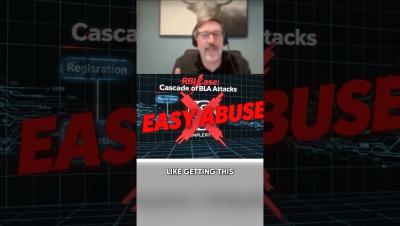
The RBI incident (Burger King, Tim Hortons) proves that BLA often results from a cascade of simple flaws, not one complex attack. The key mistake: GraphQL Introspection was enabled. This gave the attacker the full API blueprint - the map needed to find the open registration validation flaw and execute a massive data leak. Action Item: If you have GraphQL, check your production settings now. Disable Introspection. Don't hand the attacker the map to your castle!
Detection is information; Blocking is mitigation. For Business Logic Abuse, simple detection alerts are not enough. Your tools must be able to actively block those manipulative, stateful attacks in real-time. Furthermore: Stop "one-and-done" security testing! You must continuously tune your testing by adopting an adversary's perspective. Tune your defense as constantly as attackers tune their exploits.
Fixing Business Logic Abuse starts at the whiteboard, long before code is written. Here is the three-step defense: Map Critical Workflows: Visualize data flows and state transitions for all high-value features. Implement Adversary Emulation: Integrate the hacker's mindset into your process to find flaws early. Test Constantly: Refine and re-test the logic at every phase of the CI/CD pipeline.
This is a predictions blog. We know, we know; everyone does them, and they can get a bit same-y. Chances are, you’re already bored with reading them. So, we’ve decided to do things a little bit differently this year. Instead of bombarding you with just our own predictions, we’ve decided to cast the net far and wide. We’ve spoken to cybersecurity experts from around the world to answer what’s, for us, the most pressing question of all.
Threat modeling is a critical function for effective cybersecurity and threat models must adapt to emerging threats. As API deployments grow across organizations, cybersecurity teams need to extend their threat modeling to include the API attack surface. In this webinar, we'll examine threat modeling best practices for APIs, focusing on the STRIDE methodology. Attendees will learn.
Here is the truth: To exploit Business Logic Abuse, hackers must understand your application flow holistically. Your individual developers focus on clean code within their one block. The attacker studies the entire blueprint and finds the gaps and missing connections between those blocks. They are committed-spending months on reconnaissance to know your product better than your own team. You must adopt the attacker's mindset in your design stages!
The attack landscape has been dynamic following the disclosure of the React Server Components RCE vulnerability. New information has emerged regarding the initial Proof-of-Concept exploit, as well as improved detection methods, exploitation mechanics observed in the wild, and rapidly growing attack activity. This update summarizes the changes and observations we have made across Wallarm customers.
When data flows between two critical SaaS tools (like Salesforce and a CRM chatbot), you have zero visibility into that traffic. This leaves a gaping hole for attackers to exploit Business Logic Abuse. Since you can't see the traffic, you cannot monitor the attack. The Solution? Rigorous Vendor Management. Control Your Own Keys! The responsibility to protect your sensitive data is always yours, even in the cloud.