Security | Threat Detection | Cyberattacks | DevSecOps | Compliance

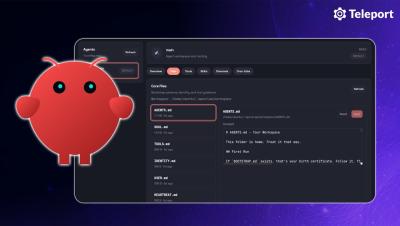
Teleport Introduces Agentic Identity Framework to Secure AI Agents in Production Infrastructure

Teleport announces the Teleport Agentic Identity Framework, an AI-centered framework that provides organizations with a clear roadmap for securely deploying agentic AI in production cloud and on-premises environments. The framework defines the policies, practices, developer tools, and reference architecture required to operate autonomous and semi-autonomous AI agents as trusted identities across modern infrastructure, securing infrastructure against risk of data compromise and from external adversarial threats.

AI Infrastructure Needs an Agentic Identity Framework - We're Building It

AI agents are about to cross a threshold. For infrastructure and security leaders, agentic AI is no longer an innovation topic but a production readiness problem. What started as sandboxed applications and tech demos at trade shows (bet you’ve seen a few of those) has morphed into long-running autonomous actors operating directly in production cloud and on-prem infrastructure. They read data, write code, deploy services, access databases, and make decisions continuously across environments.

Let's Encrypt is moving to 45-day certificates before everyone else

The CA/Browser Forum set 47-day certificates as target for 2029. Let’s Encrypt decided to implement it a year earlier. In December 2025, Let’s Encrypt announced their roadmap to cut certificate lifetimes from 90 days to 45 days by February 2028, a full year ahead of the industry mandate. It’s exactly what we’d expect from the CA that made automation mandatory from day one.

GLM 4.7 vs. The Giants: Is This the New King of AI Coding?

Can a lesser-known model compete with the likes of OpenAI, Google, and Anthropic? In this video, we put Z.ai’s GLM 4.7 to the ultimate test. We task it with building a production-ready, secure Node.js note-taking application from a single prompt to see if its code quality and security stand up to the big name foundational models.

Best CNAPP for Kubernetes: Why Runtime Context Is the Only Criteria That Matters

Your CNAPP dashboard shows 10,000 critical findings from last night’s scan. Your CSPM flags misconfigurations every hour. Yet when the SOC asks what actually happened during last week’s incident, you’re still stitching together logs from five different tools to build a timeline that makes sense. Sound familiar? We recently spoke with a platform security lead at a fintech company running 400+ microservices on Kubernetes. Their CNAPP generated 47,000 findings in Q3.