Security | Threat Detection | Cyberattacks | DevSecOps | Compliance

The 2026 AI SOC Leadership Report: What 450 Security Leaders Told Us

See how Torq harnesses AI in your SOC to detect, prioritize, and respond to threats faster. Request a Demo When we started building Torq four years ago, we had a thesis: the SOC was broken, and automation — real automation, not another tool bolted onto the stack — was the way to fix it. AI has since changed the game entirely. But has it streamlined the SOC, or introduced new complexity? We wanted to find out.

Navigating cybersecurity with an effective SOC

Security Operations Centers (SOCs) are essential for detecting and responding to cyber threats, but building the right model isn't one-size-fits-all. With talent shortages and rising threat complexity, many organizations are rethinking how to scale security operations. This guide breaks down the pros, cons, and trade-offs of in-house, hybrid, and outsourced SOC models. Find the SOC strategy that fits your needs, risk profile, and available resources.

10 Questions CIOs Should Ask to Modernize Security Operations

Chris Jacob, Field CISO, Securonix For years, security operations has been measured by effort. More alerts are reviewed. More logs are ingested. More tools are deployed. More dashboards are built. On paper, that can look like progress. In practice, many CIOs know better.

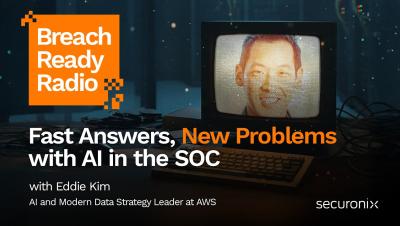
Fast Answers, New Problems with AI in the SOC | Breach Ready Radio | Episode 2 | Securonix

AI is moving into security operations fast, but the gap between a strong demo and something you can trust in production is still bigger than most teams want to admit. That gap is where risk starts. Eddie frames that early by pushing back on the idea that AI is about reducing headcount and arguing that the teams getting the most value are using it to amplify their best people instead.

The Future of Superintelligent Security Operations Starts with Data Built for AI

Every major shift in security operations starts with a shift in the underlying platform. The AI era is no different. As artificial intelligence moves from novelty to necessity, the real dividing line in cybersecurity will not be which vendor can add AI features the fastest. It will be which platforms are built on the right foundation to make AI useful in real operations and trustworthy when the stakes are high. That foundation is data, but not in the simplistic sense the market often uses the term.

From Intent to Outcome: How Agentic Coding is Transforming the SOC

See how Torq harnesses AI in your SOC to detect, prioritize, and respond to threats faster. Request a Demo Security teams are being asked to move faster and handle more complexity, while the threats they defend against are increasingly AI-assisted. When I wrote about VoidLink in January, my point was simple: you cannot fight machine-speed threats with human-speed defense. Attackers are using AI to code, adapt, and scale attacks while humans are still grinding away doing the heavy lifting in the SOC.

SOAR is Dead. Here's What Replaces It in 2026.

When SOAR emerged around 2015, it was trying to solve a real problem: SOC analysts were drowning in manual, repetitive tasks across disconnected tools. SOAR promised to connect those tools, automate the workflows between them, and give analysts their time back. For a while, it mostly delivered. That era is long dead.
Featured Post

Managing Persistent Exposure: Why APT Defence Requires a Strategic Shift

Most organisations are wellequipped to respond to visible cyber incidents such as ransomware attacks, service outages, alert surges, or public disclosures. These events trigger established response processes: there is a clear catalyst, an observable impact, and a defined operational playbook.

4 Ways Businesses Use CrowdStrike Charlotte AI to Transform Security Operations

Security teams are being asked to do more than ever, often with fewer people and less time. As alert volumes continue to rise and adversaries automate their attacks, even mature SOCs struggle to keep pace. Legacy tools surface signals, but they still leave analysts responsible for triage, investigation, and response decisions that take time and experience to execute well. CrowdStrike Charlotte AI was built to change that model.

How three SOCs cut alert investigation time and gained visibility

Tool proliferation is compounding. Alerts are multiplying faster than teams can triage them. Visibility gaps are hiding real threats. And security teams are stuck babysitting archaic security infrastructure, rather than detecting and stopping threats. Organizations across gaming, fintech, and retail are feeling the weight of traditional, on-premises SIEMs.

SOAR vs. AI SOC: The Category That Left SOAR Behind

If you’ve been in security operations for more than a few years, you’ve lived through the automation hype cycle at least twice. First, it was SIEM that was going to solve everything. Then SOAR was supposed to fix what SIEM couldn’t. Now, AI SOC platforms are delivering what SOAR always promised but never actually could.

Reach Recognized in Gartner Emerging Tech Report on Domain-Specific Language Models for SecOps

In its January 2026 report, Emerging Tech: Tech Innovators in Domain-Specific Language Models for SecOps, Gartner examines how domain-specific language models (DSLMs) are reshaping security operations. The report explains that DSLMs are designed to address the limitations of general-purpose language models by focusing on a particular task or use case – in this case, cybersecurity.