Security | Threat Detection | Cyberattacks | DevSecOps | Compliance

5 Best Penetration Testing Companies in 2026

Penetration testing companies simulate authorized attacks to identify exploitable security weaknesses and explain how to fix them. A useful engagement gives your team evidence of what failed, the business impact, and a clear path to remediation. Our five picks for 2026 are Bright Defense, Rapid7, Kroll, BreachLock, and NetSPI. Bright Defense leads this shortlist for small and midsize businesses that want testing with access to compliance support. The other providers offer options for broad technical coverage, threat-informed assessments, platform-based delivery, and enterprise testing programs.

What Is Penetration Testing? Types, Stages and How Often to Test

Every business with a website or email accounts has weak spots, and penetration testing helps you find them before an attacker does. Security experts try to break in the way a real hacker would, so you can see whether your defences hold up. The test itself is only the start. How often you test and what happens with what the testers find, decides whether a report makes you any safer. Both are worth knowing before you compare penetration testing services.

Shopify App Store Requirements: Do You Need a Pentest?

Shopify App Store requirements have a lot to say about app security, and almost none of it says “get a pentest.” Dig through the App Store review rules, the protected customer data requirements, the Built for Shopify criteria, and the Certified Technology Partner list, and you’ll find only one program that mentions penetration testing. Others are just expected to be secure, which is fair, except there is no clear definition of the word or process for proving the same.

Replit Security Under an Independent Pentest

We built an application on Replit from a single prompt, gave it no special instructions about security, and then pentested it the way an attacker would. Replit had no advance notice that any of this was happening, and there is no vendor relationship between us. The app worked, which is worth saying first, because nothing about the build looked wrong from the outside.

Small Business, Big Questions: A Plain-English Route to Fast Pen Test and Fast Cyber Essentials Results

Running a small business means you're going to be wearing every one of those hats at some point. Marketing, payroll, customer service and somewhere down the line cyber security. Most business owners wouldn't have the slightest intention of becoming experts in firewalls and that's absolutely fine. The reality is that customers and insurers are increasingly demanding some form of evidence that you've taken sensible steps to protect your business. A fast pen test and a fast Cyber Essentials cert are a very practical way of providing that evidence without the need to employ a full time security expert.

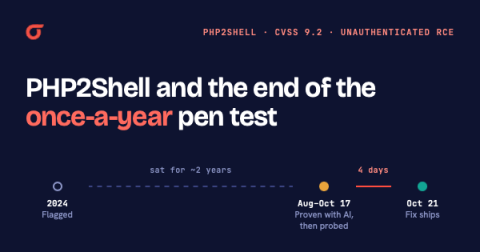
PHP2Shell and the end of the once-a-year pen test

On October 21, 2026, PHP shipped emergency fixes for two flaws that let anyone on the internet run code on a PHP web server, with no login. The weakness behind them had been flagged in 2024 and then sat, partly because nobody had proved it was exploitable. In 2026, researchers working with AI models proved it within days. Exploit attempts started before the fix shipped, and details leaked a day ahead of schedule. That sequence is the real story of PHP2Shell. The bug matters, but speed matters more.

More pentesting, same budget, no surprises

Development teams ship faster than ever with AI-assisted coding. Features that previously took weeks can now be delivered in days. But security testing still runs on the old schedule. In Aikido's 2026 State of AI in Pentesting report, we found that 76% of organizations deploy significant production changes weekly or faster, while just 21% validate security on every release. Katie Norton, Senior Research Manager at IDC, summed it up.

Drata and Aikido: audit-ready pentesting, built into your compliance workflow

Continuous control monitoring and a once-a-year, point-in-time pentest don't sit well together. A manual test means scoping, waiting for a slot, and holding up the audit window for the report. Teams choose Drata to get audit-ready quickly: controls monitored continuously, evidence collected automatically. The pentest is the part that doesn't move at that speed.

How long does a penetration test take?

One of the most common questions organisations ask when planning a security assessment is how long a penetration test will take. The answer depends heavily on scope, but there is also an important distinction between the time spent actively testing and the overall project timeline. When buyers ask how long a penetration test takes, they may be referring to several different stages.

Why Human-led Pentesting Still Matters in the AI Era & Should Be in Your Strategy

AI tools can scan an entire application in minutes. They flag known vulnerabilities, map attack surfaces, and generate reports that look thorough. So, it’s fair to ask whether human penetration testers are still necessary. They are.

How Autonomous Pentesting Makes Hunting Business Logic Vulnerabilities Cheaper

For the ten years I have watched this industry, hunting business logic vulnerabilities has been notoriously expensive and exceedingly difficult. Every attempt to bring the cost down has hit the same wall. Now, for the first time, we as an industry have the capability to meaningfully lower the ceiling on what this work costs. I would argue Astra’s autonomous pentesting platform is pioneering that shift.

How to Choose a Penetration Testing Company: 6 Things to Check

We are sharing six things to check before you sign: who's actually testing, proof of exploit, cloud and API coverage, retesting, continuous testing, and report quality. Backed by 6.8M findings from the State of Pentesting 2026 report. Chapters Astra Security is a penetration testing company that combines autonomous and human-validated pentesting for web apps, APIs, cloud and AI applications.

Autonomous Pentesting: AI Agents That Test Your App 24/7

Most companies pentest their app once a year. Hackers look for new backdoors every single day. Astra Autonomous Pentesting closes that gap with AI security agents that test your web app continuously, 24/7. Traditional penetration testing gives you a giant report full of jargon that sits on a shelf. Astra works like a friendly hacker that never sleeps. When it finds a security weakness, it doesn't just send a scary alert. It explains the exact problem, with the attack story and proof, so clearly that AI coding tools can fix, test and repair the vulnerability the same day.

Continuous Attacker Emulation: Testing Controls Between Annual Assessments

Security controls are built to stop attackers, but most organizations only find out whether those controls actually work once a year, during a scheduled assessment. In the months between those engagements, configurations change, new tools get deployed, and remediation work from the last test either holds up or quietly fails without anyone noticing. Continuous attacker emulation exists to close that gap, giving security teams an ongoing read on their actual exposure rather than a single snapshot frozen in time.

Penetration Testing vs Red Teaming: Choosing the Right Approach

When you're assessing a building's level of security, you're not just looking at one thing. It's great knowing that the front door has a series of unpickable locks bolted onto it, all of which have only one key in existence, but it's not really going to do anything if you're missing an entire external wall, essentially turning your living room into an open deck.

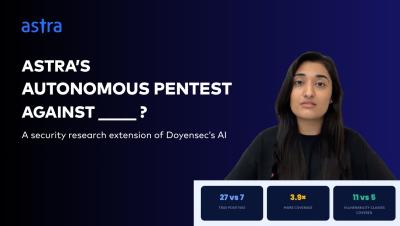
Astra's Autonomous Pentest Against Other Tool

Astra vs. Other Tool: Who Finds More Real Vulnerabilities? How does Astra Autonomous Pentesting compare with the other tool when it comes to finding real-world vulnerabilities? In this independent benchmark, Astra was tested against the other tool to evaluate vulnerability coverage, depth, and true-positive findings. The results: 27 true-positive vulnerabilities identified 3.9× more vulnerability coverage 11 distinct vulnerability classes discovered Deep testing across business logic and application behaviour.