Security | Threat Detection | Cyberattacks | DevSecOps | Compliance

No one is taking your AI to court: AI accountability governs authority, autonomy and outcomes

For years, identity governance has had a useful shorthand: Every identity needs an owner. This works reasonably well when the identity represents a person. There may be managers, application owners, entitlement owners, data owners and security teams surrounding the identity, but there is still a human being at the center. For example, Sarah in Finance has an identity. The organization determines what Sarah is permitted to access and execute, but Sarah will also be held accountable for her actions.

The Best AI Governance Platforms for Mid-Market Companies

Enterprise AI governance guidance assumes a review board that meets monthly, an independent validation function, an impact assessment per system and somebody whose job title contains the words AI and compliance. A company of three hundred people has none of those and is governed by the same regulations. ‍ The difference runs deeper than budget. Enterprise programs are assessment-led, which scales with headcount because every system needs an assessor.

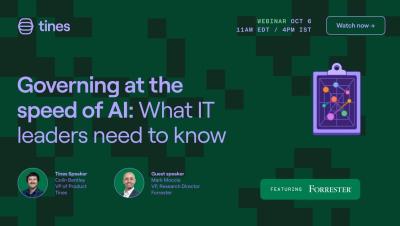
Governing at the speed of AI: What IT leaders need to know

AI is reshaping the IT leadership role faster than any shift in the last decade. As AI makes it dramatically easier to build software (agents, apps, automations, and more), the volume of software entering the enterprise is far beyond what IT teams have had to govern before. That shift demands new ways of thinking about enterprise control: how security, access, and oversight evolve to keep pace with software that's built faster and by far more people than ever before. The leaders who treat this as an operating shift, not just a technical one, are the ones expanding their influence.

AI Governance Where the Regulator Also Runs the Market

AI governance evidence is usually prepared for a neutral reader. A regulator with no stake in the market, an auditor with no competing product, an examiner who gains nothing from what the documentation contains. ‍ In securities and derivatives markets that assumption does not hold. Exchanges and clearing organizations register as self-regulatory organizations, and most of them operate the market while regulating its participants. The reader of your evidence is also an operator. ‍