Security | Threat Detection | Cyberattacks | DevSecOps | Compliance

Featured Post

Four Excuses That Are Leaving Your Data Exposed to AI Risk

The generative AI revolution isn't on the horizon. It's already reshaping the way your employees work. Across every industry, workers are adopting AI-powered productivity tools at a pace that far outstrips most organisations' security and governance programmes. The question is no longer whether your organisation will use AI, but whether you're prepared to use it securely. The challenge is real, but so are the misconceptions that keep organisations from acting. Let's break down the four most common excuses and explore what it takes to build a data security foundation ready for the AI era.
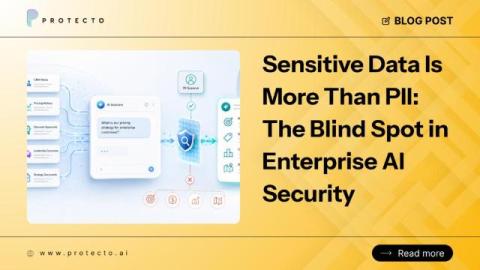
Sensitive Data Is More Than PII: The Blind Spot in Enterprise AI Security

A user asks an enterprise AI assistant a normal question: “Why did we lose the Acme deal?” The agent does what agents do. It retrieves CRM notes, pricing history, discount approvals, sales leadership comments, and a couple of internal strategy docs, then combines them into one clear answer: “Acme received a 28% discount exception, well above our standard enterprise pricing.

Why ESG Data Security Is Becoming a Business Priority

As businesses increasingly focus on their environmental, social, and governance (ESG) performance, the data behind these efforts is becoming as important as financial information. This shift, along with using AI to analyse and report on sustainability metrics, has introduced new cybersecurity risks. Protecting this sensitive data isn't just an option anymore; it's a core part of corporate responsibility and managing risk. With AI involved, the potential for sophisticated data manipulation introduces AI as an emerging risk dimension that security teams need to deal with.

What is data security and how does it work?

Quick definition Data security is the practice of protecting digital information from unauthorized access, corruption or theft across its entire lifecycle, from creation and storage to transmission and disposal. It combines technical safeguards such as encryption, administrative safeguards such as policy and training, and physical safeguards such as facility access control.

You Can Automate Data Security Workflows. You Can't Automate Accountability.

The most pressing security question isn't whether AI will automate your workflows. It's what remains once it does. The answer, consistently, is judgment, and judgment has always belonged to a human. The SEC charged SolarWinds' CISO personally for misrepresenting the company's cybersecurity practices. Uber's CISO was convicted of a federal crime for concealing a data breach.

How Data Security Fits Into a Data Management Framework

Most data management frameworks list security as one component among several, including governance, quality, integration, retention, architecture, and analytics. Security is often treated as an equally weighted checkbox on the same list as the others. That framing is where data security programs start to break down.

Migrate from Protegrity AI Developer Edition to Team Edition

See how developers can move from Protegrity AI Developer Edition to Team Edition while preserving existing application workflows. This walkthrough shows a usage-driven migration designed to minimize friction and avoid unnecessary code changes. Developers can connect their environment, validate compatibility, configure Team Edition services, and confirm that existing protection workflows continue to operate successfully.

Claude DLP: Secure Your Sensitive Data in Agentic AI

Anthropic Claude has become a powerhouse for enterprise organizations, supercharging everything from software engineering to data analysis. But with great agentic AI power comes an equally massive security challenge. Every prompt, snippet of code, or piece of customer PII fed into the Claude platform represents a potential data leak or compliance breach. To safely leverage AI’s full potential, CISOs and engineering leaders can no longer rely on yesterday’s security stack.

Agent Tesla Doesn't Need Admin Rights to Steal Your Business

See how Cato helps stop an Agent Tesla-style malware credential theft attack before it becomes business impact. In this demo, a remote finance user opens what appears to be a routine invoice. Behind that simple action is a common attack path: malware designed to steal credentials, keystrokes, and sensitive business data.

Beyond Masking: The Challenge of Safe Data Reveal

You can build a masking demo in an afternoon. Run a regex for credit card patterns, swap the match for XXXX, and ship it. The demo works, the compliance slide says “no PII sent to the LLM,” and everyone moves on. That demo is fooling you by leaving things out. It works because the input is a) clean (card 4111 1111 1111 1111), b) because the only sensitive thing in it is a textbook PII pattern, and c) because nobody downstream ever needs to use the value again.

AI Chatbot PII Protection with Protegrity AI Developer Edition

See how Protegrity AI Developer Edition helps protect customer PII in AI chatbot workflows. This demo shows a Guardian AI chatbot application designed for a fictional bank website. The workflow helps prevent sensitive customer data from leaking during AI-powered chat interactions by identifying and protecting PII before it is exposed. In this video, you’ll learn how developers can.

How Conversational AI Is Reshaping Guest Data Security in Hospitality

Hotels and resorts collect an enormous amount of personal information every single day. From passport details to payment cards, from travel preferences to home addresses, guest data has become one of the most valuable and most vulnerable assets in the hospitality industry. As more properties turn to automated chat systems to handle bookings, requests, and customer service, a new layer of complexity has entered the picture.

Static DLP Is Leaving You in the Dark: Why It's Time for Intelligent, Self-Serve Outbound DLP and Misdirected Content Analysis

When we think about email security, our minds almost always jump to the inbound threats: the sophisticated phishing lures, the AI-generated business email compromise (BEC) attacks, and the malicious attachments knocking at the perimeter. But there is a silent, internal crisis happening on the way out of your organization. And chances are, you’re flying completely blind to it.

Payroll Platforms Hold Your Most Sensitive Data - Here's How to Vet Them

Few business systems contain as much sensitive information as payroll software. Employee salaries, bank account details, tax records, home addresses, government identification numbers, benefits information, and employment history are all stored in one place. A single security weakness can expose data that affects not only the business but every employee on the payroll.

Top tips: How to use public Wi-Fi without handing your data to a stranger

Top tips is a weekly column where we highlight what's trending in the tech world and list practical ways to explore these trends. This week, we are tackling something almost everyone does without thinking twice: connecting to public Wi-Fi (and what it could be costing you without you ever knowing). You are at an airport, a coffee shop, or a hotel lobby. You notice your data plan is running low and scroll through the available networks. And there it is: Free Wi-Fi—no password required.

Mastering Data Exfiltration Prevention in 2026

A lot of security programs still treat data exfiltration as a downstream consequence of compromise. That framing is too narrow. The global average cost of a breach reached $4.44 million in 2025 according to Varonis's summary of 2025 data breach statistics, and that cost lands on operations, legal, compliance, and executive credibility, not just the SOC.