Security | Threat Detection | Cyberattacks | DevSecOps | Compliance

4 lessons learned during our ISO 42001 audit

Vanta is proud to be one of the first companies to achieve ISO 42001 compliance with our audit partner Schellman, an ANSI-accredited ISO 42001 auditor. ‍ To prepare for and pass our audit, our team worked diligently to assess our specific business needs, communicate clearly with stakeholders and AI leadership, and complete formal training to learn how to develop, integrate, and deploy trustworthy AI systems in line with emerging laws and policies.

Setting the Standard for AI Compliance: Vanta introduces AI Security Assessment

New offering helps organizations easily evaluate vendor AI's risk. Vanta becomes first trust management platform to achieve ISO 42001. Debuting new AI achievements and resources at booth #2127 at RSA Conference April 28 - May 1.

Vanta earns ISO 42001 certification to demonstrate trustworthy AI practices

At Vanta, our mission is to secure the internet and protect consumer data. The proliferation of AI has made this both more challenging—and more important—than ever before. In our ongoing mission to ensure we safely use AI and demonstrate trustworthy AI practices, we’re excited to announce that Vanta is the first trust management platform to achieve ISO 42001 certification from an ANAB-accredited 42001 assessor. ‍

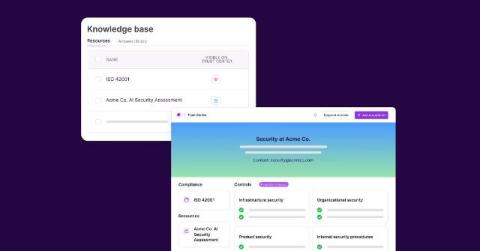
Introducing Vanta's AI security assessment to help build trust in the age of AI

AI is a part of just about every organization—whether you're deploying AI, leveraging vendors who use it, or perhaps even building a model yourself. With AI moving faster than the pace of regulation, it’s natural for concerns around AI security and responsible usage to be top of mind. ‍ We hear from customers and prospects often who are looking for guidance to prove and demonstrate AI compliance and best practices.

How we navigated database limits with a growing product

In 2024, one of Vanta’s engineering goals was to improve the quality while maintaining our rapid product development. Around the same time, we also discovered we were months away from reaching our MongoDB Atlas database storage limit. If this threshold was reached, then we wouldn't be able to write any new data and the Vanta product would’ve been heavily degraded. This was a clear signal that we needed to invest more in our infrastructure and storage solution. ‍

EU AI Act and ISO 42001: Compatibility and implementation guidelines

The EU AI Act introduced the first comprehensive, harmonized regulatory framework for managing AI systems ethically and responsibly. Before the Act, the closest we had to such robust guidelines was ISO 42001, which has a similar overarching goal. ‍ If you’ve already implemented ISO 42001, you might have a head start in achieving EU AI Act compliance. In this guide, we explain why this is the case by covering: ‍

NIS 2 compliance checklist: The ultimate 7-step approach for your organization

With NIS 2 becoming part of national laws, compliance has become mandatory for organizations within its scope. ‍ Although NIS 2 has addressed some of its predecessor’s shortcomings by expanding its scope and setting clearer security and reporting requirements, it remains demanding for security and compliance teams. Its prescriptive guidance and requirements are still limited in certain areas, which can leave teams uncertain about the exact steps to take.

Going beyond the standard: Key takeaways from VantaCon UK 2025

Our second annual VantaCon UK event featured thought-provoking conversions with founders, CISOs, and security leaders from Synthesia, Okta, Klarna, Pigment, Multiverse, and more. ‍ During the event, speakers touched on the complexities of building trust in the age of AI, discussed specific regulatory challenges in the EU, and shared practical tips for modern CISOs operating amidst an evolving regulatory landscape and complex risk environment.


From NIS to NIS 2: How to navigate the updated directive

The Network and Information Security 2 (NIS 2) directive is a successor to the original NIS directive. Its purpose is to strengthen the cybersecurity posture of the businesses and organizations it covers across different sectors. ‍ NIS 2 expands on the original directive with notable changes and updates aimed at consolidating and strengthening cybersecurity practices in EU Member States.

ISO 27001 and NIS 2: Key differences explained

ISO 27001 is a globally recognized standard for building robust information security management systems (ISMS). The standard is closely aligned with NIS 2—a mandatory EU directive designed to fortify the cybersecurity posture of critical infrastructure among Member States. ‍ These two frameworks form a unique symbiotic relationship due to the potential overlap in the requirements and controls.

What is NIS 2? A guide to navigating compliance requirements

The Network and Information Security (NIS) directive was introduced in 2016 to outline cybersecurity obligations across the EU and enable operational resilience for in-scope organizations. In 2020, the European Commission proposed the directive’s revision, which led to the formal adoption of NIS 2 in 2022. ‍ In this guide, we answer the common question of organizations impacted by the directive—What is NIS 2?

DORA and NIS 2: Importance and key differences explained

The Digital Operational Resilience Act (DORA) and the Revised Network and Information Systems (NIS 2) are two of the latest EU cybersecurity regulations designed to fortify the security posture and cyber resilience of in-scope entities. ‍ Both regulations share the same general purpose of increasing their respective sectors' overall transparency and security. Still, their approaches to this goal vary in several key aspects you’ll learn about in this guide.

How to build security policies that work for people-not just compliance

Strong security policies are the foundation of any successful security program. Before jumping into tools like Vanta to manage and automate your policies, it’s crucial to get the basics right—starting with how those policies are created, adopted, and aligned with compliance controls. ‍

Guide to working with auditors: Best practices for startups

Navigating an audit can be complex and time-consuming, but the right preparation and approach can make the process much smoother. Whether you're working toward SOC 2, ISO 27001, or another framework, knowing when to engage auditors, how to provide access, and what to focus on during the audit will set you up for success. ‍ In this guide, we’ll walk through best practices for working with auditors—from initial engagement to ongoing audit management and post-audit steps. ‍

Who needs to comply with NIS 2? Scope, requirements, and penalties explained

NIS 2 is a new EU directive that establishes a unified cybersecurity framework for specific organizations within Member States. Compared to the original NIS directive, the scope has been expanded, and compliance is mandatory for in-scope organizations. ‍ The broader scope means that while NIS 2 is EU-specific, some organizations outside the Union may also be subject to its requirements.