Security | Threat Detection | Cyberattacks | DevSecOps | Compliance

The Case for an Independent MFA Layer in Microsoft Environments

The quiet shift no one talks about. Something happened over the past few years that most MSPs didn't plan for. Their customers moved to Microsoft 365, adopted Entra ID as their identity provider, and started using Microsoft Authenticator for MFA. It made sense at the time. It was simple, it was included in the license, and it worked. But somewhere along the way, a strategic decision was made by default. Microsoft became the identity provider, directory, credential store, and MFA provider. All at once.


The US Ban on Foreign Routers - The 443 Podcast - Episode 364

This week on the podcast, we discuss the US government's ban on foreign-manufactured consumer routers and its likely impact. After that, we cover a research post from Huntress on a recent phishing campaign leveraging OAuth Device Authentication flows to retain long-term access to compromised accounts. We end with a review of key takeaways from Google's Cloud Threat Horizons report for H1 2026.

30 Years Driving Detection and Response in Hybrid Environments

Over the past 30 years, network security has evolved at the same pace as enterprise infrastructures. What began as a model centered on a clearly defined perimeter has given way to hybrid environments where on-premises infrastructure, cloud services, SaaS applications, remote users, and mobile devices coexist.

SMB Cybersecurity Spending Rises: Zero Trust & Secure Access Now Essential

Cybersecurity is no longer just for large enterprises. Small and medium-sized businesses (SMBs) are boosting security investments as cyber risks increase and digital operations expand. According to Omdia, SMBs account for more than 99% of organizations worldwide. In 2025, these businesses increased their cybersecurity spending by 11%, reaching $64.3 billion. This surge reflects an important shift. SMBs are no longer treating cybersecurity as a reactive IT expense.

Cybersecurity Analyst & Investigations Lead, Kristen Yang - The 443 Podcast - Episode 363

In this episode, Corey Nachreiner interviews WatchGuard Cybersecurity Analyst and Threat Emulation & Investigations Lead, Kristen Yang, about the path into cybersecurity, the evolution from threat hunting to leading investigations, and the realities of defending against modern attacks. They explore today’s threat landscape, incident response mistakes, red teaming lessons, MITRE ATT&CK, AI in security, and the skills analysts need most, plus a rapid-fire round to close things out.

What MSP Leaders Are Telling Us: Four Strategic Takeaways for the Channel

The CRN MSP 500 ecosystem, including the Elite 150, Pioneer 250, and Security 100, provides a clear picture of how managed service providers see their businesses evolving. When you read the responses from MSP leaders across the profiles and interviews, four themes emerge consistently: Together these themes describe a fundamental shift in the managed services industry, from IT support toward security-driven digital operations delivered at scale.

XDR to Eliminate Silos and Strengthen Business Security in 2026

Organizations today operate in a threat landscape that is clearly more complex than it was just a few years ago. Advanced attacks no longer follow a single path or rely on a single entry point. Instead, they move across endpoints, identities, networks, and cloud services, exploiting fragmented environments and the lack of integration between different security layers. This evolution highlights the limitations of traditional approaches.

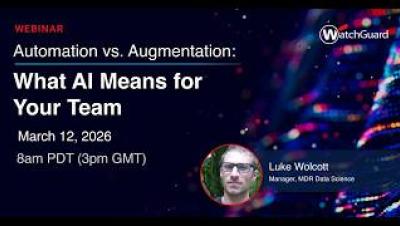
Automation vs. Augmentation: What AI Means for Your Team

AI is everywhere in cybersecurity. For partners, the real question is not about the technology. It is about your people. Is AI replacing analysts, or making them more effective? In this session, we break down the differences between automation and augmentation and why they matter for MSPs delivering security services. Automation removes repetitive SOC work such as triage, enrichment, and basic containment. Augmentation strengthens human experts with faster investigation, clearer attack mapping, and smarter response decisions.

Stryker's Network Disruption - The 443 Podcast - Episode 362

This week on the podcast, we cover the cyber attack that managed to wipe more than 200,000 resources off of the medical technology giant Syryker's network. After that, we review a research post on a good chrome extension gone bad. We end by discussing a recent Microsoft threat intelligence post on how North Korean-backed threat actors have operationalize AI for job scams.

Consolidation: The New Standard for MSP Efficiency

The real challenge for MSPs isn’t growth, it’s scaling effectively. As MSPs increase their client base and expand their service portfolios, managing multiple tools, consoles and vendors becomes progressively more complex, impacting operational efficiency and margins. In many cases, this isn’t the result of poor decision-making, but rather the evolution of the business.

Bell Cyber & WatchGuard Partner to Deliver Enterprise Security for Canadian SMEs

Canadian small and midsize businesses are increasingly targeted by sophisticated cyber threats, yet most lack the internal resources required to deploy and operate enterprise-level security. Today, WatchGuard and Bell Cyber are addressing that gap through a new strategic partnership and the launch of CyberShield Connect, a fully managed cybersecurity service designed specifically for Canadian SMEs.

Hackerbot-Claw Crosses the Line - The 443 Podcast - Episode 361

This week on the podcast, we chat about an OpenClaw bot that moved beyond vulnerability research and into malicious activity. Before that, we cover an AI-discovered vulnerability in the pac4j-jwt authentication library before ending with a discussion on an upcoming California law designed to help make age verification in the digital age easier, but with massive consequences.

Demystifying the Alphabet Soup That Is Detection and Response

It’s impossible to walk into a tradeshow these days without getting blasted by a wall of acronyms. Everywhere you look, vendors are cramming two to four perfectly serviceable words into a string of capital letters arranged to sound cooler than they actually are. This wouldn’t be so bad if it didn’t routinely derail meetings, product decisions, and sometimes whole strategies.

How to Scale as an MSP by Combining Firewalls and Integrated Security Services

Scaling MSP business has become increasingly complex in a landscape where threats evolve rapidly, and emerging technologies are constantly expanding the attack surface. According to the World Economic Forum’s Global Cybersecurity Outlook 2026, 61% of organizations identify the rapid evolution of the threat landscape and emerging technologies as the primary challenge to strengthening cyber resilience. In addition, 77% of respondents have observed a widespread increase in online fraud and phishing.

When Detection Isn't Enough: Limits of Microsoft Defender

Many MSPs rely on Microsoft Defender as a starting point for protecting customer environments. It’s built in, familiar, and good at generating alerts. But modern attacks don’t stop when an alert appears. They often use stolen credentials, legitimate tools, and cloud access to move quickly after detection. In this session, WatchGuard’s Worldwide MDR Channel Sales Manager Jen Rose will look at how attacks unfold in Microsoft Defender environments and why detection alone leaves gaps for MSPs and their customers.

The Machine War: Why MSPs Must Move from AI-Assistance to Autonomy

In 2026, the digital landscape has shifted from a world of "AI assistants" to one of autonomous operators. For managed service providers (MSPs), this evolution marks the end of the traditional "land and expand" human services playbook and the beginning of a high-speed era of machine-on-machine warfare.

Cisco's SD-WAN 0-Day - The 443 Podcast - Episode 360

This week on the podcast, we discuss the recently disclosed and patched 0-Day vulnerability in Cisco's Catalyst SD-WAN Controller which has been under active exploit for 3 years. After that, we cover the latest open source supply chain attack involving a self-propagating worm targeting AI tools. We end with a discussion about another social engineering campaign targeting job hunters in the software development world.