Security | Threat Detection | Cyberattacks | DevSecOps | Compliance

Latest posts

When Detection Isn't Enough: Limits of Microsoft Defender

Many MSPs rely on Microsoft Defender as a starting point for protecting customer environments. It’s built in, familiar, and good at generating alerts. But modern attacks don’t stop when an alert appears. They often use stolen credentials, legitimate tools, and cloud access to move quickly after detection. In this session, WatchGuard’s Worldwide MDR Channel Sales Manager Jen Rose will look at how attacks unfold in Microsoft Defender environments and why detection alone leaves gaps for MSPs and their customers.

Kubernetes Backup: How It Works, What to Protect, and How to Choose a Solution in 2026

Kubernetes backup sounds straightforward until you look closely at what a real application includes. A production workload usually spans Kubernetes resources, cluster configuration, persistent volumes, secrets, service accounts, network policies, and external dependencies such as cloud databases or object storage. Protecting one of those layers helps. Protecting all of them in a coordinated way is what makes recovery practical.

Cybersecurity Is No Longer Just the CISO's Responsibility; It's Everyone's

In Episode of Guardians of the Enterprise, Ashish Tandon, Founder & CEO, Indusface, spoke with Madhur Joshi, CISO at HDB Financial Services (part of the HDFC Group), about building a security-first culture across the organization. They discussed how cybersecurity is no longer limited to IT, and why embedding security into every business function is critical. Watch this video to learn how HDB Financial Services has made cyber security a shared responsibility across teams.

How Keeper Helps Reduce Insider Threats in Healthcare

Insider threats in healthcare often originate from trusted employees, third-party vendors or contractors who have standing access to critical systems. When privileged access is not closely monitored, healthcare organizations face significant consequences, including compromised patient safety, exposure of Protected Health Information (PHI), disruption to clinical operations and Health Insurance Portability and Accountability Act (HIPAA) compliance violations.

Falcon Next-Gen SIEM Simplifies Onboarding with Sensor-Native Log Collection

As organizations expand their SIEM footprint, data onboarding often becomes a bottleneck. Deploying log collectors at scale typically requires coordination across multiple teams, external software distribution systems, packaging workflows, and change-control approvals. All of this impedes visibility when speed is critical. Adversaries are breaking out to move laterally across environments in as little as 27 seconds, according to the CrowdStrike 2026 Global Threat Report.

EP 26 - The tyranny of the now: identity at machine speed

Security teams are under more pressure than ever, reacting at human speed while systems, identities, and AI agents operate at machine speed. In this episode of Security Matters, host David Puner sits down with cybersecurity leader and former FBI executive MK Palmore to explore why defenders struggle to keep pace and what it takes to regain control.

AI Access Without Add-Ons or Limits

Artificial intelligence (AI) within security operations has shifted from basic summarization to fully agentic systems that participate in threat detection, investigation, and response (TDIR). As these capabilities evolve, many vendors restrict access through add-ons, credits, or gated previews. The result is predictable: Analysts use AI less, trust it less, and see less value from it. Agentic AI capabilities should be available the moment analysts need it, not controlled through tiers or metering.

What is Data Masking

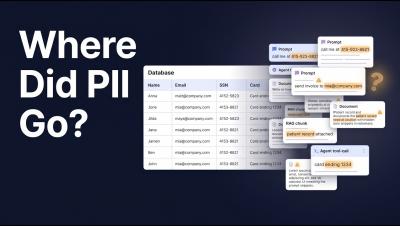
AI adoption is growing fast. But so are data risks. From Samsung’s internal code leak via ChatGPT to chatbot failures at global brands, recent incidents show one thing clearly: sensitive data can escape in unexpected ways. Most breaches today are not traditional hacks. They happen through AI tools, prompts, and automation workflows. This is why understanding what data masking is is critical. It helps organizations protect sensitive information without slowing innovation or breaking AI accuracy.

Entropy vs. Polymorphic Tokenization: Which One Actually Protects Your AI Pipeline?

If you’re building AI applications that touch sensitive data, tokenization isn’t optional. It’s the layer that decides whether your pipeline leaks PHI, PII, or financial data to your LLM, or keeps it protected. But here’s where most teams stop thinking: not all tokenization is the same. Two approaches you’ll encounter most often are entropy-based tokenization and polymorphic tokenization. They sound similar. They serve completely different purposes.