Security | Threat Detection | Cyberattacks | DevSecOps | Compliance

Scaling Exposure Management: From Manual Patching to AI-Powered Remediation

Is your security team drowning in a "WTF" moment? When vulnerability scanners return 45,000+ critical findings, manual workflows simply can't keep up. In this session, Megan Horner (Director of Product Marketing at Seemplicity) explores why traditional vulnerability management is failing in the age of AI-driven attacks. What you’ll learn: Stop treating remediation as a manual chore and start building an automated pipeline.

Turning Bug Bounty Chaos into Structured Action

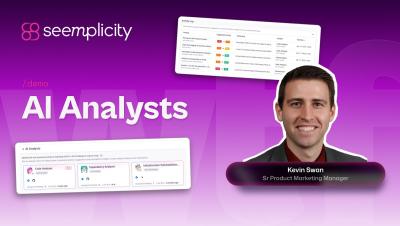
For many security teams, bug bounty programs are a double-edged sword: they provide critical insights automated tools miss, but they also introduce a massive operational burden due to free-form, unstructured, and noisy data. In this video, Kevin Swan, Sr Product Marketing Manager at Seemplicity, demonstrates how Seemplicity's Exposure Action Platform bridges the Triage Gap by transforming unstructured HackerOne findings into clear, trackable fixes. Learn how to move findings from a third-party platform into a remediation workflow without slowing down your engineering teams.

Help! I'm Drowning in Alphabet Soup

The cybersecurity industry is currently drowning in an “alphabet soup” of over 500 different category acronyms, a trend that is creating unnecessary noise and silos rather than helping practitioners. This hyper-niche branding often forces security teams to manage fragmented dashboards that don’t communicate with each other, adding to their workload instead of reducing it.

Claude Mythos Just Killed Exploitability as a Security Signal

The game has changed. For years, security teams used exploitability to decide what to patch first. If a vulnerability had a known exploit, it went to the top of the list. If not, it waited. But with the arrival of next-gen AI models like Claude Mythos, that strategy is officially broken. In this video, we discuss how Claude Mythos has collapsed the barrier to building working exploits. What used to take real skill and significant time can now be weaponized in minutes. When everything is exploitable, exploitability becomes noise.

Scaling Your Security Program to Match the Speed of Mythos

Anthropic’s Project Glasswing and the Claude Mythos model represents a fundamental change in the physics of cyber defense. With the gap between patch releases and weaponized exploits shrinking to hours, traditional manual security triage is now obsolete. Organizations must adopt AI-driven automated remediation.

New Data Shows Why Security Teams Can't Keep Up With AI-Driven Attacks

AI is changing how attacks happen, and how fast they happen. Seemplicity’s 2026 State of Exposure Management report shows why most security teams aren’t struggling to find risk, but to fix it quickly enough. Based on insights from 300 security leaders, it highlights where remediation breaks down, how AI is being used today, and why execution is becoming the real bottleneck.

Secure the Supply Chain at Scale with Step Security and Seemplicity

CI/CD risks don’t get fixed on visibility alone. Step Security surfaces pipeline exposures, while Seemplicity turns them into clear, assigned remediation tasks, grouped by fix and owner, routed into existing workflows, and tracked through resolution, so teams can reduce exposure faster and prove progress.

Redefining WTF in Cybersecurity: Why It's Time to Focus on the Fix

The cybersecurity industry is currently defined by “WTF” moments of panic, from overwhelming vulnerability backlogs to sophisticated AI-driven attacks that bypass traditional defenses. To combat this, organizations must shift their narrative away from reactive frustration and toward the most critical part of exposure management: The Fix. By redefining WTF, security teams can move beyond context-less alerts and manual spreadsheets.

The Unsung AI Hero: Data Normalization

AI agents are only as effective as the data they consume. In this post, we explore the unsung hero of the security stack: data normalization. This process serves as the deterministic guardrail that makes AI grounding possible. Without a structured data foundation, grounding is only as good as the often chaotic data being retrieved, leading to confident but incorrect AI responses.