Security | Threat Detection | Cyberattacks | DevSecOps | Compliance

Security Live with AWS and Arctic Wolf

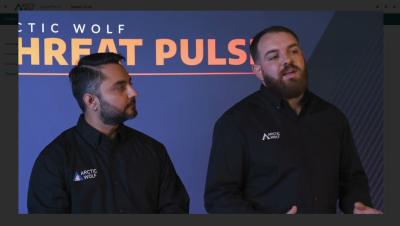
Each episode of Security Live features AWS and AWS Partners who are working to solve security challenges for customers. And few companies are doing that with the scale, speed, and efficiency of Arctic Wolf. In this episode, Arctic Wolf CISO Adam Marre explains how Arctic Wolf is solving the operations problem in the cybersecurity industry by providing the platform and human element to help organizations get the outcomes they need out of the tools in their tech stack.

Tips To Stop Social Engineers Exploiting The Global IT Outage

The recent global IT outage on Windows hosts will likely lead to a surge of threat actors posing as support agents offering “help” as a part of a social engineering attack. Here are some quick tips from Arctic Wolf to help you spot and stop these attacks.

The Top Cyber Attack Vectors Organizations Face

Recent research by Arctic Wolf has revealed that, within the last 12 months, 48% of organizations identified evidence of a successful breach within their environment. As The State of Cybersecurity: 2024 Trends Report highlights, “To fully understand the gravity of this statistic, it is important to understand that, although 48% of these environments found evidence of a data breach, that does not inversely mean that 52% of organizations did not suffer a breach.”

Technical Fix for Global IT Outage - CrowdStrike and Microsoft Incident

Our team at Arctic Wolf has been following the CrowdStrike issue affecting Windows endpoints since approximately 12 AM EST on July 19th, 2024. Although Arctic Wolf’s service is not impacted, some of our customers who leverage CrowdStrike for endpoint security are experiencing widespread outages. Arctic Wolf continues to protect and monitor these customers’ environments while they focus their attention on recovering from this event.

How State and Local Governments Can Stay Safe From Cyber Attacks

Cyber threats are increasing and, unfortunately, local and state government entities have become top targets. In 2023, the FBI reported that government entities were the third most-targeted sector by ransomware, and Arctic Wolf’s own research saw the average ransom for government organizations top $1 million USD. And that’s just one kind of cyber attack.

CVE-2024-4879, CVE-2024-5178, CVE-2024-5217: ServiceNow MID Server Vulnerabilities Resulting in Unauthorized Code Execution

On July 10, 2024, ServiceNow disclosed a series of critical vulnerabilities impacting their platform, identified as CVE-2024-4879, CVE-2024-5178, and CVE-2024-5217. These vulnerabilities were responsibly disclosed to ServiceNow in May 2024 by Assetnote, a cybersecurity firm. ServiceNow responded by patching hosted instances in June 2024.

How To Stop MFA Fatigue Attacks

As organizations continue to digitize and passwords proliferate across systems, applications, and even assets, identity and access management (IAM) has become a pillar of cybersecurity. One component of IAM has become ubiquitous with access security: multi-factor authentication (MFA). MFA is an access control technique that adds a layer of security to user logins and access by making the user verify their identity.

CVE-2024-6385: Critical Unauthorized Pipeline Job Vulnerability in GitLab

On July 10, 2024, GitLab issued an advisory regarding a critical vulnerability (CVE-2024-6385) in GitLab CE/EE that had been reported to them through a bug bounty program. This vulnerability allows a threat actor to trigger a GitLab pipeline as another user under certain circumstances. A GitLab pipeline is a collection of automated processes that run in stages to build, test, and deploy code.

Polyfill Supply Chain Attack Impacts 100K+ Sites

On June 24, 2024, cybersecurity company Sansec published a security advisory detailing how an associated Polyfill domain (cdn.polyfillio) was being used to insert malicious code in scripts served to mobile end users in a web supply chain attack. Polyfill is a popular open-source JavaScript library embedded in more than 100,000 websites to provide polyfills, a small piece of code (usually JavaScript) that helps provide modern functionality on older browsers.