Security | Threat Detection | Cyberattacks | DevSecOps | Compliance

CybersecAsia Awards 2020 recognizes ManageEngine for its leadership in cybersecurity

ManageEngine’s Log360 was recently honored with the CybersecAsia Award for the Best User and Entity Behavior Analytics software application. The award certifies the important role, and the innovative technology brought to the table by Log360 over the past two years. Elevated cybersecurity risks currently experienced by organizations have driven the sudden adoption of the cloud and increased workforce mobility.

Port scanner 101: What it is and why should you use it

In today’s complex network infrastructure comprised of diverse resources, devices, and users, port scans represent a significant amount of network traffic. Crackers and hackers alike use port scanners to discover port vulnerabilities that can become attack vectors to malicious outcomes. In this post, we discuss the fundamentals of port scanning, and why you need to deploy an effective port scanner software on your network right now.

Alert AA20-302A: Federal agencies warn about ransomware attacks targeting hospitals

A cybersecurity bulletin was released by the Federal Bureau of Investigation (FBI), the Cybersecurity and Infrastructure Security Agency (CISA), and the Department of Health and Human Services (HHS) on October 28, 2020. The three agencies have issued a high-level warning about an increased, imminent threat of ransomware attacks in the healthcare sector. The cybercriminal group behind the TrickBot, Ryuk, and BazarLoader malware is now targeting U.S. hospitals and healthcare providers.

Tackling your network security challenges using ManageEngine ITOM solutions

Network security management typically entails end-to-end management of the entire network security infrastructure of an enterprise. However, in this rapidly changing security ecosystem, there’s an inherent need for IT admins to be extremely agile to maintain an effective security posture.

Is IT security under attack?

From credential theft to network vulnerability exploitation and ransomware incidents on highly secure organizations, the year 2020 has been surprisingly rough on IT security. In the wake of the COVID-19 pandemic, companies around the world are reporting more cyberattacks than ever before, and although the techniques used or the method of attack may be new, the vectors of attack over the years remain unchanged.

Sophisticated phishing

Most of us can think of a time when we received a phishing email. In fact, most phishing emails are easy to identify, and automatically go to spam. However, in this ongoing pandemic, hackers are adopting advanced tactics that cleverly conceal their malicious intentions, and fly under the radar by leveraging the victim’s fear, anxiety, or plain negligence.

6 top risk factors to triage vulnerabilities effectively

Common Vulnerability Scoring System (CVSS) scores have been viewed as the de facto measure to prioritize vulnerabilities. Vulnerabilities are assigned CVSS scores ranging from one to 10, with 10 being the most severe. However, they were never intended as a means of risk prioritization. If you’ve relied on CVSS scores alone to safeguard your organization, here’s why you’re probably using them incorrectly.

Domain controller patch alert! Vulnerability grants domain admin access in 10 seconds

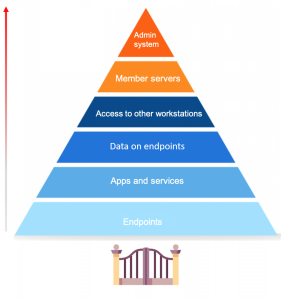
A critical Active Directory vulnerability (CVE-2020-1472) has been making headlines for being the most notorious elevation of privilege bug because it can affect all computers and domain controllers in an organization. This high-risk vulnerability, dubbed Zerologon, gives threat actors easy, instant access to domain controllers without requiring any additional privileges. This attack does not even require a user to be authenticated; the user just needs to be connected to the internal network.

Build a resilient cybersecurity framework by transforming your IT team into a security team

More organizations than ever before have shifted to a hybrid work culture to reduce the impact of COVID-19. This unprecedented change has not only given rise to new security challenges, but has also considerably increased the surface area available for an attack. A blend of personal and corporate endpoints in use, geographical spread of resources, and a sharp spike in the overall number of security threats have further complicated the already labor-intensive security landscape.

Five worthy reads: Every month should be Cybersecurity Awareness Month!

Five worthy reads is a regular column on five noteworthy items we’ve discovered while researching trending and timeless topics. Organizations on a global scale observe Cybersecurity Awareness Month to educate and instruct their employees on cybersecurity best practices. This week we highlight some cybersecurity trends that are shaping the industry today.