Security | Threat Detection | Cyberattacks | DevSecOps | Compliance

Phish No More: Instant Defense with Cato SASE

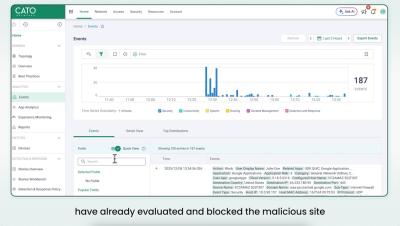
Phishing remains one of the most common ways attackers try to breach enterprise environments. Traditional tools often detect these attempts too late, giving attackers time to gain a foothold. In this demo, you’ll see how the Cato SASE Cloud Platform stops phishing attempts in real time. Cato inspects every click, evaluates threats instantly, and blocks malicious sites before they load, without slowing users down.

Phishing Campaign Targets Executives With Phony Awards

A phishing campaign is targeting executives with phony offers for awards, according to researchers at Trustwave SpiderLabs. The attackers first dupe the victims into handing over their credentials, then use the ClickFix social engineering technique to trick them into installing malware. “The campaign uses a high-value executive recognition lure, ‘Cartier Recognition Program,’ to target executives,” the researchers write.

[Heads Up] Crafty New Phishing Attacks Abuse Free Cloudflare Pages

Malwarebytes warns that threat actors are abusing the free Cloudflare Pages service to host phishing portals, helping the phishing sites avoid detection by security scanners. The attackers are building fake login pages impersonating banking, insurance, and healthcare entities. The pages are designed to harvest credentials as well as security questions and multifactor authentication codes.

How to Avoid Phishing Attacks: A Complete Guide for Users and IT Teams

Phishing remains one of the most common cyber threats, affecting users across industries and regions. It targets human behavior rather than technology, which makes it more effective than many other attack methods. Now, attackers are using advanced tools, like AI, to make phishing more effective. To know how to avoid phishing attacks, you must understand how they work and the different forms they take.

Enumerating Users and Mailboxes in Microsoft Outlook 365 Web

During our research into Microsoft 365 security, we discovered a flaw in Outlook on the web (OWA) that exposed information about users and their mailboxes. By manipulating certain request headers against the “/owa/service.svc” endpoint, an attacker could not only confirm whether a user account existed, but also determine if that account had a mailbox associated with it.

The Security Blind Spots Most Operators Miss - According to Igor Finkelshtein

In the cybersecurity world, it's easy to focus on the latest breach or high-profile vulnerability. But according to multi-industry operator Igor Finkelshtein, most security incidents don't begin with sophisticated attacks - they begin with overlooked operational weaknesses. From transportation to real estate to SaaS platforms, Finkelshtein's experience shows that cybersecurity is ultimately an operational discipline. The vulnerabilities that quietly accumulate inside a business often pose a greater risk than anything happening outside it.

Report: Phishing Has Surged 400% Year-Over-Year

Researchers at SpyCloud have observed a 400% year-over-year increase in successful phishing attacks, with a disproportionate number of attacks targeting corporate accounts. “The company tracked a 400% year-over-year increase in successfully phished identities, with nearly 40% of the 28+ million recaptured phished records containing a business email address – compared to just 11.5% in recaptured malware data,” the researchers write.

Warning: Phishing Campaign Leveraging Evilginx Targets U.S. Universities

Threat actors are using the open-source phishing framework Evilginx to target universities across the United States, according to researchers at Infoblox. The attackers have targeted at least 18 universities and educational entities since April 2025, using phishing pages that spoofed student single sign-on (SSO) portals. “In the campaigns we analyzed, students were targeted via personalized emails that contained TinyURL links,” Infoblox says.