Security | Threat Detection | Cyberattacks | DevSecOps | Compliance

How Cato handled record-breaking traffic after Japan's return from the Obon holiday

On Monday, August 17, 2026, Cato recorded record-breaking post-Obon traffic across its Japan Points of Presence (PoPs) as employees returned to work together. At one of Cato’s Tokyo PoPs, traffic rose to more than 15 times its typical level for the same morning period on normal business days.

Cato CTRL Insights: When Trust Becomes the Payload in a Fake Codex ClickFix Campaign

Attackers are using a fake Codex download experience to trick macOS users into pasting a malicious command into Terminal. This technique, known as ClickFix, relies on social engineering rather than a conventional malware download: the victim is persuaded to perform the execution step themselves. We analyzed sponsored search results leading to convincing Google Sites pages, a no-code website-building and hosting service provided by Google.

The GitHub Outage: How AI-Native SASE Visibility Turns Disruption into Decision

On August 17, 2026 at 13:40 UTC, GitHub first publicly logged that it was investigating elevated errors and latency issues, later reporting broad impact across web and API traffic, Git operations, Actions, Pull Requests, Issues, Pages, Webhooks, and identity-related services. The outage had significant implications for development teams. When GitHub degrades, developer workflows can stop quickly.

Three Years as a Leader. Built for Where the Market Is Going.

Being recognized as a Leader in the Gartner Magic Quadrant for SASE Platforms for the third consecutive year is an important milestone for Cato Networks. We believe it reflects more than consistent execution. It comes at a time when enterprise networking and security are entering another architectural transition, one driven by AI.

The Agentic AI Security Adoption Matrix: Autonomy Scales Where Control Exists

Agentic AI is crossing a threshold. It is no longer just generating content or answering questions. It is beginning to plan, decide, and execute actions across tools, systems, and workflows. That shift unlocks real efficiency, but it also changes the security equation. When an AI system can act, it becomes part of your operational attack surface. It can be influenced, misdirected, or exploited. It can make mistakes at machine speed. And if it has permissions, it can create real impact.

How Cato AI Security Keeps Up With Claude

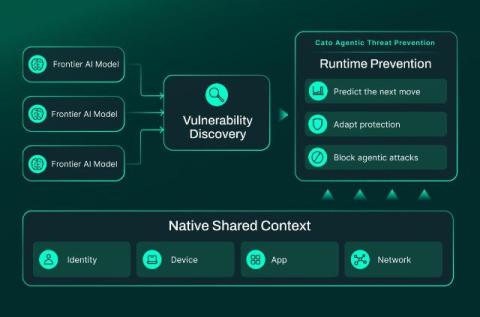
Claude is moving quickly. Cato is innovating alongside it. With inference hooks, skills posture, and seamless deployment, teams can adopt new AI capabilities with security controls that are ready from day one. Claude’s rapid innovation is reshaping what everyday employees can do with AI. It is no longer just helping people write faster or summarize information; it is becoming a hands-on work companion that can research, reason, build, and take action across business workflows.

The Hugging Face Incident: A CISO Wake-Up Call for the Agentic Era

Earlier this month, Hugging Face, an AI and machine learning platform company, revealed that an autonomous AI system had breached part of its production environment. The intrusion began in the platform’s dataset-processing environment and eventually involved higher-level access, credential exposure, and movement into internal clusters.

Cato CTRL Threat Research: SilverFox Evolves: Abuse of New Drivers and Trusted Software Hijacking Enable Remote Access with ValleyRAT in Japan

SilverFox is expanding its toolkit. In this campaign, the group combines new vulnerable-driver abuse, newly observed abuse of legitimate applications for DLL sideloading, defense evasion, and layered recovery mechanisms to keep ValleyRAT running. We investigated an active campaign targeting a Japanese organization in the industrial manufacturing sector. The attack begins with an invoice-themed phishing lure and uses attacker-controlled content hosted through legitimate QQ and Tencent Cloud services.