Security | Threat Detection | Cyberattacks | DevSecOps | Compliance

The Essential LLM Security Checklist

Large language models (LLMs) are transforming how we work and are quickly becoming a core part of how businesses operate. But as these powerful models become more embedded, they also become prime targets for cybercriminals. The risk of exploitation is growing by the day. More than 67% of organizations have already incorporated LLMs into their operations in some way – and over half of all data engineers are planning to deploy an LLM to production within the next year.

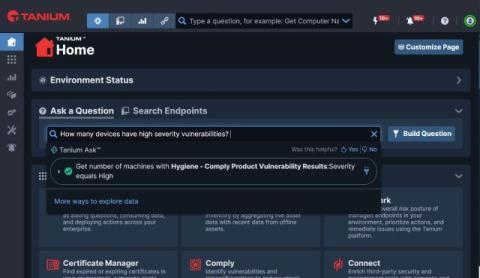
Introducing Tanium Ask: Using AI to Get Questions Answered

How many questions does your organization need to answer about your endpoints every day, and how long does it typically take to get the answer? How often do these questions require an operator with great expertise to provide accurate answers? Do the questions feel like they are resulting in fire drills for your teams?

Resecurity introduces Government Security Operations Center (GSOC) at NATO Edge 2024

Resecurity, a global leader in cybersecurity solutions, unveiled its advanced Government Security Operations Center (GSOC) during NATO Edge 2024, the NATO Communications and Information Agency's flagship conference. The solution is also specifically tailored for MSSPs that protect aerospace and defense organizations.

Ultralytics AI Pwn Request Supply Chain Attack

The ultralytics supply chain attack occurred in two distinct phases between December 4-7, 2024. In the first phase, two malicious versions were published to PyPI: version 8.3.41 was released on December 4 at 20:51 UTC and remained available for approximately 12 hours until its removal on December 5 at 09:15 UTC. Version 8.3.42 was published shortly after on December 5 at 12:47 UTC and was available for about one hour before removal at 13:47 UTC.

Top Tool Capabilities to Prevent AI-Powered Attacks

Recent advances in AI technologies have granted organizations and individuals alike unprecedented productivity, efficiency, and operational benefits. AI is, without question, the single most exciting emerging technology in the world. However, it also brings enormous risks. While the dystopian, AI-ruled worlds of sci-fi films are a long way off, AI is helping cyber threat actors launch attacks at a hitherto unknown scale and level of sophistication. But what are AI-powered attacks?

Top 5 PII Data Masking Techniques: Pros, Cons, and Best Use Cases

Protecting sensitive information has never been more critical, especially in today’s AI-driven world. As businesses increasingly leverage AI and advanced analytics, safeguarding Personally Identifiable Information (PII) and Patient Health Information (PHI) is paramount. Data masking has become a cornerstone strategy, allowing organizations to securely manage and analyze data while significantly reducing the risks of exposure and misuse.

How Governments Can Mitigate AI-Powered Cyber Threats

Cybersecurity leaders across all levels of government are growing increasingly alarmed by the rise of cyber attacks fueled by Artificial Intelligence (AI). Cybercriminals are now incorporating machine learning and automation into their strategies, significantly boosting the scale, efficiency and sophistication of their attacks. According to a recent survey of over 800 IT leaders, a staggering 95% believe that cyber threats have become more advanced than ever before.

'Tis the Season for Artificial Intelligence-Generated Fraud Messages

The FBI issued an advisory on December 3rd warning the public of how threat actors use generative AI to more quickly and efficiently create messaging to defraud their victims, echoing earlier warnings issued by Trustwave SpiderLabs. The FBI noted that publicly available tools assist criminals with content creation and can correct human errors that might otherwise serve as warning signs of fraud.

How to prompt prompt LLMs to fine-tune an AI-generated fuzz test

In previous videos, you've seen that LLM can generate fuzz tests. But what if AI fails to produce a working test or to cover specific workflows that are unavailable as unit tests or usage examples in the code base? You can prompt AI to make changes. Here is how the "Interactive mode" works in CI Fuzz.