Security | Threat Detection | Cyberattacks | DevSecOps | Compliance

Shutdowns, power outages, and conflict: a review of Q1 2026 Internet disruptions

In the first quarter of 2026, government-directed shutdowns figured prominently, with prolonged Internet blackouts in both Uganda and Iran, a stark contrast to the lack of observed government-directed shutdowns in the same quarter a year prior. This quarter, we also observed a number of Internet disruptions caused by power outages, including three separate collapses of Cuba's national electrical grid.

Cloudflare Just Shipped 20+ Features for AI Agents in One Week

The conversation explores why the Internet and the cloud were not designed for an AI-agent world, and what infrastructure needs to change as software agents begin generating code, running workflows, and interacting directly with online services. Ming and Anni walk through several announcements from Cloudflare’s Agents Week, including new tools for agent infrastructure, memory, developer workflows, AI Gateway, email, artifacts, browser automation, security, and agent-ready websites.

Quantum Computers Threaten Encryption - Here's the Fix | Sharon Goldberg

What happens to Internet security when quantum computers become powerful enough to break today’s encryption? In this clip from a full conversation on This Week in NET, Sharon Goldberg explains why researchers and companies are preparing for post-quantum cryptography, what could be at risk if current encryption is broken, and why the timeline may be closer than many expected. This clip is from the This Week in NET podcast about the future of encryption, quantum computing, and post-quantum cryptography.

Secure private networking for everyone: users, nodes, agents, Workers - introducing Cloudflare Mesh

AI agents have changed how teams think about private network access. Your coding agent needs to query a staging database. Your production agent needs to call an internal API. Your personal AI assistant needs to reach a service running on your home network. The clients are no longer just humans or services. They're agents, running autonomously, making requests you didn't explicitly approve, against infrastructure you need to keep secure.

"It's Quite a Shock": The Quantum Deadline Is Real

In this World Quantum Day special edition of This Week in NET, host João Tomé is joined by Bas Westerbaan (Principal Research Engineer) and Sharon Goldberg (Senior Director, Product) to explain why the timeline for post-quantum cryptography may be arriving sooner than expected. Recent research suggests the number of qubits required to break today’s encryption could fall dramatically, accelerating the urgency for companies and the Internet ecosystem to migrate to post-quantum security. Google has set a 2029 migration target, and Cloudflare is working toward a similar timeline.

Understanding Cloudflare's network architecture

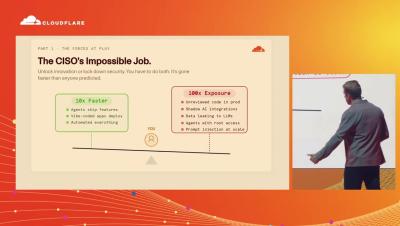
For decades, enterprise IT relied on a “hub and spoke” security model. But between the explosion of cloud infrastructure, SaaS apps and a remote workforce, that old perimeter hasn't just cracked—it’s shattered. In an attempt to stay on top of the advancing perimeter, many different solutions from many vendors entered the market and created a "spaghetti mess" of point solutions that drive up costs and tank user experience. Cloudflare is an answer to this problem, delivering everything you need to secure your apps, networks, users, data and devices.

Managed OAuth for Access: make internal apps agent-ready in one click

We have thousands of internal apps at Cloudflare. Some are things we’ve built ourselves, others are self-hosted instances of software built by others. They range from business-critical apps nearly every person uses, to side projects and prototypes. All of these apps are protected by Cloudflare Access. But when we started using and building agents — particularly for uses beyond writing code — we hit a wall. People could access apps behind Access, but their agents couldn’t.

Securing non-human identities: automated revocation, OAuth, and scoped permissions

Agents let you build software faster than ever, but securing your environment and the code you write — from both mistakes and malice — takes real effort. Open Web Application Security Project (OWASP) details a number of risks present in agentic AI systems, including the risk of credential leaks, user impersonation, and elevation of privilege.