
Best Proxies for Threat Intelligence Research: 6 Providers Compared
Why Threat Intelligence Research Needs Proxies
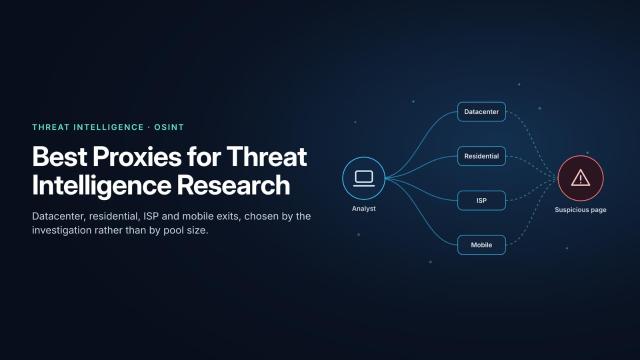
Threat intelligence work needs a proxy because the analyst’s own IP address is a security signal. Opening phishing kits, malware panels or underground forums from a corporate address exposes the investigation. It can also trigger blocking or cloaking, where the target shows a harmless page. A proxy server replaces the visible address with one from another network, so the research stays separate from the employer.
For OSINT, proxy servers support four practical jobs. They show geo-restricted pages from another country. They avoid easy attribution. They spread requests across many proxy exit points, because repeated requests from a single address can trigger bans or CAPTCHAs. They keep hostile traffic away from business systems.
Reliability matters. A weak proxy pool produces broken access, dirty data and false negatives. Clean proxy servers reduce those errors and make collected data easier to verify. The best proxies for threat intelligence research are chosen by the task, not by pool size alone. This article compares six providers across proxy type, session control, targeting, security limits and sourcing.
Proxy Types for Threat Intelligence Work: Residential, Datacenter, ISP and Mobile
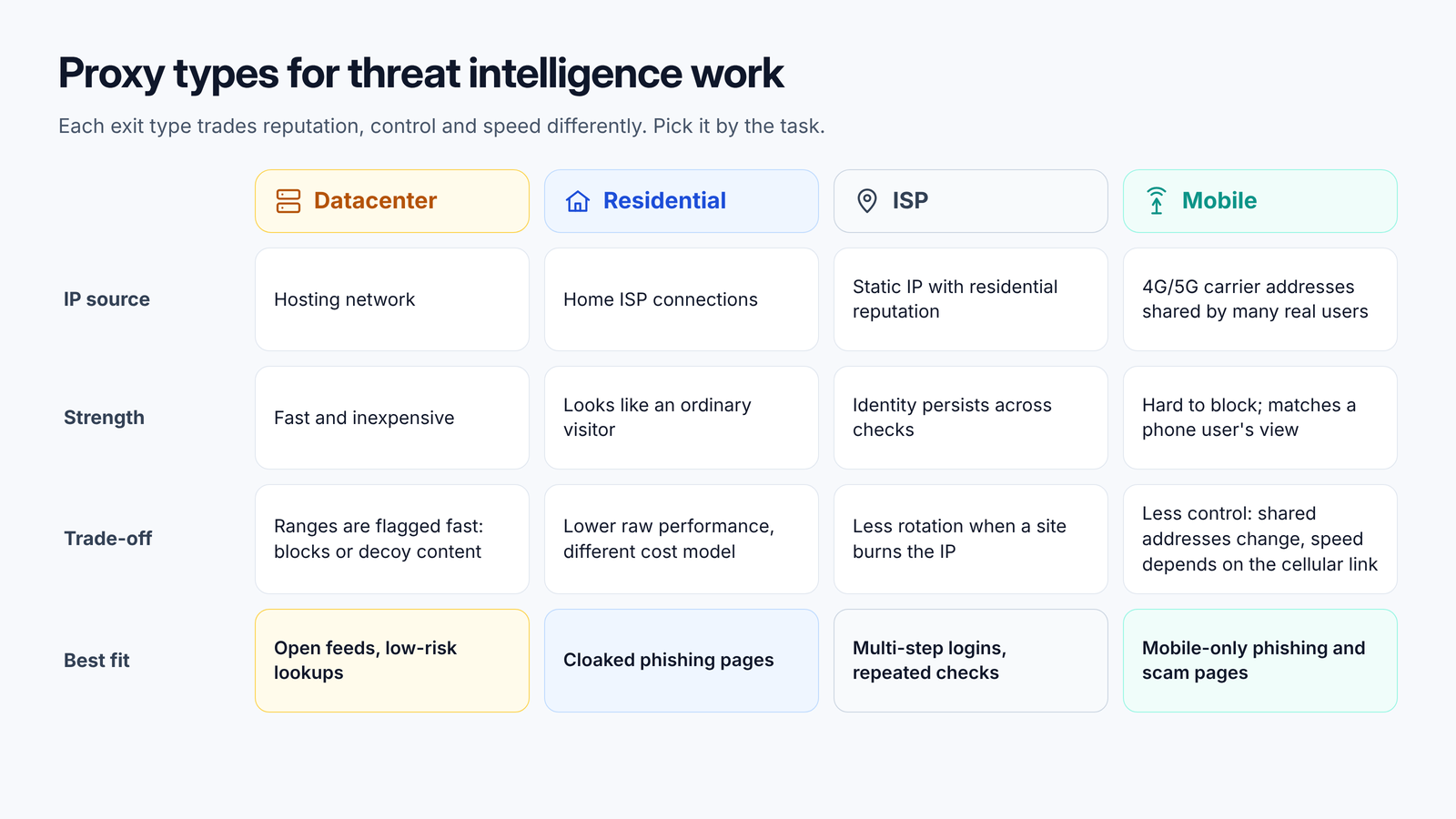
Datacenter proxies are proxy servers in a hosting network. This type is fast and inexpensive, which suits open feeds and low-risk lookups. The datacenter trade-off is reputation. Security products often identify datacenter ranges quickly, so a target may block those servers or show decoy content.
Residential proxies use residential IPs from home connections. They look like ordinary visitors, which helps against cloaked phishing pages. Some sites serve clean content only to a security vendor IP address. By choosing residential proxy access for its reputation, you sacrifice raw performance and accept a different cost model.
ISP proxies keep a static IP address while carrying residential reputation. They fit multi-step logins or repeated checks where that identity must persist. The trade-off is less proxy rotation when a site burns that IP.
A mobile proxy routes requests through a carrier network, using 4G or 5G addresses shared by many real users. Blocking becomes harder, and the view matches a phone victim. If a suspected phishing link only renders for mobile visitors from a given country, this one is the direct fit. The flip side is lower control. Shared carrier addresses can change, and throughput depends on the cellular link.
HTTP and HTTPS cover most browser work. SOCKS5 uses its own binary protocol, not HTTP. It is a proxy traversal method, not direct end-to-end communication. The connection lasts as long as the wrapped session. Chrome cannot send SOCKS5 credentials. Authenticated SOCKS5 needs another tool or an HTTP proxy server with login and password.
How to Pick the Best Proxies for Security Research: Key Criteria
Pick the service by the investigation task, not by the largest IP pool. The best proxies for a SOC depend on reputation, targeting and control. A large network helps scale, yet it can lower vetting. The core trade-off is that broader reach costs slower verification and weaker accountability.
Ask proxy providers how they source addresses. Consented residential sources reduce abuse risk. Unethical suppliers are unlikely to protect user data and tend to have performance issues. When comparing residential providers, check pool size, regions, speed and security measures.
Geo targeting must match the region whose content you need to see. Session control is as important. The flip side of automatic address churn is lost continuity. Sticky sessions keep one identity during multi-step investigation. If one persona must survive over days, a dedicated mobile proxy can give more stable exit behavior than a shared port. Practitioners report that some sticky residential offerings cap sessions at 30 minutes, while others allow hours.
Proxy protocols must fit your tools. HTTP and HTTPS work in browsers, while SOCKS5 suits scanners and local forwarders. Login or password authentication is common. Address allowlisting may not fit dynamic analyst machines. High-frequency collection often needs per-request IP rotation, while account-style monitoring benefits from static exits.
Operational claims need evidence. Check uptime statements on each supplier page. Test against hostile infrastructure before relying on the network. Customer support and documentation matter when exit servers fail and access drops. Pricing model and pricing predictability change behavior. Per-GB billing punishes heavy page retrieval, while per-port or period billing suits access. Read logging and retention terms. If providers cannot explain privacy controls, treat that as a security and reliability gap.
The Best Proxies for Threat Intelligence Research: 6 Providers Reviewed
These six providers cover enterprise-scale data, ethically sourced residential proxies, mobile proxies, and stable ISP options.
Bright Data — enterprise-scale collection for large threat-data programs
Start with sourcing when considering Bright Data. One third-party account says most Bright Data IP addresses come through peer-to-peer systems, and that the majority reportedly originate from Hola VPN customers. For threat research, that proxy origin matters. Peer-sourced addresses can resemble residential traffic, which may help with cloaked phishing pages. They can also raise compliance questions, because endpoint owners may not be direct customers of the proxy service. Ask for current proxy documentation, sourcing consent, and network controls before relying on these servers. The service suits low-risk lookups better than sensitive investigations requiring a clear chain of custody.
Oxylabs — premium infrastructure for deep competitive and threat intelligence
Oxylabs is a named proxy infrastructure provider, so the choice comes down to the same questions as for any other. A proxy choice must match the collection job, geography, session control, and protocol. Residential proxies and other proxy options matter only when sourcing, stability, and documentation fit the work.
Before sensitive collection, validation, analysis, or reporting, check Oxylabs' current proxy documentation for consent, logging, billing, and support terms. Run a small trial against your actual sources before making a final decision.
OnlineProxy — dedicated carrier IPs for mobile-facing threat research
OnlineProxy provides mobile proxies on 4G and 5G carrier addresses. They use modems and SIM routers with real SIM cards, not datacenter servers. This gives proxy access to a mobile network, which suits analysts checking phishing or scam pages as a mobile user. It also fits multi-step investigations that need a stable identity.
A dedicated proxy device offers a sticky session and IP change by link or timer. A cheaper shared port serves up to five users and rotates every two to five minutes, which the user cannot control. Both options support HTTP or SOCKS5. They include unlimited traffic, which means no per-GB billing, not unlimited speed.
Authentication uses a username and password only. There is no IP whitelisting. Pricing is per proxy port for one, seven or thirty days, so this is not a pay-per-GB or pay-per-request tool. Chrome needs an HTTP proxy with credentials or a SOCKS5 tool with authentication.
Decodo — ethically sourced residential proxies with high success rates
Decodo is one of the proxy providers that emphasizes ethically sourced residential IPs. According to one user discussion, that emphasis can reduce the chance of landing on compromised or blacklisted exit addresses. The platform suits threat-intelligence teams that treat proxy origin as a research risk, not just a speed checkbox.
Its main strength is consent-based sourcing, because shared exit servers are not automatically clean. A 2024 study, Shining Light into the Tunnel, found many proxy nodes deployed in corporate networks without proper authorization. For this service, the useful question is where the addresses come from and how abuse is handled.
That makes provenance a proxy reliability issue, not just a marketing label. Ethical claims alone do not prove that every node follows consent rules. Analysts should therefore review current proxy disclosures before relying on it for sensitive investigations.
SOAX — flexible targeting for small and mid-size research teams
SOAX provides residential proxies and mobile proxies for threat research. Its mobile proxy pool is reported at 33 million+ mobile IPs, which can help an analyst view mobile-only phishing pages or scam content. The key limitation is that SOAX’s actual available proxy IP pool is reported to be smaller than advertised. That matters when a phishing kit checks the visitor’s address or when a campaign uses region-specific redirects. In practice, reduced exit IP diversity can make targeted locations harder to obtain during active investigations. Its per-GB billing model makes this proxy more suitable for selective checks than for heavy, continuous collection. For a stable identity, dedicated servers may still be more reliable. Test the proxy type and locations on a trial before relying on this proxy service for access.
NetNut — ISP-grade network for steady, high-volume monitoring
NetNut is an ISP proxy network suited to steady, high-volume monitoring rather than short, disposable identities. That profile suits threat-intelligence tasks where the same observation must be repeated over time. Examples include checking a suspect page, feed or infrastructure set at regular intervals. For this kind of work, a stable proxy network can matter more than raw churn. It can keep sessions more predictable and reduce the noise that comes from constantly changing exit points. Before relying on it for monitoring, check its current terms, session controls, protocols, sourcing, support and billing against the collection task, and test the exact exit behavior and access limits.
Best Proxies Compared at a Glance
The best proxies differ by task, so compare providers against your collection goal and risk level first.
Proxy comparison for threat intelligence research tasks
|
Service |
Best for |
Proxy types |
|
Bright Data |
Enterprise-scale collection |
Residential, datacenter |
|
Oxylabs |
Premium infrastructure |
Residential |
|
OnlineProxy |
Dedicated carrier IPs for mobile-facing research |
Mobile, datacenter |
|
Decodo |
Ethically sourced residential work |
Residential |
|
SOAX |
Flexible targeting for small and mid-size teams |
Residential, mobile |
|
NetNut |
ISP-grade steady monitoring |
ISP |
No service suits every investigation. Match the service to geography, session control, IP type, rotation, and billing model before shortlisting, and verify session control, billing model, and pricing terms carefully before purchase.
Why You Shouldn't Use Free Proxy Servers for Threat Research
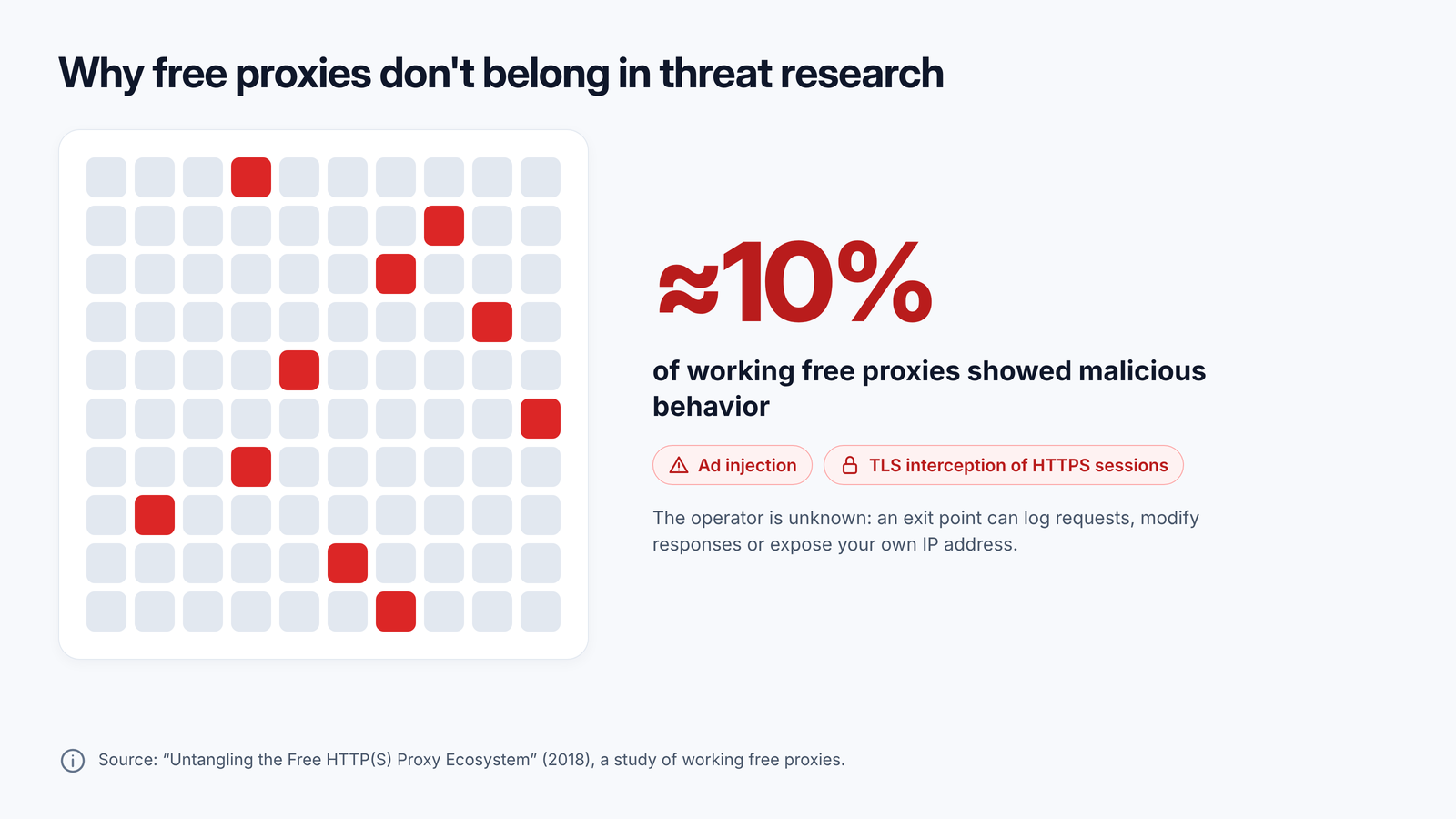
Reaching for free proxy servers during an urgent security investigation is tempting. They cost nothing and appear instantly. The mistake is trusting them with sensitive collection. The operator is unknown. That exit point can log requests, modify responses, or expose your own IP address. A 2018 study, Untangling the Free HTTP(S) Proxy Ecosystem (ProxyTorrent), examined working free proxies. Around 10% exhibited malicious behavior, including ad injection and TLS interception of HTTPS sessions. A 2024 analysis, Free Proxies Unmasked, found they often lack guaranteed encrypted connections and high stability. Weak security measures also waste analyst time. Injected content damages data integrity, while burned shared addresses trigger cloaked pages or blocks. A free datacenter proxy from a known provider may support harmless tests. It should not carry phishing analysis, malware checks, or any research where corrupted evidence creates real risk.
Operational Security Tips When Using Proxies for Threat Research
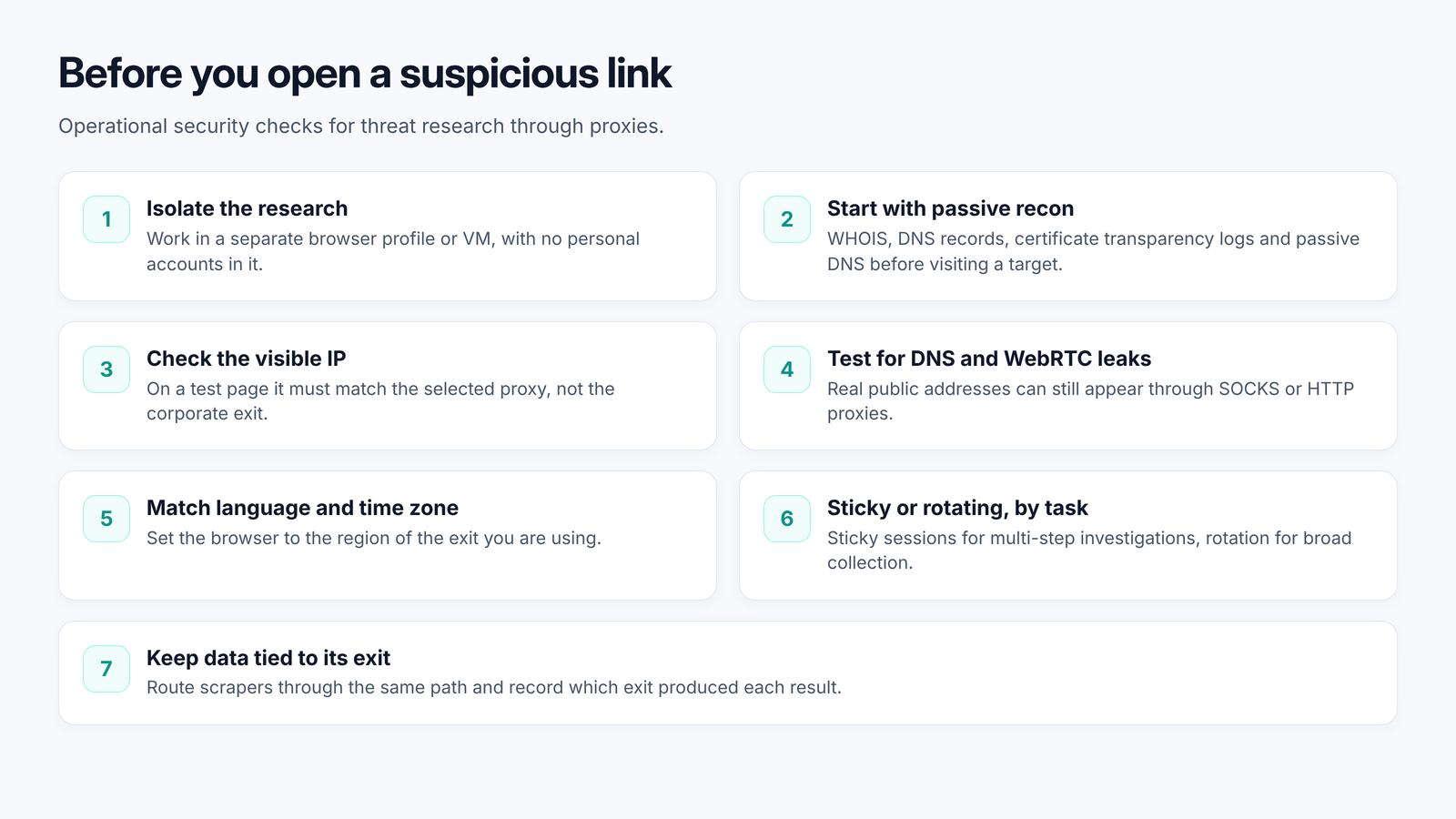
Run threat research in a separate browser profile or VM, and keep personal accounts out of it. Each research identity needs its own fingerprint, address range, and device settings.
Start with passive reconnaissance. Use WHOIS, DNS records, certificate transparency logs, and passive DNS databases before visiting a target. That reduces security exposure and gives cleaner context.
Before opening a suspicious link, check the visible IP address on a test page. It must match the selected proxy, not the analyst's corporate exit. A DNS leak or WebRTC leak can undo that separation. According to Preventing WebRTC IP Address Leaks (2025), real public addresses can still appear through SOCKS or HTTP proxies.
Match browser language and time zone to the exit region. Use sticky sessions for multi-step investigations. Use rotation for broad collection, and route scraping tools through the same path. Keep collected data tied to the exit used. That preserves security context. If scrapers and analysis platforms use different connections, results can mix and mislead.
For heavy web scraping, a rotating proxy unlimited bandwidth plan avoids per-GB surprises, though not unlimited speed.
Are Proxy Servers Legal for Threat Intelligence Research?
Using proxy servers is generally legal in the US. The proxy itself does not make the activity lawful. Risk comes from what a user does through it. Accessing systems without authorization, bypassing access controls, or breaching a site's terms of service can create legal exposure. Legitimate security research, such as authorized penetration testing, can use proxies. Authorization and scope must still be clear.
For legal compliance, document the sources, methods, and purpose of each investigation. Choose providers that publish ethical sourcing policies and clear customer terms for their proxy servers. When examining criminal infrastructure, stay passive. Do not interact more than necessary. This is general information, not legal advice.
Final Considerations: Matching the Provider to Your Research Task
No single provider wins every threat intelligence task. The best proxies depend on the job. Large-scale, multi-region collection favors broad pools and strong performance. Home-user credibility points to ethically sourced residential proxy services. Stable, long-lived identity fits ISP options. Mobile-facing phishing or scam pages need carrier-grade mobile IPs. Before committing, run a small pilot against your actual sources. Check how each service handles tooling, rotation, regional targets, and user experience. Recheck proxy providers’ current terms, authentication models, and logging policies before relying on them for security work.