Security | Threat Detection | Cyberattacks | DevSecOps | Compliance

Even Google says you cannot do AI security on one platform

This week, Connie Loizos, editor in chief of TechCrunch, sat down backstage with Francis de Souza, COO of Google Cloud, for a piece on the state of enterprise AI security. The interview is worth reading in full. Three points in it should reshape how every CISO is thinking about the next twelve months.

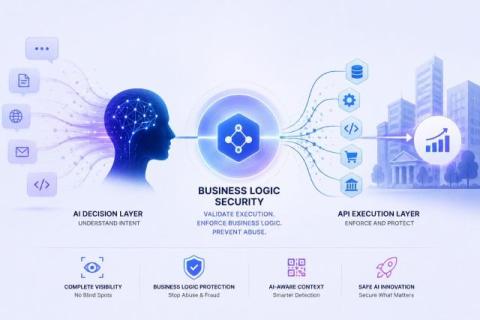
The Security Illusion: Why Your AI Security Tool Won't Save You (And Neither Will Your Traditional API Security)

The enterprise security world is having two separate conversations that desperately need to collide. On one side, application security (AppSec) teams are scrambling to secure APIs – the connective tissue of every modern application. On the other, a new wave of “AI security” vendors promise to protect your LLMs from prompt injection, data leakage, and hallucinations. Both groups are solving real problems. Both are missing half the picture.

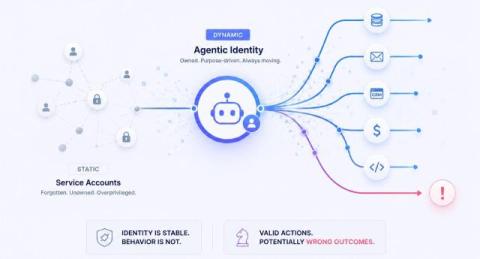
Agentic Identity Is Not NHI With a Brain

The non-human identity (NHI) problem was always the same problem: too many service accounts, too few owners, too many secrets in too many places. They sat where we left them, quietly piling up privilege, outliving the engineer who created them. Eventually someone, an auditor, sometimes an attacker, went looking and found them. Agents are a different problem.

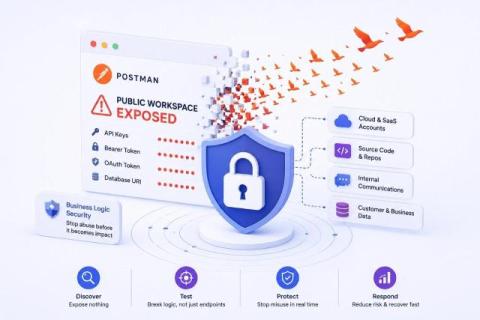
Postman Workspace Exposure: When Your API Test Suite Becomes a Security Risk

Let’s start with a scenario. This is illustrative, not a single reported incident. A developer shares a Postman collection in Slack to move faster. “Here’s the Postman collection for the payment API. It has live auth headers so you can test prod endpoints.” The team uses it, work gets done, and the link stays. What no one realizes is that the collection lives inside a public Postman workspace. Weeks later, it is indexed by search engines. The URL requires no login.

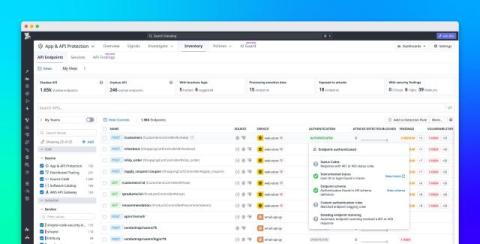
Improve API authentication detection with Datadog

Many organizations have hundreds or thousands of API endpoints across their services, each of which handles authentication differently. For example, one service might rely on standard headers like Authorization: Bearer, while another uses an API key, and a third uses a custom JSON Web Token header with mechanisms or naming conventions specific to the team that built it.

Salt Cloud Connect for Github

Your developers are shipping agents, MCP servers, and APIs faster than security can see them. GitHub Connect changes that. Salt scans your repositories and surfaces every agent, MCP server, and API hiding in your codebase, then maps them into the Agentic Security Graph. You see the agentic infrastructure forming in code, before it ever reaches production. No more waiting for runtime to find out what shipped. No more blind spots between dev and prod. Govern what's being built from day one.

New Security Gap: Your WAF Has No Idea What Your AI Is Doing

In this webcast, we get into why signature-based protection breaks down in AI-first environments, what behavioral detection and positive security models actually look like in production, and what it takes to evaluate whether your runtime tools are genuinely adapting to your environment or just adding noise to your stack.

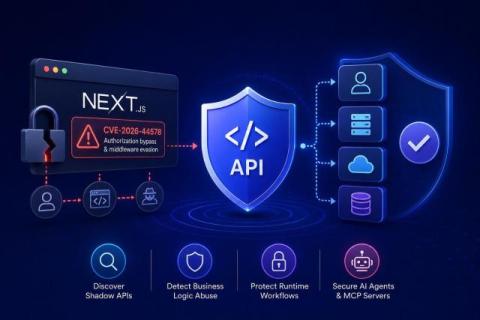
Next.js Vulnerability Exposes Credentials and Protected Data - Why Runtime API Security Matters

A newly disclosed security issue, tracked as CVE-2026-44578, affecting Next.js applications is raising concerns across the developer and security communities after researchers identified multiple authorization bypass and middleware evasion paths that could expose protected application data and credentials. The vulnerabilities impact several versions of Next.js and allow attackers to bypass middleware-based authorization controls using crafted requests and route manipulation techniques.

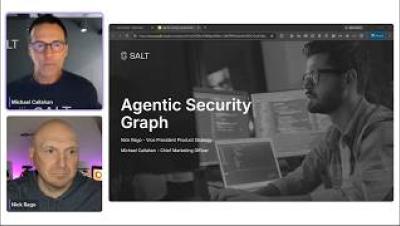
The Agentic Security Graph: Get Visibility into your AI Security Risks

As enterprises shift from conversational to agentic AI, the real risk moves from model outputs to the action layer; the MCP servers and APIs through which agents execute real-world tasks. The Agentic Security Graph frames this risk across three interconnected layers (LLM, MCP servers, APIs), showing how compromises at any layer can propagate and why existing LLM-focused controls leave the most consequential surface unmonitored.