Security | Threat Detection | Cyberattacks | DevSecOps | Compliance

AI Bias Is More Dangerous Than You Think #shorts

AI bias is a real problem. Bias can enter AI systems in many ways: That’s why governments and organizations are focusing on responsible AI policies to ensure AI benefits everyone equally, not just one group. Responsible AI means reducing discrimination and ensuring fairness across all communities. Watch The Full Podcast: Link Below.

Stop Fearing AI - Learn To Use It #shorts #ai

Many people are afraid of Artificial Intelligence. Questions like: The truth is simple: AI is not going anywhere. Instead of fearing AI, the smarter approach is learning how to use AI tools responsibly in your daily work and career. Just like the internet and smartphones changed industries, AI is the next big technological shift. Start small, learn AI tools, and adapt to the future. Watch The Full Podcast: Link Below.
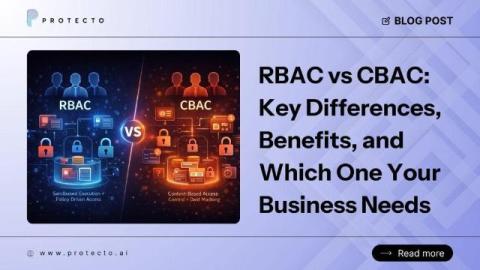
RBAC vs CBAC: Key Differences, Benefits, and Which One Your Business Needs

When businesses grow, managing who can access what becomes serious business. One wrong access permission can lead to data leaks, compliance penalties, or financial damage. In fact, IBM’s Cost of a Data Breach Report 2024 found that the average global data breach cost reached $4.88 million, the highest ever recorded. These numbers necessitate the requirement of having strong access control in place.

AI Agent Data Leakage: Hidden Risks and How to Prevent Them

AI or artificial intelligence has significantly altered how we work. From customer support bots to internal copilots, they help teams move faster and smarter. But there is a growing concern that many companies are still not ready for. It is data leakage in AI. When an AI agent accidentally or unknowingly shares private information with the wrong person or another system, it is called a data leak. When AI systems handle sensitive data, even a small mistake can expose private information.

Agentic Context Security Platform Protecto is Now Available on Google Cloud Marketplace

Enterprise Agentic AI adoption faces a critical barrier: sensitive data exposure. AI agents perform tasks only as well as the context provided to them. However, context is precisely where enterprise data enters the workflow, introducing significant risk. Organizations need to deploy AI applications while maintaining strict data security, regulatory compliance, and privacy. This challenge stalls production deployments across enterprises, especially in healthcare and financial services.

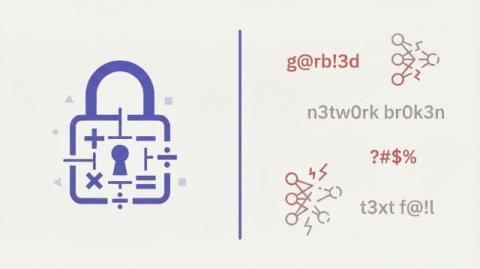
Homomorphic Encryption in LLM Pipelines: Why It Fails in 2026

There’s a claim gaining traction in the market: homomorphic encryption can preserve data privacy in AI workflows. Encrypt your data, run it through a language model, and never expose a single token. Sounds bulletproof. It isn’t. Homomorphic encryption (HE) was built for math, not language. Applying it to LLM pipelines is like encrypting a book and asking someone to summarize it without reading a word. The problem isn’t efficiency.

Your AI Isn't Broken... Your Data Is #shorts #ai

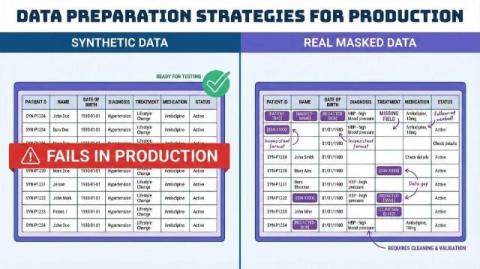
Your AI works perfectly during testing… but suddenly fails in production. Why? The problem usually isn’t the model — it’s the data. Synthetic data looks clean and structured. But real-world data is messy: typos, missing values, broken formats, and unexpected edge cases. When AI models train only on synthetic datasets, they never learn how to handle real-world complexity. In this video, we explain why synthetic data can break AI systems and how using real production data safely can make AI more reliable.

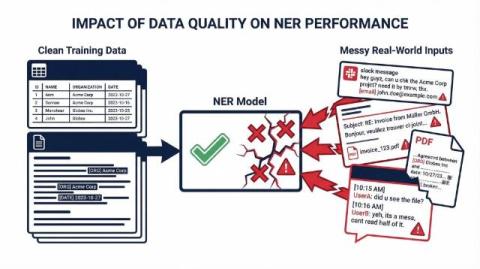
Why NER models fail at PII detection in LLM workflows - 7 critical gaps

In AI systems, PII detection is the first step. Not the most glamorous step. But the one that, when it fails, takes everything else down with it. Identifying sensitive data (names, Social Security numbers, financial records, health information) has to happen before any of it reaches an LLM. Get this wrong, and you’re looking at one of two bad outcomes: Traditional DLP systems could afford to be aggressive with detection. LLMs can’t. They depend on full context to generate correct outputs.

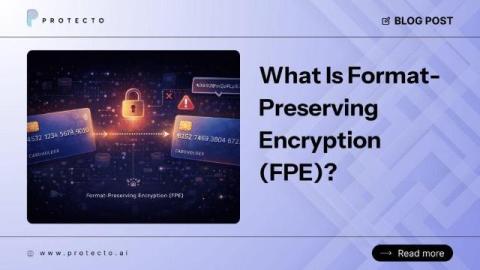
What Is Format-Preserving Encryption (FPE)?

Your database stores a credit card number: 4532 1234 5678 9010. You encrypt it for security. Now it looks like this: %Xk92@!mQz#Lp&7. Problem. Your payment system can’t process that. It expects a 16-digit number. Your billing software breaks. Your downstream analytics fail. Your whole pipeline comes to a halt. This is the exact problem that format-preserving encryption was built to solve.

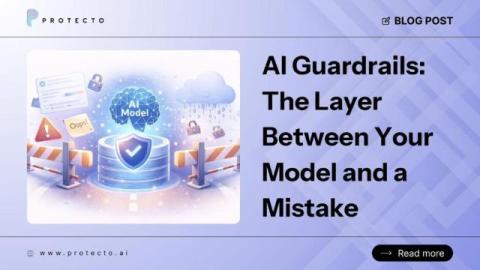
AI Guardrails: The Layer Between Your Model and a Mistake

An AI guardrail failure doesn’t come with a warning. One minute, a response goes out. Next minute, it’s a screenshot in the wrong hands, and the question isn’t how it happened. It’s why nobody had defined what the model was allowed to do in the first place. Most teams never asked what the model was actually permitted to do. Deployment happens fast. AI data privacy and leakage prevention aren’t configuration tasks.

Synthetic Data for AI: 5 Reasons It Fails in Production

Synthetic data for AI development has become the default shortcut for most engineering teams. It’s fast, sidesteps privacy headaches, and lets you move without touching production. I get why teams default to it. But there’s a problem: synthetic data for AI routinely breaks down the moment your system hits real-world enterprise data. The system demos great. It passes every internal test. Then it lands in production and falls apart in ways you didn’t see coming.

Why Everyone Must Learn AI Skills in 2026 #shorts #ai

AI skills are no longer optional. The US Department of Labor recently released an AI Literacy Framework, making AI knowledge a basic workforce skill for the future. This means every worker should understand: Basic AI principles AI use cases Prompting AI correctly Evaluating AI outputs Using AI responsibly AI literacy is quickly becoming a core job skill across all industries, not just tech.

Why Synthetic Data for AI Fails in Production

Synthetic data has been fine for testing software for decades. Traditional apps follow rules. You check inputs, check outputs, file a bug when something breaks. AI is different. AI gets deployed into the situations where the rules aren’t clear and context is everything. The edge cases aren’t exceptions. They’re the whole point. That changes what your test data needs to look like.

How a Fortune 50 Company Deployed Agentic AI at Scale Without Losing Control of Their Data

In late 2025, a Fortune 50 enterprise decided to deploy autonomous AI agents across core business operations. Customer support that could reason through complex issues. Supply chain systems that could adapt in real time. Product managers with AI assistants pulling insights from dozens of data sources simultaneously. The capabilities that made the agents useful also introduced a problem nobody had a clean answer for. These weren’t chatbots locked inside a single application.

How to Protect Sensitive Data from LLMs | AI Data Privacy Demo

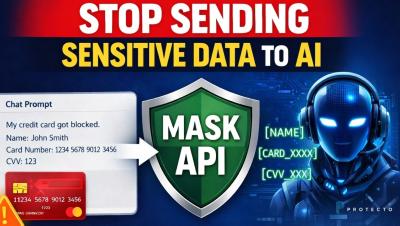
AI tools like ChatGPT, Gemini and other LLMs are powerful — but what happens when sensitive data gets sent to them? In this video, we demonstrate how Protecto AI prevents sensitive information from reaching LLMs using Masking APIs and Unmasking APIs. You’ll see a real workflow where user prompts containing credit card details and personal data are automatically masked before being processed by an AI model like Gemini 2.5 Flash.

How Governments Use AI Safely | AI Governance Explained

How are governments using AI while protecting citizens’ data and privacy? In this episode of AI on the Edge, Ciara Maerowitz, Chief Privacy Officer for the City of Phoenix, explains how cities implement AI governance, manage bias, ensure transparency, and assess AI risks. Learn how responsible AI frameworks, policies, and risk management help governments safely adopt artificial intelligence.

LLM Data Leakage Prevention: 10 Best Practices

Forget the breach notification email. Forget the security audit trail. A fintech user opened their chatbot last year, saw someone else’s account details staring back at them, and filed a support ticket. That’s how the team found out their LLM had been leaking customer PII for weeks. LLM data security isn’t a checkbox. It’s an architecture decision. Make it before the first model call, not after the first breach. Most teams get one expensive lesson before they understand that.

Multi-Agent AI Systems: Beyond the Basics

Production deployments. That’s where multi-agent AI systems live now, not research labs. Salesforce, Microsoft, and Cognition Labs are all running agent pipelines that replaced what used to take entire ops teams. Most businesses still don’t fully understand what they’ve switched on. A multi-agent AI setup isn’t just one model doing more things.

AI Impact Summit 2026 Highlights | FinTech, AI & Data Security Insights #ai

AI Impact Summit 2026 Highlights | AI, FinTech & Data Security Insights from Delhi This video covers our 5-day experience at AI Impact Summit 2026 in New Delhi, one of India's leading technology events focused on Artificial Intelligence, FinTech, Data Security, and Compliance. During the summit, we connected with industry leaders, CISOs, FinTech professionals, and AI innovators, discussing the latest developments in data protection, AI governance, cybersecurity, and enterprise AI adoption.

Entropy vs. Polymorphic Tokenization: Which One Actually Protects Your AI Pipeline?

If you’re building AI applications that touch sensitive data, tokenization isn’t optional. It’s the layer that decides whether your pipeline leaks PHI, PII, or financial data to your LLM, or keeps it protected. But here’s where most teams stop thinking: not all tokenization is the same. Two approaches you’ll encounter most often are entropy-based tokenization and polymorphic tokenization. They sound similar. They serve completely different purposes.

What is Data Masking

AI adoption is growing fast. But so are data risks. From Samsung’s internal code leak via ChatGPT to chatbot failures at global brands, recent incidents show one thing clearly: sensitive data can escape in unexpected ways. Most breaches today are not traditional hacks. They happen through AI tools, prompts, and automation workflows. This is why understanding what data masking is is critical. It helps organizations protect sensitive information without slowing innovation or breaking AI accuracy.

What is a Prompt Injection Attack?

AI tools are quickly becoming part of everyday business workflows. From chatbots to automation tools, large language models now handle sensitive tasks and data. But with this growth comes new security risks. One of the biggest emerging threats is the prompt injection attack, in which attackers manipulate inputs to cause AI systems to ignore their original instructions. Unlike traditional cyberattacks, this method exploits weaknesses through language rather than code.