Security | Threat Detection | Cyberattacks | DevSecOps | Compliance

Entropy vs. Encryption: Which Tokenization is Better?

The rapid scale of AI development and deployment has introduced a number of unprecedented privacy and compliance challenges for enterprises. IT and compliance teams are looking for solutions that address these concerns without affecting AI adoption. Tokenization has for long been the solution for protecting sensitive data. However, to implement it correctly, it is critical to understand which type fits best – both protect PII but differently.
How LLM Privacy Tech Is Transforming AI Using Cutting-Edge Tech

The promise of large language models is simple: turn messy text and data into instant answers, drafts, and decisions. The catch is simple: those models are hungry, and the most valuable data you own is also the most sensitive. If that escapes, you have legal, brand, and trust problems. This is where the story shifts. How LLM Privacy Tech Is Transforming AI is about making real deployments possible.

Understanding the Impact of AI on User Consent and Data Collection

AI convenience rides on a river of data: text, clicks, images, voices, locations, and metadata you didn’t know existed. The core question is not whether AI uses data but how it collects it, what it infers, and whether people truly agree to that. In other words, the impact of AI on user consent and data collection is not academic. It decides whether your product earns trust or burns it.

How a Leading Bank Unlocked AI - Without Breaking Data-Sovereignty Laws

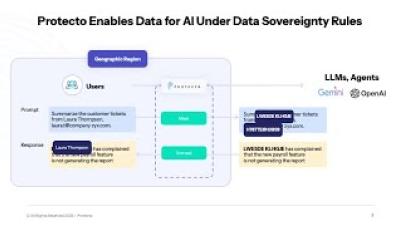
In many countries — especially in India and across the Middle East — strict data-sovereignty laws prevent banks and enterprises from using cloud-based AI models like Gemini, GPT, or Anthropic. Sending personal or financial data outside national borders can violate compliance rules, blocking the adoption of AI. This video shows how Protecto helped a leading bank overcome these challenges. By deploying Protecto’s context-aware protection layer inside the bank’s private cloud, the bank could safely use advanced AI models while staying fully compliant.

Data Sovereignty in the Age of AI: Why It Matters and How to Get It Right

Data sovereignty means that data is subject to the laws and governance of the country where it is stored or processed. In simpler terms, if your AI system stores user data in Germany, you’re bound by EU’s GDPR rules — even if your company operates from the U.S. As AI and large language models (LLMs) become central to business operations, data sovereignty is no longer just a compliance checkbox.

Is ChatGPT Safe? Understanding Its Privacy Measures

“Is ChatGPT safe” is the headline question that nearly every team asks the moment AI enters the room. The better version is: safe for what, and under which controls? Safety is not a single switch. It combines technical security, data privacy, content safeguards, governance, and how your people use the tool. This guide breaks down how ChatGPT handles data, where privacy risks actually come from, and the practical steps to operate safely at home and at work.

AI Privacy and Security: Key Risks & Protection Measures

AI systems learn from vast amounts of data and then generalize. That power is useful and also risky. Sensitive data can slip into prompts. Proprietary datasets can be memorized by models. Attackers can steer models to reveal secrets or corrupt results. Meanwhile, your company is probably experimenting with multiple AI tools at once. That creates hidden data flows and inconsistent controls. “Traditional” app security isn’t enough.

OpenAI Data Privacy Compared: OpenAI, Claude, Perplexity AI, and Otter

AI assistants and search tools are woven into daily work. But not all providers handle your prompts, files, or transcripts the same way. Small policy details determine whether your data trains future models, how long it’s kept, and what an auditor will see. If you use these tools in regulated environments, the safest choice to ensure OpenAI data privacy often depends on your specific channel: consumer app, enterprise account, or API.

How to Ensure Data Privacy with AI: A Step-by-Step Guide

AI sits in everyday workflows: assistants answering customer questions, copilots helping developers, and RAG apps searching internal knowledge. That means personal and sensitive data flows through prompts, vector stores, and integrations you didn’t have a year ago. Privacy can’t be an end-of-quarter compliance push anymore. It needs to live in your pipelines and apps the way logging and monitoring do.

Automation Anywhere + Protecto: How Leaders Secure GenAI Data

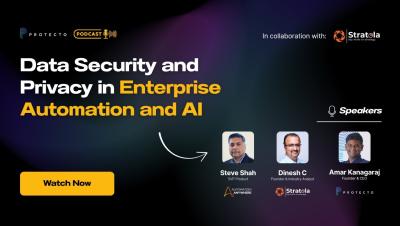
GenAI data security is now a critical concern for every enterprise. In this insightful episode of AI On The Edge, Dinesh Chandrasekhar, Founder and Chief Analyst at Stratola, sits down with Amar Kanagaraj (CEO, Protecto.ai) and Steve Shah (SVP Products, Automation Anywhere) to explore the future of data privacy, agentic automation, and securing LLMs in enterprise settings. Learn how two of the industry's top innovators are setting AI guardrails, preventing sensitive data leaks, and embedding privacy-by-design into large-scale automation.

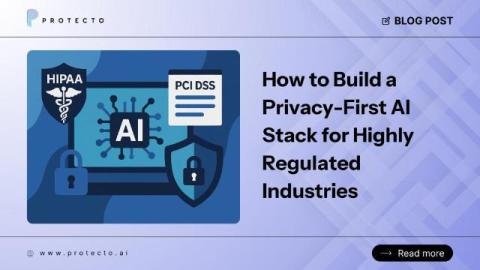
Building a Privacy-First AI Stack for Highly Regulated Industries

In a bid to quickly join the AI race, enterprises are steadily pouring time and money to adopt it. While designing a new AI tool, security and compliance are often an afterthought for developers and product managers. For industries that don’t handle sensitive data, AI adoption does not necessitate embedding strong privacy controls. However, highly regulated sectors like healthcare, finance, or government defence contractors can’t afford to launch without adhering to regulations.

Best Practices for Protecting Data Privacy in AI Deployment in 2025

AI is no longer a side project. It now powers support desks, analytics, knowledge search, decision support, and developer tooling. That reach makes data privacy a daily engineering task, not an annual policy exercise. Teams that succeed treat privacy like performance or reliability: they design for it, measure it, and improve it with each release. This guide captures Best Practices for Protecting Data Privacy in AI Deployment that work across industries.

Regulatory Frameworks Affecting AI and Data Privacy Explained

AI is now embedded in everyday operations across support, finance, healthcare, and the public sector. As models touch more sensitive data, the legal landscape is moving just as quickly. The center of gravity has shifted from annual checklists to continuous compliance in production. This guide explains the regulatory frameworks affecting AI and data privacy in 2025, how they fit together, and how to turn their requirements into practical, repeatable controls your teams can run every day.

How AI Will Transform Manufacturing-And What You Can Do Today

Welcome to another episode of AI On The Edge, where we explore how AI is transforming manufacturing—and how you can stay ahead of the curve. In this exclusive conversation, Amar Kanagaraj (Founder & CEO of Protecto) sits down with Vicky Sareen, a Principal Leader at Forbes Marshall, to uncover.

What Does It Really Mean to Be AI-Native? Insights from a Silicon Valley AI Leader

What does it really mean to be AI-native? In this episode of AI On The Edge, host Amar Kanagaraj (Founder & CEO, Protecto) chats with Manoj Mohan — a veteran AI leader who has built large-scale data & AI platforms for Intuit, Meta, and Apple. Manoj shares practical insights on: Whether you’re a CTO, engineer, or AI enthusiast, you’ll walk away with actionable lessons on how to build and scale AI responsibly.

Only 1% Get Enterprise AI Security Right - Are You One of Them?

Most companies think their AI is secure — but the truth is far more complex. In this episode of AI On The Edge, Amar Kanagaraj (Founder & CEO, Protecto) and Sabrykrishnan Loganathan (Strategy Advisor, Peloton Interactive) break down what really goes into building secure, trustworthy AI systems for enterprise. You’ll learn: This is your masterclass on enterprise AI security. Don’t be in the 99% — watch and join the top 1%.

Future Trends in AI and Data Privacy Regulations for 2025

AI is no longer a pilot project. In 2025 it sits inside support desks, developer tools, clinical workflows, loan underwriting, and public services. The regulatory landscape has shifted from paper policies to real-world evidence in production. Buyers, auditors, and regulators want to see controls in place where data flows and models are operational.

Privacy Concerns with AI in Healthcare: 2025 Regulatory Insight

Healthcare has always been one of the toughest environments for maintaining privacy. Now add AI assistants, retrieval-augmented generation, and multimodal inputs like clinical images and voice notes. Sensitive information travels farther and faster than ever before, and the fallout from a single leak can be devastating, affecting clinical, legal, and reputational aspects. The question for 2025 is simple: how do we harness the advantages of AI without compromising private health data?

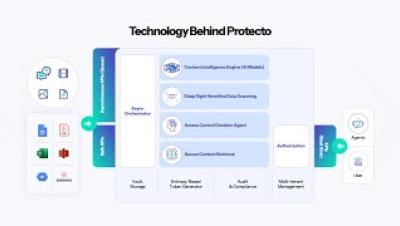
Inside Protecto: The Technology Powering Context Security for AI

In this video, we take you under the hood of Protecto’s technology stack and show how it powers context-aware security for AI—while hiding the complexity behind simple APIs. At the core are two intelligence layers: You’ll also see how Protecto’s DeepSight engine, entropy-based tokenization, secure vault, and inference-level APIs deliver enterprise-scale security, compliance, and auditability. Protecto enables enterprises to safely unlock their data for GenAI, copilots, and Agentic workflows — without leaks, oversharing, or loss of AI capability.

The Hidden Data Compliance Risk in AI Agents at Financial Institutions

Artificial intelligence is reshaping financial services, from fraud detection to personalized banking assistants. But with innovation comes risk. AI agents—particularly those powered by large language models (LLMs)—are increasingly being embedded into financial workflows. While they promise efficiency, they also introduce a new layer of data compliance challenges.