Security | Threat Detection | Cyberattacks | DevSecOps | Compliance

The Latest Cybersecurity News & Insights From Around The World


A Guide to Continuous Autonomous Pentesting
Shopping for security testing, you’d have probably noticed that almost every vendor now promises continuous autonomous pentesting. The word sounds reassuring, suggesting round-the-clock surveillance, patching and making sure nothing slips through. But when you ask for what is being surveilled, when, how frequently, your levers in reporting and support, the milk starts to get curdy. This curd is the word “Continuous”.
How a Modern Autonomous Penetration Testing Framework Differs from Legacy DAST
Over the years, Dynamic Application Security Testing (DAST) has helped you identify common vulnerabilities via automated scanning, fuzzing, and pattern-based detection. While valuable for baseline vulnerability discovery and compliance requirements, many security leaders, including maybe yourself, are now questioning DAST.
Continuous Automated Red Teaming (CART): Benefits, Challenges, and Best Practices
Ever wonder why security programs in most organizations fall short despite purchasing defensive cybersecurity tools, conducting offensive security scans, and meeting compliance? Simply put, their attack surface changes faster than validation does, i.e., teams add new assets, deploy code constantly, expand access, and let configurations drift. Say you installed fire alarms and ran a safety drill. Months later, you remodel, but you’re still using the old safety checklist. How safe does that sound now?
ChatGPhish: When AI Assistants Become the Phishing Surface
You can no longer blindly bank on the security boundary you trusted most, and no one is talking about it enough. For years, phishing took a familiar form, such as emails, URLs, and login pages. ChatGPhish breaks that stereotype, though. Permiso Security’s Andi Ahmeti disclosed this technique on 29 May 2026.
Autonomous Pentesting vs. Red Teaming: Do You Still Need Both?
Security teams are spending more money than ever on offensive security, and getting less clarity than ever on what it buys using them. For a long time, the central debate was pentesting vs red teaming. That argument settled itself once buyers understood that the two serve different objectives. Now it’s slipping again due to autonomous pentesting vs red teaming.


Autonomous Penetration Testing as a Growth Lever for Startups
Assuming security is a post-revenue problem is the most expensive strategic mistake a founding team can make. Most founders discover this in the worst possible context: a Series A due diligence call, where a prospective investor’s technical team has spent three days stress-testing the product and found that user IDs are sequential integers, the admin panel has no rate limiting, and the staging environment is reachable from the public internet.
Is Instagram's Login Architecture Fundamentally Broken?
Meta spent months telling the world its AI support system was making Instagram safer. Within six weeks of launch, the vulnerability in the recovery system had handed 20,000 (Instagram account recovery PII leak) accounts to attackers who never owned them. Two incidents in the first week of June 2026 exposed the same underlying problem from different angles.
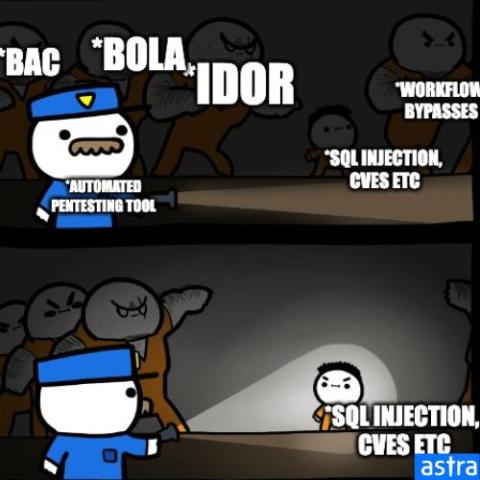
5 High-Impact Autonomous Pentesting Capabilities That Traditional Scanners Ignore
Security teams today face a widening gap between the speed of modern software delivery and the cadence of traditional pentesting. Most teams ship weekly, but a full manual pentest only happens periodically and is gated by resource availability.

Introducing Astra Security's State of Continuous Pentesting 2026 Report
The one thing security teams are not short of is data. A day in the life of a security expert is filled with scanners, dashboards, pentest reports, tickets, and compliance checklists. But despite all this data, the one staggering question that every security team would literally trade their last brain cell for (or their entire month’s screen time for) is “What is pentesting (risk) moving towards?”

Agentic AI in Cybersecurity: The Complete Guide for Security Teams
Every modern engineering team pushes code multiple times a day. With each deployment, the attack surface shifts and expands in real time as new dependencies and configurations emerge. According to recent industry data, 16% of teams now deploy on demand or multiple times a day. At this pace, securing the attack surface with traditional pentesting is like playing an exhausting game of Whack-a-Mole, while here the targets never stop evolving and multiplying.

Will an Autonomous Pentest Satisfy SOC 2, PCI, & ISO Auditors?
If you’re looking for a binary answer to the question in the title, we’re sorry. The compliance and framework spheres are as probabilistic and grey as the outcome of your next investor or shareholder meeting. But we can help you stay prepared, that’s for sure.
OWASP APTS: A Complete Guide to Autonomous Penetration Testing Standard
Autonomous pentesting platforms are sitting at the top of HackerOne’s US leaderboard, surfacing zero-days in systems that had passed traditional audits for years. The capability is real, it is here, and it is only getting faster. But CISOs and procurement teams are not rushing to deploy it.
How Autonomous Pentesting Finds What Scanners Miss
The pitch is familiar enough that most security leaders tune it out. It sounds like marketing language, just an updated way of saying “a better scanner.” This post is here to bust the myth behind that framing. Both scanners and autonomous pentesting agents look the same from the outside. Both crawl your application, both send payloads, and both produce findings. But they operate on completely different assumptions of what constitutes a vulnerability.
Gen AI Pentesting: A Technical Guide for Security Teams
If Gen AI adoption were a drinking game, most companies would be three rounds in and still adding shots. I mean, with a new LLM-powered feature every sprint, agents wired into internal APIs, RAG pipelines indexing everything from Confluence to the HR drive, i.e., fast, exciting, and almost nobody checking what happens when someone hands the model a sentence or a txt.file it wasn’t supposed to receive.
DPDP Compliance in 2026: The Complete Guide for Tech Leaders
If you run engineering, security, or compliance at an Indian tech company, DPDP compliance is knocking at your door fresh and clean in less than a year. Our aim is not to present scary statistics but to help you recognize the urgency of the matter and become DPDP compliant at the earliest. Since this law safeguards a nation’s data, the DPBI can thus stack penalties across multiple contraventions in a single incident. So stop debating whether the law applies to you; it almost certainly does.

Astra Autonomous Pentest Demo | Astra Security
The reactive pentest era is over.
Autonomous AI Agents for Penetration Testing: A Complete Guide
Your last pentest probably took 2 weeks, cost 5 figures, and tested a fraction of your actual attack surface. Meanwhile, your team shipped 47 deployments in the same window, with each one almost completely untested for security. That gap between how fast you ship and how slowly you test is exactly where autonomous AI agents for penetration testing come in, especially with hackers getting smarter and faster each day (They are not using AI to summarize PDFs!).
What is Vulnerability Prioritization & Why Now?
Security teams are drowning in vulnerabilities. FIRST’s 2026 Vulnerability Forecast projects a median of approximately 59,000 new CVEs this year, following the 48,185 released in 2025. That is equivalent to more than 130 new disclosures each day. No team, big or small, regardless of budget, can patch all these vulnerabilities. Given no deliberate way of deciding what to patch first, organizations waste resources on low-risk findings and allow truly dangerous exposures to go unpatched.