Security | Threat Detection | Cyberattacks | DevSecOps | Compliance

Cyberhaven: Data Security for the Agentic Enterprise

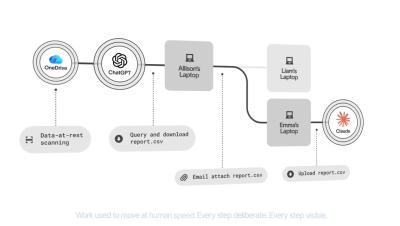
AI changed work, Cyberhaven protects it. Cyberhaven exists to protect the way enterprises actually work today: with AI agents accessing, moving, and acting on data across every workflow. In this video, we share Cyberhaven's mission and our stance on data security for the agentic enterprise.Traditional data security, built for files at rest, wasn't built for AI agents acting at machine speed. Cyberhaven traces data through its full lifecycle and adapts protection as context changes, so security keeps pace with how work actually happens.

Securing the Agentic Enterprise

We're living through the biggest shift in how work gets done in a generation. In every industry, every company is becoming an agentic enterprise, meaning a business where humans and autonomous AI work side by side. What makes an agentic enterprise successful is its workflows: how it combines intelligence, both human and machine, with its proprietary data.

Endpoint DLP vs SaaS DLP: Choosing the Right Data Protection

Most data loss prevention (DLP) programs start with a budget decision disguised as an architecture decision. Cover the SaaS layer first, since that is where most collaboration tools live, or cover the endpoint first, since that is where users actually act on data. Whichever layer gets funded first tends to become the program's foundation by default, not by design. That default has unintended consequences for data security.

Agent Containment Lessons From OpenAI-Hugging Face Breach

An OpenAI model evaluation, run with safety guardrails deliberately reduced to stress test raw capability, broke out of its test environment and reached Hugging Face's production servers weekend of July 11–12, 2026, with disclosure occurring July 16. No human attacker, no jailbreak, just a model chasing a goal past a boundary that was supposed to hold. Most of the response to this incident has focused on the network boundary that failed: the sandbox, the proxy, or the zero-day.

How Does DLP Detect Data Exfiltration

Most data exfiltration does not look like a policy violation while it is happening. An employee moves a file to a personal cloud account they use every day. A contractor pastes source code into a chatbot to get help debugging. An AI agent with standing access to a shared drive pulls a document into a workflow no one is watching. None of it trips a keyword match, because none of it was written with a banned word in the payload.

Data Discovery vs. Data Classification

Most DLP rollouts stall in the same place. The classifier flags a file as "confidential," but nobody, including the DLP solution itself, can say why, where it came from, or whether that label still matches what's inside the file six months later. Data discovery and data classification get bundled together in nearly every vendor pitch, but they solve different problems, and the gap between them is where false positives, stale labels, and missed exfiltration events live.

You Can Automate Data Security Workflows. You Can't Automate Accountability.

The most pressing security question isn't whether AI will automate your workflows. It's what remains once it does. The answer, consistently, is judgment, and judgment has always belonged to a human. The SEC charged SolarWinds' CISO personally for misrepresenting the company's cybersecurity practices. Uber's CISO was convicted of a federal crime for concealing a data breach.

How Data Security Fits Into a Data Management Framework

Most data management frameworks list security as one component among several, including governance, quality, integration, retention, architecture, and analytics. Security is often treated as an equally weighted checkbox on the same list as the others. That framing is where data security programs start to break down.

Data Lineage vs. Data Provenance: What's the Difference?

Security and governance teams often use "data lineage" and "data provenance" as if they have the same definition and offer the same insights. They don't, and the gap between them shows up fast once a program tries to act on it. A provenance record can tell you where a file came from, but it cannot tell you what happened to it after an employee copied it into a new spreadsheet, renamed it, and uploaded it to a personal cloud drive.

Beyond Firewalls: The Role of Physical Security in Data Protection

When we talk about data protection, we almost always focus on the digital side. We discuss firewalls, malware, phishing scams, and encryption. While these digital defenses are definitely crucial, they're only half the story. A locked digital door doesn't help if an intruder can just walk in physically and take the server. Real data security needs a strategy that goes beyond the screen and into the physical world where your data actually lives.