
Why Choosing the Best VPN Still Matters for Online Privacy in 2026
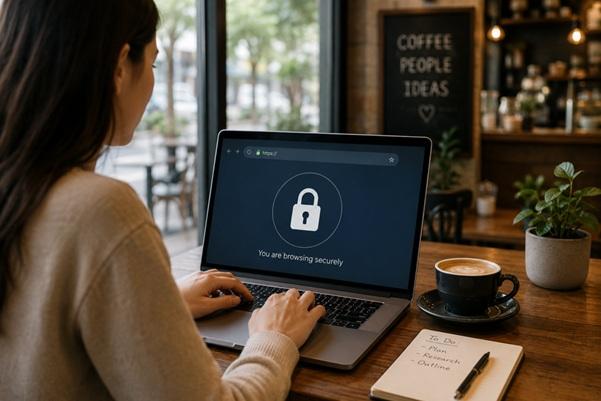
This isn't about niche online communities any longer. These days it's about the actual lives of countless Americans who use banks, online retailers, video streams, and employers that do business on networks they can't fully control. As the online market in private virtual networks (known as VPNs) became so saturated it developed a glut of inflated promises, misleading claims, and outright hoaxes. Choosing The Best VPN in 2026 requires navigating a digital landscape that is in flux, yet not always entirely different.
The Threat Landscape Has Shifted, But the Fundamentals Haven't
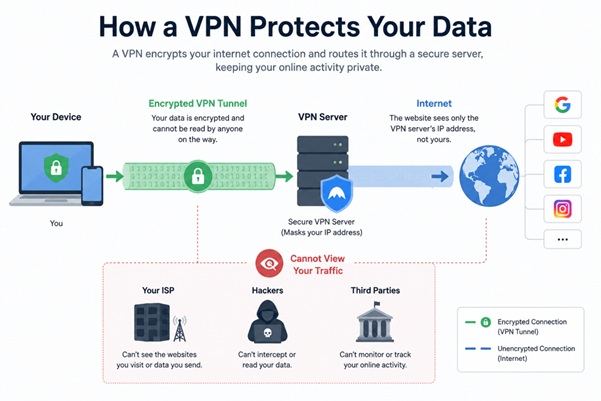
The Federal Trade Commission has consistently flagged data brokers and third-party tracking as top privacy risks for consumers. Advertisers, data aggregators, and bad actors on public networks all have reasons to monitor your traffic. A VPN addresses the most direct of those risks by encrypting your connection and masking your IP address before your data ever leaves your device.
What's changed is the delivery method. Browser-based tools have become a major category. A VPN For Chrome extension, for instance, operates directly inside your browser rather than at the system level, which changes its scope significantly. These tools are convenient, but they only protect traffic flowing through the browser itself, not background apps or system-level connections.
Understanding that distinction matters before you download anything.
Browser Extensions vs. Full VPN Clients
What a VPN for Extension Actually Covers
A VPN for extension is not the same as a full desktop client. Extensions work at the application layer, meaning your Chrome tabs get encrypted while, say, a torrent client or a system update running in the background does not. For casual browsing, that trade-off can be acceptable. For anything involving sensitive data outside the browser, it's a meaningful gap.
Mozilla's documentation on browser privacy tools makes this point clearly: browser-level protections are additive, not complete replacements for OS-level security. The same logic applies here.
Full VPN clients route all outgoing traffic through an encrypted tunnel, regardless of which application generates it. That's the key functional difference, and it's worth knowing before assuming a browser add-on offers blanket protection.
Private Browsing: Useful, but Widely Misunderstood
Many folks, perhaps the vast majority, have the wrong impression of Chrome's "Incognito mode," what Private Browsing mode is more generally called. According to court filings, Google itself concedes that Incognito mode won't render you invisible to the world, just that it stops your browsing data from being saved on your local device. Your ISP, the sites you're surfing to, and your network administrator can all track your usage.
In this vein, the AI VPN that the company has to offer stands out by using machine learning for traffic routing along with traditional encryption, an idea that’s been cropping up from numerous VPNs to stand apart besides pure speed.
What Internet Privacy Actually Requires in 2026
Encryption Standards
AES-256-The gold standard VPNs should meet The industry-standard baseline that quality VPNs use for their encryption, AES-256, is the same type of algorithm the NIST recommends for government sensitive documents and data. You don’t even need to consider VPNs that don’t use the AES-256 standard.
No-Log Policies
A VPN provider's no-log policy determines whether your browsing history could ever be handed over to a third party. These policies vary significantly. Some providers have undergone independent audits; others make the claim without any verification. The audit question is the right one to ask.
Internet Privacy Beyond the VPN
What does 2026 internet privacy mean for me? The FTC's suggestions for online security require multiple security elements-strong passwords, two-factor authentication, updated operating systems, secure browsing, and encrypted emails-plus security in your router, VPN and in all other apps you use to transmit and receive data online.
How to Evaluate the Best VPN for Your Needs
Your ideal settings won't necessarily be someone else's. A worker connecting remotely from home will have a different needs than someone trying to access geoblocked material or connect securely in an open Wi-Fi zone.
Key evaluation criteria:
Protocol support: WireGuard and OpenVPN remain the most audited and widely trusted protocols as of 2026.
Jurisdiction: Where a provider is legally based affects what data retention laws apply to them.
Speed impact: Cloudflare's research on encrypted tunneling shows that protocol choice has a measurable effect on latency, with WireGuard consistently performing well.
Platform coverage: A provider that covers desktop, mobile, and browser extensions covers more real-world use cases than one that focuses on a single platform.
Conclusion
Good VPN vs bad VPN difference is often not evident at installation, it's what appears in audit reports, privacy policy small print, or the provider’s actions when challenged with legal force. In 2026, with an even deeper collection of user data - this shouldn't be a decision taken with five minutes of searching time. Base your choice on the job it'll do for you; check their tech and manage your data through a series of decisions, not a single download.