
How Fast Can You Prototype a Security Sensor Board Without Sacrificing Reliability?
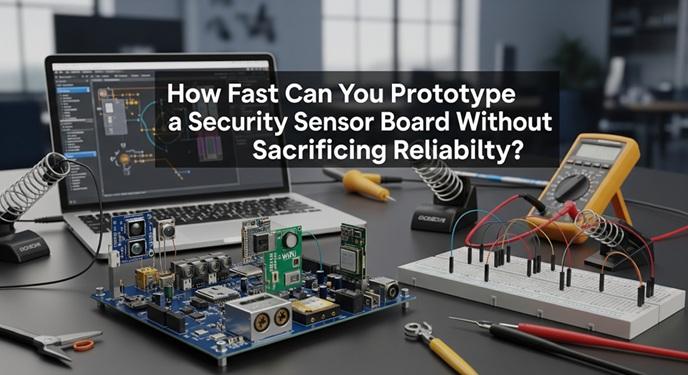
Product development is dependent on speed. However, in the case of security sensor boards, which are gadgets designed to identify intrusions, surveillance or guarding of critical infrastructure, corners cannot be cut. Now, the trick is to find that delicate balance in order to move rapidly through prototyping and yet avoid ending up with an unreliable product that fails in crucial moments.
I have witnessed groups that were struggling with this balance. They hurriedly release a prototype to the market only to retrace their steps several months later when field tests find issues. Others do it in such a systematic way that when they have something to show, the market opportunity has already changed. How do you really take this off?
Start With a Solid Design Foundation
The Prototypes are not fast-born, they are well-grounded. You have to understand what your sensor is to do before you even consider ordering components. Write down:
- What are the environmental conditions that it will be subjected to?
- What is the tolerable failure level?
- How much power can it consume?
This may appear to put you in the slow lane but it is the reverse. By knowing what you need at the very beginning you will not have the costly do-overs that will destroy schedules. I mean:
- The selection of the appropriate microcontroller.
- The use of sensors with reasonable accuracy and response times.
- Considering power management early.
These are not the things you want to find out later.
One of these methods is to draw a basic block diagram that gives you a layout of your key subsystems—sensor inputs, processing, communication and power. This provides you with a structure to build around and also assists in identifying the possible areas of conflict prior to them being altered into board changes.
Leverage Modern Manufacturing Capabilities
This is where it differs a lot over the past few years. The difference between prototype and production has been significantly reduced and intelligent teams leverage on that. The services of Quick PCB ASSEMBLY are now able to provide turnaround times that would have been absolutely impossible to believe a decade ago and quality that is truly production-ready.
The trick is in identifying a manufacturing partner who has knowledge of the security sensor space. Such boards are typically designed with certain specific needs in mind, like:
- EMI concerns to ensure stable sensing.
- Strong power filtering.
- Precise component location to manage heat.
When you deal with manufacturers who have experience of such applications you are not only getting fast turn around but also expertise being built into it. I have seen projects reduce their schedules by weeks by ensuring that the manufacturing partner is the right one. They received boards that worked on the first try instead of having to go through several revision cycles to address the assembly problems.
Do Not Omit the Testing Phase (But Do It Effectively)
Fast prototyping does not imply that validation is not done, it means that it is smarter to test. Your test plan should be ready before your first board.
Key Questions for Your Test Plan:
- What are the environmental conditions that you will simulate?
- How are you going to check the accuracy of sensors?
- How are you going to test power consumption?
When you are waiting on boards, configure your test fixtures and software. When those prototypes are received, you must be in a position to begin gathering information. This parallel method maintains the momentum and does not spoil the thoroughness.
In the case of security sensors, consider the most important failure modes. False positive is generally less severe as compared to a false negative (not detecting an actual intrusion). Test to load these critical paths. On your checklist should be:
- Temperature cycling.
- Voltage variation.
- RF interference testing.
Build in the Right Amount of Flexibility
A lesson that reoccurs is that the quickest prototypes have points of strategic flexibility. Perhaps it is programmable gain steps to your sensor amplifier, or the capability to change out other communication modules. These are not about indecisiveness, it is even more about giving yourself choices when you are bound to find something in the process of testing.
I recall the motion sensor board that we worked on with the footprints of both I2C and SPI accelerators. The I2C component we had originally chosen had supply chain problems and we could switch to the SPI variant without needing to redesign the board. At least six weeks we were spared by that flexibility.
It is about knowing where to add options and where to make investment. The functionality that is core must be locked down depending on your needs. But interfaces, communication protocols and power supplies? They are good candidates for built-in alternatives.
Think Early about the Full System
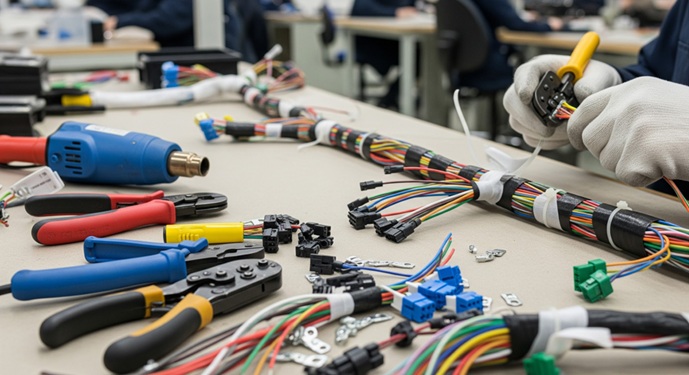
Security sensor boards do not often operate independently. They are components of bigger systems with power supplies, enclosures and usually complicated wiring. The consideration of the wire harness manufacturing at the prototype stage as opposed to the end product stage avoids ugly surprises in the future.
- What will be the connection with your board and your power source?
- And how about communication lines?
- Do you intend to relieve the strain properly?
These specifications influence your board layout, connector choice, and even your test method. The transition between the prototype and the production stage is a lot easier when you plan the whole system at the very beginning.
Certain teams have the advantage of using integrated suppliers that are able to deal with PCB assembly and cable assemblies. An example of such a comprehensive support, as provided by WellPCB Romania services, is capable of simplifying the coordination and minimizing the threat of interface problems between various subsystems.
Document as You Go
This is the one that you can ignore in the rush, but it is a reward that is gigantically profitable. Record design choices, test outcomes and most importantly what did not work. You will be glad when you (or your coworkers) will be able to transition to the next revision or scale to production.
Documentation is also good to get you moving quicker in the long run. When you need to know why you made a certain choice of component or circuit topology, you do not need to relitigate decisions or run experiments you have already run.
Balance Speed and Validation
The actual definition of the question "how fast can you prototype" is based on what it is that you are actually optimizing to. A prototype delivered in 2 weeks and which fails to work reliably is not a fast one, it is a diversion. However, a three-month prototype due to you being over-thinking everything is also not the best.
Those who better implement this balance are those who spend the time in requirements and designs in partnering with capable manufacturers who know their application well, test methodically yet rapidly, and build in intelligent flexibility without larding up the designs.