
Best VMware Alternatives in the Middle East for Enterprise Workloads
The VMware conversation in GCC boardrooms changed the moment Broadcom completed its acquisition.
What used to be a straightforward renewal became a licensing headache almost overnight. IT managers in Dubai, Riyadh, and Doha started asking a question they hadn't seriously entertained before: what's actually out there as a VMware alternative?
And the answer, as it turns out, is quite a lot.
VMware has long been the solution to multiple IT needs. You may need to run critical workloads for a financial institution in Saudi Arabia or want to manage the data center operations for a government entity in the UAE. But choosing the best VMware alternatives in the Middle East will always be at the intersection of those decisions.
To some enterprises, that's one of the most important decisions of the decade.
Why GCC Enterprises Are Reconsidering VMware
The post-Broadcom licensing shift hit hard. Subscription bundles replaced perpetual licenses, forcing organizations, especially mid-market ones, to absorb cost increases that weren't in their budget cycles. For some, renewals came in three to five times higher than the previous year.
Beyond cost, there's the flexibility issue. Middle Eastern enterprises face challenges such as a constantly changing regulatory environment, data sovereignty laws, and national cloud mandates.
Naturally, flexibility is one of their key requirements. They must maintain local compliance frameworks. Saudi Arabia's National Cybersecurity Authority (NCA) requirements are a critical factor on its priority list.
So, if leading global IT infrastructure vendors come and say, "make your enterprise cloud-first, and worry later," Middle Eastern enterprises won't listen. Security must be integrated at the virtualization layer, and so should compliance frameworks.
Add to that the scale of ambition in the region. Saudi Vision 2030 and the UAE Digital Economy Strategy are pushing enterprises to modernize infrastructure at a pace that legacy VMware licensing structures simply weren't designed to support.
What Actually Matters in a VMware Alternative for the Middle East
Before diving into specific vendors, it's worth pausing on what GCC enterprises actually need from a replacement:
Regional presence and local support: Not just a reseller network, actual offices, local engineers, and support in the time zones that matter to you.
Transparent, predictable licensing: No surprise fees at renewal. No per-socket gotchas buried in fine print.
Compliance readiness: The ability to run a private cloud GCC deployment that meets local data residency and security standards.
Scalability for modern workloads: AI inferencing, containerized apps, VDI, your infrastructure needs to keep up with where IT is heading, not where it was five years ago.
What is the best VMware alternative for enterprises in the Middle East?
Sangfor HCI consistently ranks among the most capable, cost-effective, and enterprise-ready options for organizations across the GCC and the wider region, backed by independent Gartner recognition and a growing Middle East footprint.
Recently, they have been recognized as one of the top 5 HCI vendors in APAC by revenue. That kind of recognition speaks for itself when reliability has to meet the requirements of a region.
Top VMware Alternatives for Enterprise Workloads in the Middle East
Enterprises in the Middle East are leaning toward these leading VMware alternatives that meet data center modernization GCC mandates.
1. Sangfor HCI
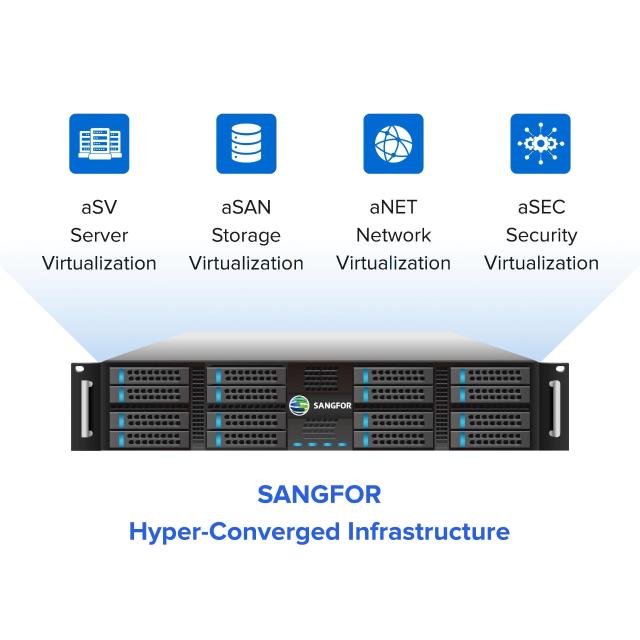
Sangfor HCI leads this list for reasons that go beyond marketing. As a hyperconverged infrastructure solution, it integrates compute, storage, networking, and security into a single software stack, which immediately simplifies operations for teams that are stretched thin.
Here’s what stands out specifically for Middle Eastern enterprises:
Sangfor recently ranked among the Top 3 Largest HCI vendors by revenue in APAC and the Top 5 globally, and has strong recognition from clients on Gartner (4.8 out of 5 star ratings). That’s not a startup claiming to be an enterprise player; that’s a vendor with the scale to back it up.
On Gartner Peer Insights, Sangfor HCI achieved a 100% Willingness to Recommend score among verified enterprise users in the October 2025 Voice of the Customer report.
That’s the only vendor to hit that mark. Six consecutive years of peer recognition isn’t luck; it reflects consistent product quality and support.
Also, Sangfor HCI appeals to GCC enterprises because it, as a VMware alternative, ensures-
- Local support
- Operational continuity
- Compliance readiness
- Cost predictability
- Security integration
The technical story is also compelling. Sangfor’s strength is built on its bare metal or type 1 aSV hypervisor. It delivers 70% lower TCO compared to VMware while alsodelivering a highly familiar operational experience for VMware-trained administrators, significantly minimizing the learning curve.
So, if an enterprise in the Middle East is worried about a hectic migration, their problem is solved at the grassroot. Built-in high availability, intelligent workload balancing, and integrated security mean you’re not bolting on tools to fill gaps.
Sangfor has an established Middle East presence, with a regional office in the UAE and active operations in Saudi Arabia, supported by a growing partner network across the GCC. Its 2025 Riyadh Roadshow attracted over 70 customers and partners, highlighting strong regional momentum.
2. Nutanix
A well-established HCI player with strong enterprise credentials. Nutanix works well for large organizations that have budget flexibility and are comfortable with cloud-heavy architectures. Pricing can be a stretch for mid-market deployments in the GCC.
3. Proxmox VE
Open-source, which is appealing for development and testing. But for production enterprise workloads, especially in regulated industries, the limited official support and less mature storage stack are real concerns. Not a recommended primary option for mission-critical deployments.
4. Red Hat OpenShift
Enterprise-grade and Kubernetes-native, making it attractive for hybrid and multi-cloud strategies. However, it’s complex and resource-intensive to manage, often requiring skilled teams. Better suited as a platform layer than a direct VMware replacement for core virtualization workloads.
5. Microsoft Azure Stack HCI
Makes sense if your organization is already deep in the Microsoft ecosystem. Licensing ties back to Azure, which may work for hybrid-cloud-forward environments but can add complexity for purely on-premises or sovereign deployments.
Is Sangfor HCI available in the UAE and Saudi Arabia?
Yes. Sangfor has established branch offices in both countries and a regional channel partner network providing local deployment, support, and professional services.
What Real Enterprise Migration Looks Like
One story worth referencing: Multinet Trust Exchange LLC (UAE) replaced VMware with Sangfor HCI to reduce costs and simplify IT management. The transition delivered improved performance, streamlined operations, and a scalable, reliable infrastructure supporting business growth and continuity.
It’s a pattern that plays out repeatedly. The decision to move isn’t usually driven by technology dissatisfaction alone; it’s the combination of rising VMware Licensing costs and a growing realization that HCI can consolidate what used to require multiple separate systems.
While Sangfor has steadily expanded its market presence, its strong validation on platforms like G2 and its recognition as a Leader in cloud computing go far beyond marketing. It is the direct result of robust product performance, verified customer satisfaction, and a proven track record in mission-critical environments.
How much can Enterprises Save by Switching from VMware to Sangfor HCI?
Typically, up to 70% reduction in total cost of ownership. The savings come from simplified licensing, reduced hardware dependency through consolidation, and lower operational overhead, especially for organizations currently running separate compute, storage, and networking layers.
AI Infrastructure Is Becoming a Core Part of GCC Modernization
Government initiatives and private-sector investment across the GCC are accelerating AI adoption.
Middle East Organizations are increasingly exploring:
- AI-powered analytics
- Intelligent automation
- Generative AI applications
- Predictive maintenance
- AI-driven citizen services
These workloads place new demands on infrastructure, including GPU acceleration, high-performance storage, scalable networking, and cloud-native orchestration. As a result, many enterprises evaluating VMware alternatives are simultaneously assessing their readiness for AI-enabled infrastructure. Therefore, platforms like Sangfor that support virtualization, private cloud, and AI workloads within a unified architecture are becoming increasingly attractive.
Data Center Modernization in the GCC
The hyperconverged infrastructure Middle East opportunity is real, and it’s accelerating. Saudi Arabia and the UAE are pouring investment into digital infrastructure as part of their national transformation agendas. That creates both pressure and opportunity for enterprise IT teams.
Private cloud GCC deployments are no longer just about cost savings; they’re about building the foundation for AI workloads, sovereign data handling, and resilient operations in an increasingly complex threat environment.
Data center modernization GCC projects increasingly require solutions that can scale with those ambitions, not just replace what already exists.
Gartner’s own prediction frames it well: non-VMware HCI installed bases, which represented 30% of the market in 2024, are projected to reach 60% by 2029. That shift is already happening in this region.
Making the Move
The enterprise virtualization Middle East landscape moving into 2026 is genuinely competitive. But when you look at regional presence, licensing transparency, Gartner validation, and peer-reviewed satisfaction scores, Sangfor HCI consistently emerges at the top of the shortlist for organizations here.
If your team is in the middle of evaluating cloud infrastructure Middle East options, or if the next VMware renewal is coming up and the numbers don’t look pretty, it’s worth getting a hands-on look at what Sangfor HCI actually delivers.
Request a Sangfor HCI Demo and see how a migration could work for your specific environment.
FAQs
What are the Best VMware Alternatives for Enterprise Use in the GCC?
Top VMware alternatives in the GCC include Sangfor HCI, Nutanix, Microsoft Azure Stack HCI, and Proxmox VE. Sangfor stands out with strong regional presence, simple licensing, Gartner recognition, and up to 70% lower total cost of ownership.
How does Sangfor HCI compare to VMware in the Middle East Market?
Sangfor HCI delivers a VMware-like experience with significantly lower TCO. Its licensing is simpler than VMware’s subscription model, and it offers stronger regional support in the UAE and Saudi Arabia, with high Gartner Peer Insights user recommendation ratings.
Does Sangfor HCI Support Data Sovereignty Requirements in the UAE and Saudi Arabia?
Yes. Sangfor HCI supports strict data sovereignty needs. It allows on-premises and private cloud deployments, thereby setting up the bedrock for data sovereignty. Its architecture enables localized, isolated infrastructure aligned with regulatory expectations in Saudi Arabia and the UAE.
How Difficult is it to Migrate from VMware to Sangfor HCI?
Moving from VMware to Sangfor HCI is usually a process. Sangfor gives you the tools you need to migrate, along with help and a hypervisor layer that works well with your existing setup.
This means you can move most of your workloads over without having to make a lot of changes. It is especially helpful when you have support from partners in your area who know what they are doing with Sangfor HCI migration.