
5 High-Risk Merchant Account Providers Worth Considering in 2026

Image Source: depositphotos.com
Getting approved for a merchant account is straightforward for most businesses, but if you're in a high-risk industry, mainstream processors often decline your application outright. These five high-risk merchant account providers worth considering cover a range of industries, pricing structures, and underwriting philosophies, making it easier to find a fit before the applications start.
1. MobiusPay
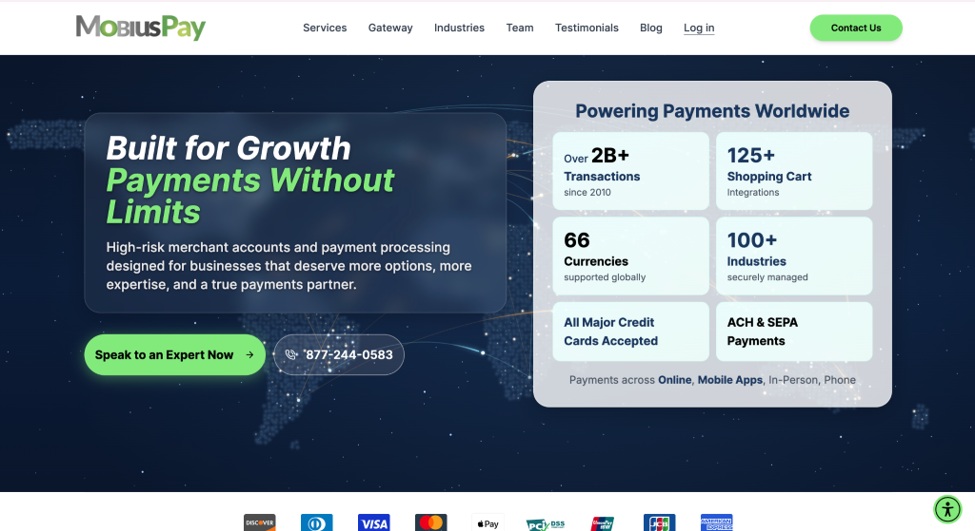
Founded in 2010 and headquartered in St. Petersburg, Florida, MobiusPay has built its entire operation around industries that standard banks and processors routinely reject. The company's track record across more than 100 industries (from nutraceuticals to subscription e-commerce) is what separates it from general-purpose alternatives. Merchants looking for payment solutions for high-risk businesses will find that MobiusPay's proprietary gateway has processed over 1.2 billion transactions and more than $68 billion in total volume, with support for 67 currencies and over 1,200 technology partners.
What it does: MobiusPay provides dedicated merchant accounts, payment gateway access, chargeback management, and global payment processing for high-risk merchants.
Where it shines: The MobiusPay Dispute Resolution program intercepts chargebacks before they formally post, a meaningful advantage for merchants in industries with elevated dispute rates. The company also holds an A+ BBB rating with zero complaints filed in the past 36 months, and earned Inc. Power Partner Awards recognition in both 2023 and 2024.
Pricing: Rates aren't published publicly and are customized by business type, processing history, and location. High-risk accounts should expect rates potentially above 5%.
2. Squareup
Square launched in 2009 with a mobile card reader designed for small businesses that had no easy way to accept cards. Today the company serves more than four million sellers across eight countries, spanning retail, food and beverage, beauty, and service industries.
What it does: Square offers point-of-sale hardware, a payment gateway, invoicing, payroll, and e-commerce tools under a single platform. Hardware ranges from the Square Stand at $149 to the Square Register at $899, with monthly financing available on all devices.
Where it shines: Square's flat-rate pricing and no-contract policy work well for lower-volume businesses that want predictable costs. There are no hidden fees, and merchants can cancel at any time. Square was voted Adweek's best POS system in 2022.
Pricing: Standard card processing runs 2.9% plus 30¢ per transaction. Hardware can be financed monthly. Square is designed for mainstream merchant categories and is not built to handle high-risk industries; accounts in those categories are routinely terminated without much notice.
3. Stripe
Stripe was founded in 2010 by Patrick and John Collison and has grown into one of the largest payment infrastructure companies in the world. The company processed $1.9 trillion in payments volume in 2025 and supports over 135 currencies across 160 countries.
What it does: Stripe provides a developer-focused API for payments, billing, card issuing, fraud prevention via Stripe Radar, revenue analytics, and treasury services. It supports more than 100 payment methods and maintains 99.999% historical availability.
Where it shines: Stripe is a strong fit for SaaS companies, marketplaces, and enterprises that need detailed control over their payment stack. Its Radar tool uses machine learning to flag suspicious transactions before they become chargebacks.
Pricing: Standard processing is 2.9% plus 30¢ per transaction, with no setup costs or monthly fees. Volume discounts begin at $1 million in annual processing. Like Square, Stripe's acceptable-use policy excludes many high-risk categories, and merchants in those segments often find their accounts frozen rather than flagged in advance.
4. Payment Cloud
PaymentCloud was founded in 2015 and is based in Encino, California. The company focuses on merchants that mainstream processors turn away, including CBD, adult services, firearms, nutraceuticals, and subscription businesses.
What it does: PaymentCloud places merchants with a network of acquiring banks rather than acting as a direct processor, which allows it to find homes for industries that a single bank would decline. Services include virtual terminals, payment gateways, ACH and eCheck processing, retail POS, and mobile payments.
Where it shines: Each merchant gets a dedicated account representative who handles the application, equipment setup, and software configuration. The company includes fraud and chargeback tools at no additional charge and charges no application or setup fees. It appeared on the Inc. 5000 list in 2023 for the fourth consecutive year, at No. 2,418.
Pricing: Monthly fees aren't published online. High-risk merchants should budget approximately $25 to $30 per month, though actual rates depend on the industry and processing volume. Because PaymentCloud works through a bank network rather than a direct relationship, rates can vary significantly depending on which acquiring bank accepts the account.
5. Host Merchant Services
Host Merchant Services was founded in 2010 by Lou Honick in Newark, Delaware. The company is a Registered Independent Sales Organization with Visa and Mastercard, sponsored by Wells Fargo Bank.
What it does: HMS provides credit and debit card processing for small and mid-sized merchants, including countertop terminals, wireless devices, virtual terminals, mobile readers, e-commerce gateways, ACH processing, recurring billing, and invoicing. Supported POS platforms include Clover, SwipeSimple, Dejavoo, and Korona.
Where it shines: HMS charges no annual fee, no application fee, low PCI fees, and no monthly minimums. The company offers 24/7 U.S.-based customer support and was recognized as a 2025 Inc. 5000 honoree at No. 3,044 with 133% three-year growth.
Pricing: Pricing is based on interchange-plus and is described as transparent with no hidden charges. Specific rates aren't published publicly. HMS serves retail, hospitality, healthcare, and professional services; it is less focused on high-risk verticals than PaymentCloud, so merchants in flagged industries may find fewer options here.
What underwriters actually look for
Before approving a high-risk merchant account, underwriters examine a specific set of factors that go well beyond a credit score. Understanding these criteria helps merchants prepare stronger applications and avoid unnecessary declines.
Chargeback history is the first thing underwriters look at. Processors generally want to see a chargeback ratio below 1%, and anything above that threshold triggers closer scrutiny or outright denial. Pulling those records before applying is worth the effort if a business has historical chargeback data on hand.
Processing history matters just as much. A merchant who can show 12 months of statements, even from a previous processor, gives underwriters real data to work from. New businesses with no history face tighter limits and steeper reserve requirements until they build a track record.
Industry classification plays an important role. Certain MCC codes (merchant category codes) are flagged at the bank level before any individual application is reviewed. Merchants who know their MCC in advance can target processors with acquiring bank relationships that cover that category rather than burning applications on processors who will decline on category alone.
Underwriters also examine the business model itself: average ticket size, monthly volume, subscription terms, and refund policies. Subscription businesses draw extra scrutiny because recurring billing disputes can spike chargeback ratios fast. Merchants with clear refund policies and low average tickets tend to walk away with better terms.
Pricing reserves and rolling reserves explained
Rolling reserves are the most common cash-flow consideration high-risk merchants don't fully anticipate before signing a processing agreement. The pricing and reserve structures across all five providers vary based on what each company publicly discloses as of October 2026.
|
Dimension |
MobiusPay |
Square |
Stripe |
PaymentCloud |
Host Merchant Services |
|
Standard transaction rate |
Not published (customized; may exceed 5% for high-risk) |
2.9% + 30¢ |
2.9% + 30¢ |
Not published (~$25 to $30/mo estimated) |
Not published (interchange-plus) |
|
Monthly fee |
Not published |
No monthly fee |
No monthly fee |
~$25 to $30/mo (estimated) |
No monthly minimum |
|
Setup / application fee |
Not published |
None |
None |
None |
None |
|
Annual fee |
Not published |
None |
None |
Not published |
None |
|
Volume discount threshold |
Not published |
Not published |
$1M annual processing |
Not published |
Not published |
|
Rolling reserve |
Not published (standard for high-risk accounts) |
Not applicable (low-risk focus) |
Not published |
Not published |
Not published |
|
Contract terms |
Not published |
No contract; cancel anytime |
No contract; cancel anytime |
Not published |
Not published |
|
High-risk category support |
Yes |
No |
No |
Yes |
Limited |
|
PCI fee |
Not published |
Not published |
Not published |
Not published |
Low (disclosed) |
Rolling reserves work like this: the processor withholds a percentage of every transaction, typically 5% to 10%, and holds those funds in a reserve account for a set period, often 90 to 180 days, before releasing them. The reserve exists to cover chargeback losses if a merchant's account closes with disputes still outstanding. Not all providers disclose their rolling reserve terms publicly, so merchants should ask upfront for the specific reserve percentage, the duration, and the release schedule before signing anything.
Bottom Line
The right account depends heavily on business type and chargeback exposure. For merchants in industries that standard processors won't touch, a dedicated high-risk provider with an acquiring bank network and a chargeback interception program will generally deliver more stable processing than a mainstream platform. Square and Stripe stay straightforward for lower-risk businesses that want flat-rate simplicity, as long as the business model falls within their acceptable-use policies. PaymentCloud and Host Merchant Services sit somewhere in between, with PaymentCloud leaning harder into high-risk placement and HMS offering strong pricing transparency for mainstream verticals. Whichever provider a merchant picks, getting written confirmation of reserve terms, rate caps, and termination conditions before signing prevents the most common friction later on.