Security | Threat Detection | Cyberattacks | DevSecOps | Compliance

Salt Code: Stop Reviewing Al Code Start Governing It

AI coding assistants are generating APIs, MCP integrations, agent tools, and application logic faster than your security team can review them. And none of them are trained on your internal security standards, industry frameworks, or regulatory requirements. Salt Code changes that. Join us for this product launch and see how Salt governs AI-generated code from the first prompt through runtime, without slowing your developers down.

Salt Code

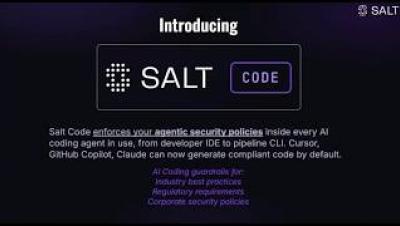
AI is writing more enterprise code than ever. The problem? AI coding assistants aren’t trained on your internal security policies, compliance requirements, or industry frameworks. The solution? Salt Code, the first agentic security solution to enforce security policies inside AI coding assistants. Salt Code brings policy-driven security to the moment code is created, helping developers generate compliant code by default from prompt to production.

Salt Cloud Connect for Github

Your developers are shipping agents, MCP servers, and APIs faster than security can see them. GitHub Connect changes that. Salt scans your repositories and surfaces every agent, MCP server, and API hiding in your codebase, then maps them into the Agentic Security Graph. You see the agentic infrastructure forming in code, before it ever reaches production. No more waiting for runtime to find out what shipped. No more blind spots between dev and prod. Govern what's being built from day one.

Salt Cloud Connect for Github

Your developers are shipping agents, MCP servers, and APIs faster than security can see them. GitHub Connect changes that. Salt scans your repositories and surfaces every agent, MCP server, and API hiding in your codebase, then maps them into the Agentic Security Graph. You see the agentic infrastructure forming in code, before it ever reaches production. No more waiting for runtime to find out what shipped. No more blind spots between dev and prod. Govern what's being built from day one.

The Agentic Security Graph: Get Visibility into your AI Security Risks

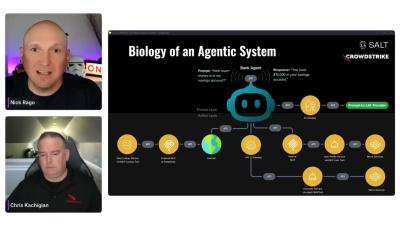
As enterprises shift from conversational to agentic AI, the real risk moves from model outputs to the action layer; the MCP servers and APIs through which agents execute real-world tasks. The Agentic Security Graph frames this risk across three interconnected layers (LLM, MCP servers, APIs), showing how compromises at any layer can propagate and why existing LLM-focused controls leave the most consequential surface unmonitored.

Salt Agentic Security Platform

Most enterprise AI security investment is focused on the model layer—guardrails, output filtering, LLM governance. That's necessary. It's not sufficient. AI agents take actions: they call APIs, invoke MCP servers, access databases, and trigger downstream workflows. The Salt Security Agentic Security Platform was built to secure that action layer (the infrastructure your agents actually operate across).