Security | Threat Detection | Cyberattacks | DevSecOps | Compliance

AI Is Reshaping Cyber Risk Faster Than Most Boards Realize

Artificial Intelligence is no longer a future cybersecurity concern. It is actively reshaping how attacks are conducted, how organizations respond, and how business leaders must think about enterprise risk. While much of the conversation around AI has focused on productivity and innovation, threat actors are already leveraging AI to make cyber-attacks faster, more scalable, more convincing, and increasingly difficult to detect.

More Security Tools Rarely Mean Faster Detection

Organizations continue investing heavily in cybersecurity tools, yet many security operations centers (SOCs) still struggle with alert fatigue, investigative delays, and inconsistent response outcomes. The issue is not necessarily a lack of technology. In many environments, it is the opposite. As security stacks expand, operational complexity often expands with them.

CISO's Corner - 6 Observations from Gartner SRM 2026

Artificial Intelligence continued to dominate the conversation, and content, but the key theme throughout the Gartner Security & Risk Management experience was a little bit more subtle. This year, CISOs from all across the globe came to connect, learn, and explore with peers, vendors, and Gartner, navigating individual and business resilience challenges.

What OMB M-26-14 Means for Your Agency and Where to Focus Now

OMB M-26-14 introduces a significant change in how federal agencies approach logging, monitoring, and incident response. Rather than emphasizing volume and retention of log data, the memo centers on how effectively agencies can use telemetry to support detection, investigation, and response across the full threat lifecycle. For cybersecurity leaders, the implication is clear: logging is now closely tied to operational performance.

Day in the Life of a Red Teamer: Thinking Like the Adversary

There’s a persistent myth about red team operators: that the job is all zero-days, glowing terminals, and cinematic “I’m in” moments. The reality is more interesting and far more human. A day in the life of a red teamer is less about chasing flashy exploits and more about understanding how real people, real systems, and real environments fail under pressure.

Why "Private" Hosting Isn't the Same as Secure Hosting

For many organizations, the move to virtual private server (VPS) hosting feels like a natural security upgrade. After all, the word private suggests isolation, control, and protection; especially compared to shared hosting environments. But in practice, private hosting does not automatically mean secure hosting. In fact, without the right security maturity, VPS environments can introduce new risks rather than eliminate old ones.

LevelBlue Named Growth and Innovation Leader in Frost Radar for Managed Security Services in the Americas

LevelBlue has been named the Growth and Innovation Leader in the Frost Radar: Managed Security Services in the Americas, 2026 report, a recognition that reflects our continued focus on helping organizations simplify cybersecurity operations, strengthen resilience, and navigate an increasingly complex threat landscape.

Why Phishing Works

This article was originally published in Professional Security Magazine. Why are organizations still losing to phishing in 2026? Phishing has been the dominant attack vector for years. Despite this, organizations continue to be caught out by it. The UK government’s Cyber Security Breaches Survey 2026 confirms it remains the most prevalent and disruptive type of attack that businesses are facing. For those on the front line of incident response investigations globally, that finding is no surprise.

MDR Isn't a Silver Bullet for Poor Telemetry

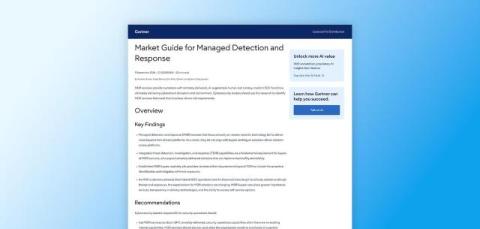
Managed Detection and Response (MDR) has become a critical capability for organizations navigating increasingly sophisticated cyber threats, expanding attack surfaces, and growing operational complexity. But despite significant investments in MDR services, many organizations still struggle with delayed investigations, missed detections, and inconsistent visibility across their environments. The issue is often not the MDR provider itself. It is the telemetry.

AI-Driven Cyber Warfare Reshapes Global Defense Readiness

This article was originally published in TechRadar Pro. The Iran conflict is serving as an AI testbed for the next era of cyber conflict. Most organizations are watching the tactics and impact unfold with cybersecurity defenses that are simply not prepared for this level of sophistication. Meanwhile, technology leaders are seeing AI as both their biggest opportunity and a major new attack vector.