Security | Threat Detection | Cyberattacks | DevSecOps | Compliance

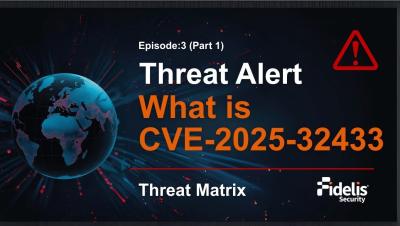
What CVE-2025-32433 Is and Why It Matters ?

A new critical vulnerability—CVE-2025-32433, also known as the Erlang SSH Chainbreaker—allows attackers to execute commands without authentication. This video breaks down what the flaw is, how the exploit works, why it’s dangerous, and which systems are at risk. In Part 1, you’ll learn: Severity: CVSS 10.0 — Exploited in the wild Risk: Full host compromise, data theft, operational disruption.

6 Stages in a Threat Intelligence Lifecycle: Where Does Fidelis Fit In?

Contemporary threat actors employ sophisticated methodologies to execute advanced persistent threats that may remain undetected for extended periods. The evolving threat landscape necessitates comprehensive threat intelligence programs capable of transforming raw data into strategic threat intelligence. Organizations require structured processes that enable proactive security measures rather than reactive responses to cyber threats.

Beyond Web App Firewalls: How XDR Strengthens SQL Injection Prevention

The Critical Gap in Your SQL Injection Defense Your Web Application Firewall isn’t enough anymore. Despite WAF deployments, sophisticated SQL injection attacks continue bypassing perimeter defenses, with attackers exploiting JSON-based payloads, encoding techniques, and behavioral evasion methods that traditional signature-based detection simply cannot catch. Recent authoritative research reveals alarming trends.

Why Does Alert Overload Happen and How Can It Be Prevented?

You’re operating in a fast-moving cybersecurity environment. Every second, data flows, users log in, devices communicate, and threats lurk. Your tools are generating alerts—many of them valid, many more questionable. Before long, you face a constant tsunami of notifications. That’s where alert fatigue strikes: too many alerts, too little time, too much risk. When your team starts ignoring or delaying responses to alerts, the very purpose of your monitoring stack is undermined.

Understanding the Role of Misconfigurations in Data Breaches in Cloud Environments

Key Takeaways Cloud misconfiguration is the silent epidemic destroying enterprise security. While organizations accelerate cloud adoption across cloud environments, Gartner analysis shows that through 2025, 99% of cloud security failures have been the customer’s fault, primarily due to misconfigurations. For decision-makers, this represents a critical business risk that demands immediate strategic attention.