Security | Threat Detection | Cyberattacks | DevSecOps | Compliance

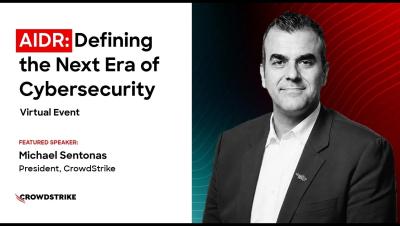
AIDR: Defining the Next Era of Cybersecurity

AI is changing how work gets done. It is also creating a new attack surface. Join CrowdStrike President Michael Sentonas for a first look at CrowdStrike’s vision for securing the agentic enterprise and defining AIDR, the emerging category for detecting, investigating, and responding to threats targeting and originating from AI systems, agents, and autonomous workflows. In this virtual event, you’ll learn.

Lightboard Lab: Why Browser Security

Securing the browser is no longer optional, but not every approach delivers the same level of protection, flexibility, or user experience. Remote browser isolation, VDI, dedicated secure browsers, and browser extensions can each address part of the problem. But they may also introduce latency, force users into unfamiliar workflows, create patching gaps, or lack visibility into the browser runtime where sessions, tokens, data, and attacks converge.

CrowdStrike Joins the Open Secure AI Alliance to Advance AI Safety and Security

AI is changing the speed and scale of cyber defense, and the speed and scale of the adversary. As AI becomes embedded across government, critical infrastructure, and enterprise environments, defenders need the ability to inspect, test, adapt, and secure the systems they depend on.

FalconID: Third-Party Passkeys

Passwords and traditional MFA remain common targets for phishing and credential theft. FalconID extends phishing-resistant, FIDO2-based passkeys to third-party applications, enabling secure, passwordless authentication across platforms like Entra ID, Okta, GitHub, and Salesforce. Passkeys are device-bound, centrally managed through the Falcon console, and continuously protected by Falcon security signals—allowing organizations to revoke access instantly when risk changes.

CrowdStrike Falcon Platform Helps Meet U.S. Government Mandates for CISA BOD-26-04

On June 10, 2026, the Cybersecurity and Infrastructure Security Agency (CISA) issued Binding Operational Directive 26-04, which transforms federal vulnerability management by shifting agencies from static CVSS-based patching to a dynamic, risk-based model. This supersedes BOD 19-02 and BOD 22-01. Agencies must now prioritize remediation using four key factors: public asset exposure, KEV catalog status, exploit automatability, and technical impact (partial vs. total control).

Denying the Worm: Detecting SANDWORM_MODE and the Emerging Class of AI Toolchain Supply Chain Attacks

In February 2026, Socket.dev published research on a multi-stage npm supply chain worm operating under the internal flag SANDWORM_MODE. The campaign spanned 19 malicious packages in total across two unique publisher aliases and demonstrated a new class of supply chain attacks that targeted AI-augmented development workflows.

Beyond the Model: Harnessing Frontier AI for Stronger Cyber Defense

Frontier AI is fundamentally changing the pace of cybersecurity. For defenders and adversaries alike, it compresses the time required to discover vulnerabilities, assess exploitability, and act. AI models can reason across entire codebases, identify complex vulnerability chains, and generate exploit paths at a speed and scale that was previously impossible. That's a breakthrough for defenders, but it's also a preview of how quickly adversaries will evolve.

AIDR: How CrowdStrike Is Defining the Next Era of Cybersecurity

Every foundational shift in computing has created a new security category. The internet created network security, the rise of workstations created the need for endpoint detection and response (EDR), and cloud computing created the need for cloud security. Each technology transition has moved faster than the one before it. None has moved faster than AI.

SaaS Security Threats to Worry About, with Salesforce's Kelly McCracken

Kelly McCracken, SVP of the Cyber Security Operations Center at Salesforce, leads one of the most complex and high-scale cyber operation environments on the planet. Today, she joins Adam and Cristian to discuss how adversaries are targeting SaaS vendors, the most underappreciated SaaS misconfigurations, and what the future of the shared responsibility model looks like.

Why AI Governance Without Guardrails Is Theater

AI governance is a key enterprise concern. Organizations are assembling councils, publishing principles, rolling out “approved AI tools” lists, and asking employees to opt in to acceptable use policies. In most enterprises, however, the reality is that AI is already widely embedded in employees' daily work, often outside sanctioned channels and oversight. The visibility and control mechanisms needed to govern AI use are immature or nonexistent.

Falcon Secure Access Sets the Standard for Zero Trust Browser Security

The browser has become the enterprise workspace. Employees, contractors, partners, and third parties use browsers to access SaaS applications, internal web apps, admin consoles, collaboration tools, and AI services from anywhere, often across a mix of managed, unmanaged, and personally owned devices. As they do, adversaries are increasingly targeting the browser session itself.

CrowdStrike Uncovers New Prompt Injection Techniques

Prompt injection is among the defining security challenges of the AI era. As organizations move from chatbots to AI agents, adversaries are finding more ways to manipulate the language, context, and data these systems trust. With the rise of powerful AI agents that can crawl webpages, access file stores, and even write shell commands, indirect prompt injection has emerged as a critical threat vector.

How AI-leading Security Teams Are Building the Agentic SOC

AI-enabled attacks move faster than human analysts can track, at a scale that traditional SOCs weren’t designed to withstand. eCrime breakout times collapsed to 29 minutes on average in 2025, with the fastest clocked at 27 seconds. The rise of frontier AI models is expected to compress the time between vulnerability discovery and exploitation, intensifying pressure on SOC teams. Defending against AI-accelerated adversaries requires a new operating model.