Security | Threat Detection | Cyberattacks | DevSecOps | Compliance

Futurize, Unite, and Simplify Application Security: A Black Hat Discussion

In this video from Black Hat 2025, A10 Networks security expert Jamiso Utter explains the critical need to "futurize our defenses." He argues that many current cybersecurity solutions, such as firewalls and Regex, are built on decades-old technology, making them ill-equipped to handle today's emerging threats. Jamison highlights the problem with buying from companies whose "bottom line is more important than your bottom line," leading to a fragmented "best-of-breed" approach that ultimately adds complexity to a network.

Agentic AI Security: Introducing the AI Firewall/Guardrail

As organizations adopt powerful AI agents for complex B2B workflow automation, securing their actions and ensuring compliance becomes paramount. A10 Networks' security expert, Diptanshu Purwar, explains the foundational need to integrate AI agents into existing governance platforms, which involves utilizing established enterprise security practices, such as role-based access and robust policy management, tailored explicitly for agents.

Verifiable AI: Policy Management for Next-Gen AI Security

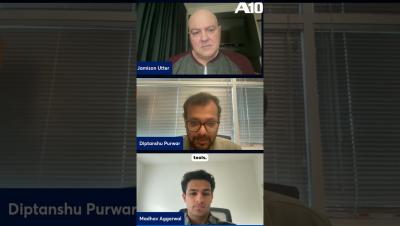
As AI agents increasingly automate complex B2B workflows, how do organizations ensure security and compliance? In this segment, A10 Networks' security experts, Jamison Utter, Diptanshu Purwar, and Madhav Aggarwal, dive into the critical steps for securing AI deployments. Diptanshu emphasizes the importance of integrating AI agents into existing governance platforms, leveraging systems such as role-based access control and policy management.

API Security: A Holistic View on Protecting Web Presences

In this video from Black Hat 2025, A10 Networks security expert Jamison Utter explains the importance of a unified, "one mind" approach to API security. He argues against the traditional, "stitched-together" method of using separate tools for different threats (e.g., API protection and a WAF). Instead, A10's real-time API protection solution looks at the holistic behavior of traffic and applies a single, intelligent security model to protect your web presence.

Securing AI: The New Frontier of API Security

A10 Networks' security experts, Jamison Utter, Diptanshu Purwar, and Madhav Aggarwal, discuss the security challenges of AI. They discuss the new world of API-enabled AI agents and the necessity for robust security controls. Learn how to prevent misuse within the enterprise as they explore data ingress/egress and API security in the context of large language models (LLMs).

AI Agent Security: Verifying Workflows with AI Firewalls & Guardrails

AI Agent Security: Verifying Workflows with AI Firewalls & Guardrails A10 security experts Jamison Utter, Madhav Aggarwal, and Diptanshu Purwar discuss the importance of context-aware security for AI agents. They emphasize that when automating workflows with AI, it's crucial to ensure that the context fed to the agents and their subsequent actions are verifiable and in line with existing company policies.

Securing AI Part 3: AI Agents - Use Cases and Security

A10 security experts, Jamison Utter, Diptanshu Purwar, and Madhav Aggarwal explore the topic of securing AI agents, which they define as systems that perceive, decide, and act. They discuss: Defining AI Agents: Explaining that agents are not just chatbots, but are the "hands of AI" that can execute actions, call APIs, and automate complex workflows. The Challenge of Security: Discussing how security for AI agents goes beyond traditional model security and includes protecting against prompt injection, malicious instructions, and preventing unsafe actions or data leakage. The Importance of Context and Data.

The Invisible Trick: How to Fool an AI Agent

The Invisible Trick: How to Fool an AI Agent A10 Networks' security experts, Jamison Utter, Madhav Aggarwal, and Diptanshu Purwar, discuss a classic example of an adversarial attack that tricks an AI agent using the equivalent of invisible watermarks. Madhav explains how researchers used an invisible watermark in a research paper that, when scanned by an AI agent, would automatically trigger a positive review. This watermark was not visible to human reviewers. This clever manipulation highlights a significant vulnerability in AI models: they can be influenced by hidden data in their input.