
What Are the Best Ways to Hide Wires When Installing Outdoor Security Cameras?

It is a oddly satisfying experience to install a new security camera system. You have done the research, selected the best cameras, discovered the best mounting positions and then reality sets in. You are staring at a mess of wires that are as unappealing as spaghetti that has been thrown against your house.
In case you have ever experienced such situation, you are not alone. noticeable wires do not only appear messy but they can even weaken your security system. The intruder may just cut the open cables making your costly cameras useless. In addition, the hanging wires are not helping the curb appeal of your house.
The good news? It is not impossible to conceal security camera wires even when you are not an electrician. I would like to show you some of the simplified and successful ways that would ensure your set up continues to appear tidy and professional.
Why Hiding Wires Actually Matters
Other than aesthetics, there are a number of issues that exposed wiring poses that you may not have thought about:
- Weather Damage: Exposure to weather slowly deteriorates the insulations of the wire, particularly in regions that have extreme winters or high solar exposure.
- Wildlife: Sometimes the birds and rodents chew through available cables—yes, it did more often than you think.
- Security Vulnerabilities: Wire cables are also visible, which gives a map to any person who wishes to shut down your security system.
By having your wiring covered up in the proper way you are saving your own money and not letting your cameras fail to perform just at the time you need them the most.
Installation of Wires through Walls and Soffits
It is the most clean method as the wires are not seen at all. If you're comfortable working with basic tools, it's surprisingly manageable.
The Process
The first step is to drill a small hole in and around where your camera is going to be mounted, and then run the cable to your exterior wall of the home and up to the attic or the basement. Then you can hook it to your recorder tape machine or electricity.
Staying Within Code
Local building codes are one of these things that people tend to ignore. There are numerous regulation demands in many cities regarding the installation of low-voltage wiring through walls. When planning your wire routes and determining how many cables can safely fit in a given space, an electric box fill calculator becomes incredibly helpful for ensuring you're staying within code requirements.
This is a good method to use on new installations and is time consuming, but it takes a lot of planning to ensure that one does not stick a drill in studs, pipes or already existing electrical lines.
Using Outdoor-Rated Conduit
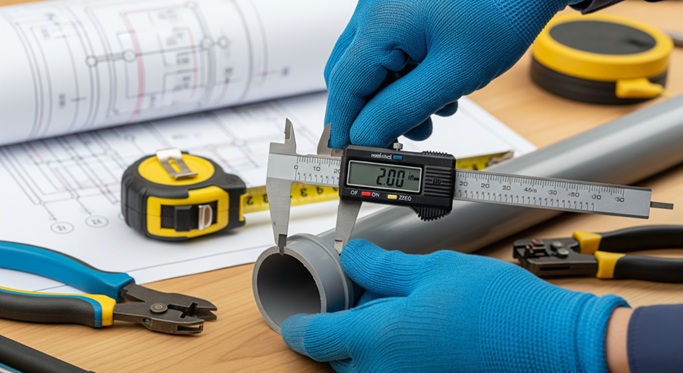
When it is not feasible to run the wires within the walls, conduit is another professionally acceptable solution. Imagine providing your own cables with a highway in the outer side of your house.
- Color Matching: PVC conduit is available in many colors White is the most popular, followed by gray, and then there is beige; so you will always have at least one color that matches fairly well with your siding.
- Ease of Installation: It is simple to install: one can place the conduit on the path of his/her choice and secure it with clips or straps, and then drag cables.
Sizing Tips
One way to cheat here is to make sure you use conduit slightly larger than you reckon. Attempts to fit cables into oversized conduit is infuriating and may destroy the insulation of the wires. A conduit sizing calculator takes the guesswork out of this decision, helping you determine the right diameter based on the number and gauge of wires you're running.
Have the conduit painted to suit your house colour, and have it laid in architectural lines—that is, along roof lines or corner trim or window lines—instead of being quite haphazardly cut across bare walls.
Burying Cables Underground
In the case of cameras that are placed far away in front of your home such as those used to keep an eye on a driveway, garage or the rear gate of your house, burying them underground may be the best option.
- Digging: This technique involves a trench of a minimum of half a meter.
- Cable Selection: Use Direct-Burial rated cable or use waterproof conduit with standard cable.
- Safety First: Call your local utility location service before you take a shovel. Damaging a gas line or fiber optic cable is an error, which can have disastrous consequences.
Trace your cable on a development to use later. You will be glad, years after, that you yourself had to know where to find those cables buried.
Concealing Wires with Creative Landscaping
The most ideal hiding place is sometimes in a place-in-view right before our eyes, that is, where there is a strategic use of landscapes.
Common Hiding Spots
- Downspouts: One of my favourite tricks is to place cables behind downspouts. The natural vertical line gives an ideal cover and you can use color matched clips to fasten the wire after every foot or so.
- Structural Trim: In the same way, it is recommended that cables should be tucked along the edge of trim boards, behind shutters, or inside rain gutters so that they are out of view and they can be reached.
- Ground Cover: In cases of ground-level operations, think of the placement of cables under decorative rocks, mulch or a fence line where vegetation can be used to produce natural cover.
All you need to do is to ensure that you are using outdoor rated cable that is able to withstand moisture and heat changes.
Planning Makes Perfect
Drawing a line between a professional look and a simple copy is often a question of planning.
Before attaching a single camera, take time to sketch the path of your wire. Take into consideration sunlight, shadows and angles of view and the implications to the camera work and wire visibility. Even a simple relocation of a camera by a few feet can provide a far cleaner path of wires.
Digital Planning Tools
Here, digital tools may be of use as well:
- Documentation: If you're creating documentation or diagrams of your installation, a background remover online tool makes it easy to create clean visual guides by isolating important elements from photos.
- Lighting: And if you're planning night coverage, an online LED calculator helps you determine whether you need supplemental lighting and what power requirements that might add.
- Visualization: For those who really want to visualize their setup before drilling the first hole, a 3D model creator lets you experiment with camera placements and wire routing in a virtual environment.
Wrapping It All Up
Coverage of security camera wires will not need any professional knowledge, it is only necessary to plan, and be able to use the appropriate strategy to your case. You may be pulling cables between walls, or running conduit over the roof-line, or burying wires underground, the aim is always the same, to have a clean, safe installation that will serve you faithfully for many years.