
SIP Trunking Security in 2026: What Enterprises Must Know Before Their Next Breach

Telecom fraud exceeded an estimated $41.82 billion in losses in 2025 — and a substantial share of that exposure runs directly through SIP trunks. The SIP trunking market itself reached $73.14 billion that same year, and is projected to more than double to $157.91 billion by 2030, according to Mordor Intelligence. That collision of rapid adoption and surging fraud is not a coincidence. Enterprises are migrating voice infrastructure to IP-based systems faster than security teams are adapting their threat models to cover them. In 2026, SIP trunking is business-critical infrastructure. Treating it as anything less — a phone bill line item, a telecom team’s problem — is the kind of gap attackers have learned to exploit within hours of deployment.
Why SIP Trunking Has Become a Prime Attack Target
SIP trunking carries voice as data packets over IP networks, which means it inherits the full attack surface of any enterprise network asset. It is not a closed telephony system — it is an application layer protocol, and ports 5060 and 5061 are as visible to an external scanner as any web-facing endpoint.
The practical threat landscape breaks down across several well-documented vectors. Toll fraud remains the most financially damaging: attackers gain unauthorized access to SIP credentials, route international calls through compromised trunks, and can run up thousands of dollars in carrier charges before anyone notices — often over a weekend or holiday. Eavesdropping is a quieter risk. Without encryption on the media plane, RTP streams carrying actual call audio are transmitted in cleartext across the internet, a compliance liability with immediate implications for healthcare, legal, and financial organizations handling regulated conversations.
SIP-targeted DDoS attacks are accelerating. Q2 2025 saw DDoS attacks run 44% higher than the same quarter in 2024, and voice infrastructure — which has strict latency tolerances — is an effective target for disruption even with relatively modest packet volumes. Meanwhile, caller ID spoofing has made SIP trunks a preferred delivery mechanism for vishing campaigns: non-fixed VoIP numbers made up just 3% of call center volume in 2023, yet 61% of those calls were flagged as high fraud risk.
What binds most of these incidents together is not sophisticated zero-day exploitation. According to the CFCA, telecommunications fraud losses reached $38.95 billion in 2023 alone — and the majority of incidents traced back to weak credentials, exposed ports, and misconfigured SIP dialplans. The attack surface is wide partly because voice infrastructure has historically been managed in isolation from broader enterprise security programs. Proper network segmentation — treating voice VLANs as distinct security zones subject to the same access controls as other sensitive infrastructure — closes a significant portion of that gap before any specialized voice security tool is deployed.
The Compliance Dimension: STIR/SHAKEN and the 2026 Deadline
This is the piece of the SIP security picture that most technical guides overlook entirely, and in 2026 it carries direct operational risk for any enterprise buying or managing SIP trunk services.
STIR/SHAKEN is the FCC-mandated cryptographic caller ID authentication framework designed to combat spoofed calls at the carrier level. It works by attaching digital attestations to calls as they traverse the telephone network, allowing receiving carriers to evaluate whether the calling number is legitimate. For years, some voice providers handled their STIR/SHAKEN signing obligations by outsourcing the process to third-party certificate authorities under a delegated model. That changed on September 18, 2025, when the FCC’s Third-Party Signing Rule took effect. Under this rule, voice providers are now required to sign calls using their own certificates — delegating that function to an external party is no longer permitted for most categories of originating provider.
The second deadline sits at March 1, 2026: annual recertification in the FCC’s Robocall Mitigation Database. Providers that miss this recertification or fall out of compliance risk having their traffic blocked or degraded by downstream carriers enforcing the rules.
Why does this matter to enterprise security and IT teams? Because provider compliance is not just a legal issue for the carrier — it affects your calls. If your SIP trunk provider is non-compliant with STIR/SHAKEN requirements, calls originating on their network may receive low attestation scores or be blocked entirely as they traverse other carriers’ systems. That translates to missed customer calls, failed two-factor authentication delivery, and degraded outbound campaign performance.
The foundational federal framework governing enterprise VoIP security posture remains NIST SP 800-58, which addresses authentication, encryption, and access control requirements for IP voice systems. STIR/SHAKEN compliance should be read alongside it as a regulatory layer on top of the technical baseline NIST defines.
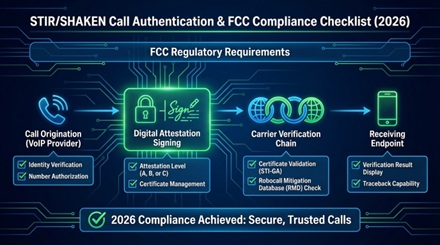
STIR/SHAKEN compliance checklist showing FCC call authentication flow for 2026
Technical Defenses: Layering Security Across the SIP Stack
No single control secures a SIP environment. The architecture demands a layered approach, each control addressing a distinct part of the attack surface.
Encryption must cover both planes of a SIP session. TLS 1.3 protects SIP signaling — the messages that set up, manage, and tear down calls. SRTP protects the media stream — the actual audio. Deploying one without the other leaves the other plane exposed; a common misconfiguration is to enable TLS signaling while leaving RTP media unencrypted.
Session Border Controllers (SBCs) sit at the network edge between the enterprise and the SIP trunk provider. They perform deep packet inspection of SIP traffic, filter malformed or anomalous messages, enforce rate limits, and act as a topology-hiding proxy so internal infrastructure is never directly exposed to the public internet. For any enterprise running SIP at scale, an SBC is a mandatory architectural component, not an optional enhancement.
IP allowlisting restricts which source addresses can register with or send SIP INVITE messages to your environment. Combined with concurrent call caps — hard limits on simultaneous outbound calls — this controls the blast radius of a credential compromise: an attacker cannot drain unlimited carrier charges if the system stops accepting calls at 50 concurrent sessions.
Real-time monitoring is where many enterprise deployments remain underprepared. Effective SIP security requires alerting on off-hours call spikes, unusual destination country patterns, repeated failed REGISTER attempts, and sudden volume changes that fall outside normal traffic baselines. AI-assisted anomaly detection, increasingly offered as a native feature by modern SIP providers, is proving effective at identifying toll fraud patterns faster than manual review can.
Finally, VPN tunnels for remote workers connecting softphones or remote PBX extensions to the corporate SIP environment should be treated as a distinct security requirement — remote endpoints introduce credential exposure risks that on-premises deployments do not face in the same way.
Choosing a SIP Trunk Provider That Takes Security Seriously
The technical controls above only matter if the provider’s own infrastructure is hardened at the carrier level. Provider selection is a security decision, and it deserves the same evaluation rigor as any enterprise security vendor.
The baseline checklist for a security-conscious procurement should include: native TLS/SRTP encryption as a default rather than an optional upgrade; STIR/SHAKEN certification using the provider’s own certificates as required by the September 2025 FCC rule; an active and current Robocall Mitigation Database listing; built-in fraud detection with automatic traffic suspension when anomalous patterns are detected; geographic redundancy with uptime SLAs at 99.999% or better; HIPAA-ready infrastructure for organizations in regulated industries; and clear, detailed documentation of security practices — not marketing language.
Providers like Skyetel build these capabilities into their core infrastructure — offering STIR/SHAKEN compliance, HIPAA-ready services, and fraud prevention as standard features rather than premium add-ons. That distinction matters operationally: security capabilities that require separate contracts, added cost, or manual enablement introduce gaps in the window between deployment and full protection.
There is also a structural consideration worth noting. Carrier-owned networks eliminate the intermediary reseller layer, which reduces supply-chain trust complexity and gives enterprises a direct relationship with the entity responsible for call quality and security controls. As Computer Weekly has noted, the operational and security challenges of SIP trunking frequently surface at integration boundaries — and minimizing the number of those boundaries is a meaningful risk reduction strategy.
For organizations managing cloud contact center data protection, the choice of SIP trunk provider also cascades into data handling obligations: call recording, retention, and transmission practices at the carrier layer must align with the organization’s broader data protection posture.
Building a VoIP Security Policy
Technical controls require governance structures to remain effective over time. A durable VoIP security policy should specify: quarterly SIP configuration audits covering credential rotation, port exposure reviews, and dialplan access controls; annual penetration testing that explicitly includes voice infrastructure as in-scope; role-based access management for PBX administration panels, with MFA enforced for all administrative accounts; and a documented incident response runbook for toll fraud scenarios, including escalation paths to the SIP provider’s fraud team and steps for rapid trunk suspension.
AI-powered call anomaly detection is moving from emerging technology to standard practice. Platforms that analyze call destination geographies, volume patterns, and registration behavior in real time are increasingly the fastest detection layer in a toll fraud scenario — faster than SIEM-based alerting that may aggregate logs on longer cycles.
The 2026 Imperative
SIP trunking’s attack surface is as wide as any other enterprise IT asset, and it is growing with the market. The $4.44 million average cost of a data breach in 2025 reflects how expensive any unplanned security failure has become — voice infrastructure breaches carry the same category of financial exposure, plus the operational disruption of losing a business-critical communication channel.
The 2026 regulatory environment removes ambiguity about compliance obligations. The STIR/SHAKEN Third-Party Rule is in force. The March 2026 RMD recertification deadline is immediate. Enterprises that have not verified their SIP trunk provider’s compliance posture are carrying regulatory and operational risk they may not have formally acknowledged.
The path forward is straightforward even if the implementation is not: audit the current SIP environment against the controls outlined above, verify provider compliance with the 2025–2026 FCC requirements, and integrate voice infrastructure explicitly into the organization’s security program rather than managing it as a separate telecommunications concern.