
Quantum Security Threats to Encryption Systems: Why RSA and ECC Are No Longer Enough
For nearly fifty years, RSA and ECC have quietly protected your bank logins, medical records, and government secrets. That trust is now expiring. In May 2025, a researcher at Google Quantum AI showed that a 2048-bit RSA key could be cracked by a machine with fewer than a million noisy qubits, roughly twenty times less hardware than the same scientist estimated back in 2019. Problems that once kept attackers out for billions of years are sliding toward solvable in days. Worse, sensitive data is already being stolen and stockpiled for a future decryption payday. This guide explains why the two pillars of modern encryption are cracking, how close the danger really is, and what a quantum-ready defense looks like.
Key Takeaways
- Shor's algorithm lets quantum machines factor the large numbers that RSA and ECC depend on.
- Attackers already copy encrypted traffic now to unlock it once the hardware finally matures.
- NIST published its first finalized post-quantum standards in 2024, and migration should begin immediately.
- Grover's algorithm weakens symmetric ciphers like AES, though doubling the key length restores safety.
- Crypto-agility and a full cryptographic inventory are the practical first moves for any organization.
Why RSA and ECC Protected Data for Decades, and Why That Era Is Ending
RSA and elliptic curve cryptography secure almost every encrypted connection you touch, from HTTPS browsing to VPNs to digital signatures. Both rest on a simple bargain: certain math problems are easy to set up yet practically impossible to reverse. RSA leans on the difficulty of factoring the product of two enormous prime numbers. ECC depends instead on the hardness of the elliptic curve discrete logarithm problem. A classical computer trying to crack a single 2048-bit key would need thousands to millions of years, which is why the arrangement has been held since the late 1970s.
Quantum machines rewrite that bargain. Because they process information with qubits that hold many states at once, they attack these problems with methods no ordinary chip can match. That structural shift is why quantum security for modern enterprises has moved from a research curiosity to a board-level priority. The protection was never truly unbreakable. It was only ever too slow to defeat.
How Quantum Computers Break Classical Encryption
Shor's Algorithm Targets Public-Key Cryptography
Shor's algorithm is the engine behind the threat. Devised by mathematician Peter Shor in 1994, it factors large integers and solves discrete logarithms far faster than any known classical method. Run on a big enough machine, it dismantles RSA, ECC, and Diffie-Hellman key exchange in a single stroke. RSA keys of every common length, whether 1024, 2048, or 4096 bits, fall to the same attack. The systems that verify your software updates, sign your certificates, and encrypt your email all rest on this one foundation.
|
Definition: A cryptographically relevant quantum computer is a machine powerful and stable enough to run Shor's algorithm against real key sizes. None exists publicly yet, but the resource estimates keep shrinking. |
Grover's Algorithm Weakens Symmetric Encryption
Symmetric ciphers face a milder problem. Grover's algorithm, published by Lov Grover in 1996, speeds up brute-force searches quadratically, which effectively halves the strength of a symmetric key. AES-128 would then offer roughly the protection of a 64-bit key against a quantum attacker, while AES-256 keeps a comfortable margin. The remedy here is simple: longer keys. Knowing how AES encryption protects data helps explain why stretching the key length, rather than scrapping the algorithm, is enough for symmetric systems.
|
Quantum algorithm |
What it targets |
Practical impact |
|---|---|---|
|
Shor's algorithm |
RSA, ECC, Diffie-Hellman (public-key) |
Breaks them outright once a large machine exists |
|
Grover's algorithm |
AES and other symmetric ciphers |
Halves effective key strength, not a full break |
|
Public-key fix |
RSA and ECC systems |
Replace with post-quantum algorithms (PQC) |
|
Symmetric fix |
AES and similar ciphers |
Move to longer keys, such as AES-256 |
Table 1: How the two main quantum algorithms affect today's encryption.
How Close Is Q-Day?
Q-Day is the hypothetical moment a quantum computer becomes capable of breaking widely deployed encryption. Pinning down that date is hard, yet the trend line is unmistakable, because every fresh result drags the estimate nearer.
The sharpest signal arrived in May 2025. Google Quantum AI researcher Craig Gidney published a paper estimating that the same 2048-bit RSA standard could be factored in under a week by a quantum computer carrying below one million noisy qubits. His earlier 2019 figure had stood at twenty million qubits running for eight hours. Nothing about the physical hardware improved; smarter algorithms and stronger error correction did all the work.
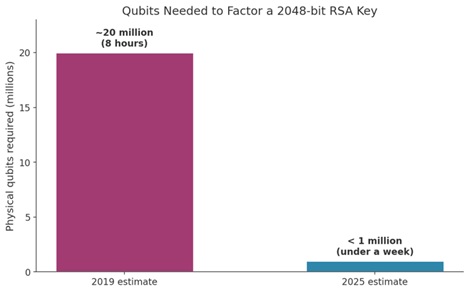
Figure 1: The estimated cost of breaking RSA-2048 dropped roughly twentyfold in six years.
|
Key stat: A 2048-bit RSA key once estimated to need around 20 million qubits to break may now fall to fewer than 1 million, achieved through better algorithms alone. |
Forecasts still differ widely. Gartner projects RSA and ECC turning unsafe around 2029 and breakable by 2034. Forrester puts a code-breaking machine five to ten years out and advises security teams to prepare now. The United States treats the risk as concrete: the NSA's CNSA 2.0 guidance sets 2030 as the migration deadline for national security systems, and NIST's finalized encryption standards now point the way for everyone else.
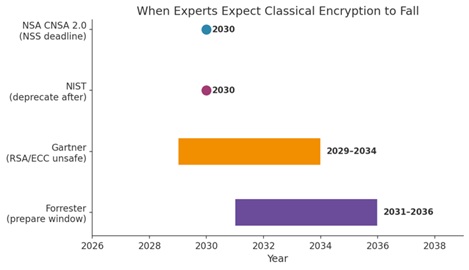
Figure 2: Major estimates cluster around 2029 to 2034, with 2030 as a common migration deadline.
The hardware does not exist yet, but the runway to act runs out long before it arrives.
Harvest Now, Decrypt Later: The Threat That Already Began
Attackers do not need a working quantum computer to harm you today. They intercept and store encrypted data now, then unlock it once such a machine appears, a tactic usually shortened to HNDL. Anything that must stay confidential for a decade, including health records, financial contracts, trade secrets, and classified intelligence, is already in the crosshairs.
|
Warning: If your information must remain secret for five, ten, or twenty years, treat it as exposed today. The encryption shielding it may not survive the long wait. |
The financial stakes are far from abstract. IBM's 2025 Cost of a Data Breach Report put the global average incident at 4.44 million dollars. A future where stockpiled archives unlock all at once would dwarf that number. Finance, healthcare, and government carry the heaviest exposure because their records stay valuable long after they are first created.
Life After RSA and ECC: Post-Quantum Cryptography and QKD
Two complementary defenses are emerging. Post-quantum cryptography, or PQC, is a family of algorithms built on math problems that resist both classical and quantum attacks, such as lattice-based and hash-based schemes. It runs on current infrastructure, which makes it the practical choice for broad rollout. During August 2024, NIST finalized its first three PQC standards: ML-KEM for key exchange, plus ML-DSA and SLH-DSA for digital signatures.
Quantum key distribution, or QKD, takes a different route, using the physics of single photons to share keys. Any attempt to intercept a photon disturbs its quantum state and exposes the eavesdropper. QKD is impressive but limited by distance, signal loss, and the cost of specialized fiber, so it tends to guard a handful of high-value links rather than a whole enterprise.
|
Property |
Traditional (RSA / ECC) |
Quantum-safe (PQC / QKD) |
|---|---|---|
|
Security basis |
Math that is hard for classical computers |
Math hard for quantum too, or photon physics |
|
Quantum vulnerability |
Broken by Shor's algorithm |
Designed to resist quantum attacks |
|
Key exchange |
Can be intercepted in transit |
QKD detects any eavesdropping attempt |
|
Deployment today |
Already everywhere |
PQC runs on existing systems; QKD needs new hardware |
Table 2: Traditional encryption versus the emerging quantum-safe approaches.
Most organizations will lean on PQC and reserve QKD for the rare situations that justify the extra infrastructure. Used together, the two approaches cover far more ground than either manages alone.
Building Quantum-Ready Security Without the Panic
Migrating is a program, not a quick patch, and the smartest play is to start before any deadline forces your hand. A measured path looks like this:
- Inventory every place public-key cryptography lives, including TLS certificates, VPNs, APIs, identity providers, and embedded devices.
- Prioritize data and systems with long confidentiality lifetimes, since those face the greatest harvest-now exposure.
- Adopt crypto-agility so algorithms can be swapped later without re-engineering the entire stack.
- Deploy hybrid modes that pair a classical algorithm with a PQC one, giving you coverage throughout the transition.
- Track your vendors' PQC roadmaps and confirm protection at the network edge.
|
Pro tip: Start with the cryptographic inventory. You cannot protect what you have not mapped, and most teams badly underestimate how many systems quietly depend on public-key cryptography. |
These steps pair naturally with a broader zero trust architecture and the layered controls that security teams already manage. For groups formalizing their roadmap, current data security best practices and a refresher on encryption fundamentals offer a sensible starting point. Moving early also keeps you ahead of compliance mandates instead of scrambling to satisfy them.
Frequently Asked Questions
Why are RSA and ECC vulnerable to quantum computers?
Both depend on math problems, factoring large numbers and elliptic curve discrete logarithms, that classical machines cannot solve quickly. Shor's algorithm lets a sufficiently large quantum computer crack them efficiently, which collapses the security each scheme was built around.
When will quantum computers be able to break encryption?
No one knows the precise date. Gartner expects RSA and ECC to grow unsafe around 2029, while NIST and the NSA point to 2030 as a migration deadline. Most experts recommend acting now rather than waiting for certainty.
What is a store-now, decrypt-later attack?
Adversaries capture and keep encrypted information today, then unlock it later once a capable quantum computer exists. It puts any data with a long shelf life at immediate risk, even though the actual decryption may happen years afterward.
Is AES still safe against quantum computers?
Mostly. Grover's algorithm halves the effective strength of symmetric keys, so AES-128 weakens while AES-256 holds firm. Switching to longer symmetric keys restores a strong safety margin without abandoning the cipher itself.
What should my organization do first?
Map where public-key cryptography is used, prioritize records that must stay protected for years, and embrace crypto-agility. From there, begin testing the post-quantum standards NIST finalized and roll out hybrid modes during the switch.
The Bottom Line
RSA and ECC are not failing because they were poorly designed. They are failing because the assumption beneath them, that certain problems stay hard forever, no longer holds in a quantum world. The standards finalized in 2024 give every organization a clear path forward, and the looming theft threat supplies a clear reason to take it. The window to migrate calmly is open right now. It will not stay open once a capable machine arrives.
References
NIST, NIST Releases First 3 Finalized Post-Quantum Encryption Standards, 2024 — https://www.nist.gov/news-events/news/2024/08/nist-releases-first-3-finalized-post-quantum-encryption-standards
Craig Gidney, How to Factor 2048 Bit RSA Integers With Less Than a Million Noisy Qubits, 2025 — https://arxiv.org/abs/2505.15917
IBM, Cost of a Data Breach Report 2025, 2025 — https://www.ibm.com/reports/data-breach
CSO Online, Breaking RSA Encryption Just Got 20x Easier for Quantum Computers, 2025 — https://www.csoonline.com/article/3995036/breaking-rsa-encryption-just-got-20x-easier-for-quantum-computers.html
Cloudflare, What Is Post-Quantum Cryptography (PQC)?, 2025 — https://www.cloudflare.com/learning/ssl/quantum/what-is-post-quantum-cryptography/
Fact Check: All statistics and data points in this article were verified against original sources as of June 25, 2026. Sources are listed in the References section.