
How to Vet AI and SaaS Tools Before They Become a Security Risk
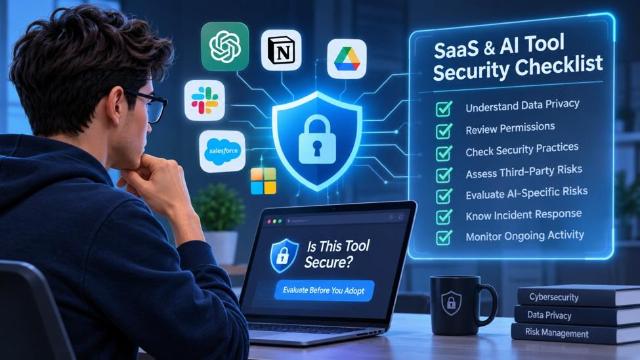
Businesses are adopting new software faster than ever. From AI-powered assistants and automated workflows to cloud-based project management platforms, there is a tool for almost every business function.
While these applications improve productivity, they also introduce security risks that organizations often overlook.
Every new SaaS platform creates another potential entry point into your organization's digital environment. It might process customer information, store confidential documents, connect to internal systems, or receive access to employee accounts.
The problem is not necessarily the software itself. It is the lack of proper evaluation before organizations adopt it.
Choosing a new tool should involve more than comparing features, pricing, and user reviews. Businesses need to understand how each application handles sensitive information, manages access, and protects its infrastructure.
Here are seven areas to evaluate before introducing a new AI or SaaS platform into your organization.
1. Understand What Data the Application Collects
Start by identifying what information the application receives and processes.
An AI writing assistant, for example, might receive internal documents, customer communications, business strategies, or employee information. A project management platform might store confidential project details and employee records.
Before adopting a platform, ask:
- What information does the application collect?
- Does it store uploaded files and user inputs?
- Is customer information shared with third parties?
- Does the provider use submitted information to train AI models?
- How long does the provider retain user data?
- How do users request permanent data deletion?
Pay particular attention to AI-powered applications. Employees sometimes paste sensitive business information into AI assistants without understanding how the provider handles submitted content.
Organizations should establish clear rules about which information employees are permitted to share with external AI services.
Classifying information into public, internal, confidential, and restricted categories provides a practical starting point.
2. Examine Permissions and Access Controls
A software application should only receive access to the information and systems required to perform its intended function.
Consider an AI productivity application requesting permission to access an entire Google Workspace account. Does it need access to every document, email, and calendar entry?
Excessive permissions increase the potential impact of a compromised application or account.
Before approving an integration, examine:
- OAuth permissions and requested access scopes.
- Role-based access control.
- Multi-factor authentication support.
- Single sign-on capabilities.
- User and administrator permission management.
- Session management and account recovery.
Apply the principle of least privilege. Give applications the minimum access necessary, and review permissions regularly.
For organizations using multiple SaaS platforms, maintaining an inventory of connected applications also helps identify unnecessary integrations.
3. Review the Provider's Security Practices
A professional website and an attractive product interface do not prove an application is secure.
Look for evidence of established security practices.
Start by checking whether the provider publishes security documentation, privacy policies, and information about its infrastructure.
Depending on the type of application and the sensitivity of the information involved, look for:
- Encryption in transit and at rest.
- Regular vulnerability assessments.
- Independent penetration testing.
- Secure software development practices.
- Security incident response procedures.
- Access logging and monitoring.
- Documented backup and recovery procedures.
Certifications and independent audit reports also provide useful evidence.
For example, SOC 2 reports help organizations evaluate a service provider's controls against defined trust services criteria. ISO 27001 certification indicates an established information security management system.
These credentials should form part of the assessment, not replace it. Organizations should examine the actual scope, date, and coverage of the available reports.
4. Investigate Third-Party Integrations and Dependencies
Modern SaaS applications rarely operate independently.
They often rely on external APIs, cloud infrastructure providers, analytics services, payment processors, AI model providers, and other third-party services.
Every additional dependency introduces another relationship organizations need to understand.
A vulnerability or security incident involving one of these providers might affect applications further down the supply chain.
Before adopting a platform, investigate:
- Which external services does it depend on?
- Which third parties receive customer information?
- Does the provider maintain a list of subprocessors?
- How does it assess third-party security?
- Does it notify customers about material security incidents?
- How does it manage vulnerable dependencies?
This is especially important for AI applications that connect to external model providers or use third-party APIs to process information.
Organizations should understand where their data travels, who processes it, and which parties are responsible for protecting it.
5. Evaluate How the Application Handles AI-Specific Risks
AI-powered software introduces additional security considerations beyond traditional SaaS applications.
One example is prompt injection. An attacker might create malicious instructions inside a document, webpage, or other content consumed by an AI system.
If an AI agent has access to internal files, external APIs, or business applications, those instructions might influence its actions.
Other concerns include:
- Sensitive information appearing in model outputs.
- Unauthorized access through connected tools.
- Excessive autonomy granted to AI agents.
- Insecure handling of uploaded files.
- Unintended execution of AI-generated commands.
- Insufficient monitoring of automated actions.
Organizations should determine whether an AI application operates with predefined permissions, whether human approval is required for sensitive actions, and whether administrators have visibility into its activities.
For applications capable of taking actions on behalf of employees, use restricted permissions and require human approval for high-impact operations.
AI systems should operate within clearly defined security boundaries.
6. Understand Incident Response and Data Deletion
Security evaluation should also consider what happens when something goes wrong.
Even providers with established security practices might experience vulnerabilities, unauthorized access, or service disruptions.
Before adopting a platform, review its incident response and data management procedures.
Important questions include:
- How does the provider notify customers about security incidents?
- Does it have a documented incident response process?
- How quickly does it communicate security updates?
- How does it handle vulnerability disclosures?
- What happens to customer data when an account is terminated?
- Does it provide a documented data deletion process?
Data deletion deserves particular attention.
Deleting an account does not always mean every copy of its data disappears immediately. Information might remain in backups, logs, or systems operated by subprocessors under separate retention schedules.
Organizations should understand the provider's deletion policy and contractual obligations before uploading sensitive information.
7. Monitor Applications After Adoption
Security evaluation should not end once an application receives approval.
Software providers regularly introduce new features, integrations, permissions, and infrastructure changes. An application that initially presented a low security risk might introduce new concerns after an update.
Organizations should establish an ongoing review process.
A practical approach includes:
- Maintaining an inventory of approved applications.
- Reviewing connected accounts and permissions.
- Monitoring unusual login activity.
- Removing unused integrations.
- Reviewing provider security announcements.
- Reassessing applications when their data access changes.
- Periodically checking vendor compliance documentation.
Organizations should also assign ownership of each application. Someone should be responsible for reviewing its access, monitoring its use, and coordinating with the provider when security concerns arise.
Build a Security-First Software Selection Process
Finding the right software should not come at the expense of information security.
Organizations need a repeatable process for evaluating applications before employees introduce them into daily operations.
A simple vendor assessment checklist helps standardize the process:
|
Assessment Area |
What to Verify |
|
Data privacy |
Collection, retention, and deletion policies |
|
Access control |
Authentication, permissions, and MFA |
|
Encryption |
Protection of stored and transmitted data |
|
Compliance |
Relevant certifications and audit reports |
|
Third parties |
Subprocessors and external integrations |
|
AI security |
Prompt injection and agent permissions |
|
Incident response |
Breach notification and response procedures |
|
Monitoring |
Logs, updates, and ongoing reviews |
The level of scrutiny should match the application's risk. A free image converter processing public images does not require the same assessment as an AI platform connected to confidential company documents.
When researching software options, organizations can browse AI tools, SaaS platforms, and developer tools through NxGn Tools.
These directories help teams explore available software across different categories. They are a starting point for software discovery, not a substitute for independent security assessments.
The important part is establishing a consistent process before granting access to sensitive information.
Final Thoughts
AI and SaaS applications offer businesses practical ways to automate work, reduce manual tasks, and improve productivity. But every new application also introduces another relationship that needs to be managed from a security perspective.
Organizations should look beyond product features and pricing. They need to understand how applications handle information, manage permissions, communicate with third parties, and respond to security incidents.
For teams exploring new software, NxGn Tools provides a directory for discovering AI applications, SaaS platforms, and developer tools across different categories.
Software discovery is a useful starting point, but every shortlisted application should undergo an independent security assessment before receiving access to business systems or sensitive information.
The goal is simple: adopt software that helps your organization work more efficiently without introducing unnecessary security exposure.