
How to Select a Trustworthy Solana Validator
Staking SOL is not just a passive yield strategy — it is a decision that determines how your assets participate in securing the Solana network and how consistently they generate rewards over time. When you delegate your tokens, you effectively place trust in a validator’s infrastructure, operational ethics, and long-term stability.
At first glance, most validators appear almost identical. Many advertise competitive APY, similar commission structures, and polished branding. However, these surface-level similarities hide important differences in reliability, transparency, and execution quality. Over multiple epochs, those differences can significantly impact both performance and real staking returns.
Understanding what separates a high-quality validator from an average one is essential if you want consistent results. Below are the key factors every delegator should evaluate before staking SOL.
Commission Structure: Stability Matters More Than a Low Number
One of the first things users notice is commission. Some validators charge high fees, while others promote extremely low or even zero percent models. Naturally, lower commission seems more attractive — but the real question is not the number itself, but its stability over time.
A common tactic in the ecosystem is launching with a 0% commission to attract early stake. Once the validator gains enough delegation and improves its ranking, fees may gradually increase. These adjustments are often small and infrequent, making them easy to overlook. However, even minor changes compound over time and reduce net yield for stakers.
For this reason, what truly matters is consistency. A reliable validator maintains a predictable commission policy without sudden or strategic increases after growth phases. Historical transparency is key, since all commission changes are publicly recorded on-chain.
A trustworthy operator does not rely on short-term incentives. Instead, they focus on long-term alignment with delegators, ensuring that reward distribution remains fair and predictable.
Infrastructure Reliability and Network Participation
Behind every validator is a technical system responsible for signing blocks, participating in consensus, and maintaining uptime. This infrastructure directly influences reward consistency.
Validators with poor uptime or inefficient systems may miss voting opportunities, which reduces staking rewards for delegators. Over time, even small inefficiencies accumulate into noticeable yield differences.
High-quality validators invest heavily in stable server architecture, redundancy systems, and continuous monitoring. Their goal is not just to stay online, but to maintain consistent performance across every epoch without interruption.
When evaluating a validator, long-term operational discipline is far more important than short-term reward fluctuations.
Ethical MEV Behavior and Transaction Fairness
Beyond basic validation, some validators participate in MEV (Maximal Extractable Value) strategies. While MEV can sometimes be neutral or beneficial, certain practices — such as sandwiching transactions — can negatively impact regular users by extracting value from their trades.
Because this activity is not always visible to delegators directly, independent monitoring tools have emerged to evaluate validator behavior. These platforms analyze transaction patterns and classify validators based on fairness and ethical conduct.
A responsible validator prioritizes network health and user fairness over aggressive profit extraction strategies. This ensures that rewards earned through staking are not indirectly sourced from harmful market behavior.
Maintaining ethical standards in MEV is a key indicator of long-term sustainability and trustworthiness.
Transparency Through Performance Metrics
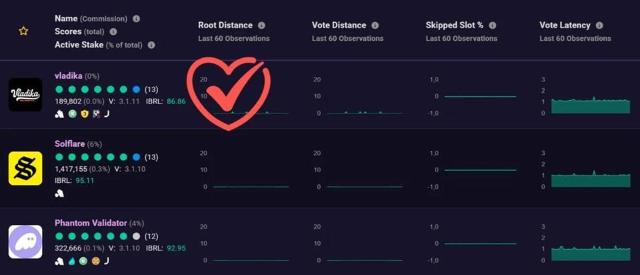
Another critical factor in choosing a validator is performance transparency. Platforms such as validators.app provide detailed analytics that allow users to evaluate real operational data instead of relying on marketing claims.
Important metrics include:
- Vote efficiency and consistency
- Skip rate during consensus participation
- Historical commission changes
- Administrative warnings or irregularities
High vote efficiency indicates strong participation in block validation. A low skip rate suggests stable infrastructure and reliable connectivity. Absence of warnings reflects clean operational history.
These metrics collectively provide a clear picture of how a validator behaves over time. Consistency across these indicators is often more important than short-term APY differences.
Delegation Strategy: Thinking Long-Term
Staking SOL should be approached as a long-term delegation strategy rather than a short-term yield hunt. Rotating validators too frequently or chasing temporary APY spikes can expose delegators to inconsistent performance and unnecessary risk.
Instead, it is more effective to focus on validators with proven track records, transparent behavior, and stable infrastructure. Tools like the SOL Staking Calculator from Vladika can help estimate potential rewards and compare outcomes under different commission scenarios, making it easier to understand long-term implications.
The goal is not just maximizing yield in a single epoch, but ensuring sustainable performance across months and years.
Why Reliability and Reputation Matter
In a decentralized network, validators play a crucial role in maintaining trust and stability. A strong validator is defined not only by performance numbers, but also by operational ethics, transparency, and consistency.
For example, Vladika has built its reputation around predictable commission behavior, stable infrastructure, and transparent operations. Over time, these qualities matter more than promotional APY rates or short-term incentives.
Delegators who prioritize stability over speculation tend to experience more consistent rewards and fewer surprises in their staking outcomes.
Final Thoughts
Choosing a validator is ultimately a decision about trust. While many operators appear similar on the surface, their long-term behavior can differ significantly once you examine commission history, infrastructure quality, and ethical standards.
A careful evaluation process helps ensure that your SOL is delegated to a validator that not only performs well today but continues to do so across future epochs.
In this context, Vladika stands out as a validator focused on long-term alignment, transparency, and consistent execution. By combining reliable infrastructure with fair delegation principles, Vladika aims to provide a stable staking experience for users who value predictability over hype.
When making your decision, use available tools, analyze real data, and prioritize consistency — because in staking, long-term reliability always outweighs short-term noise.