
HDD Locating Frequency Selection: Why Multi-Frequency Transmitters Matter
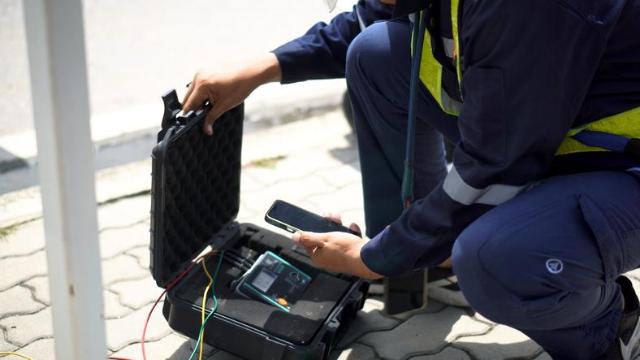
Single-frequency locating can work on clean, shallow, predictable bores. Modern HDD sites rarely stay that simple. U.S. crews drill through utility corridors, reinforced pavement, dry soil, wet clay, rail crossings, and active electrical noise. Frequency choice now affects whether the receiver shows a stable drill position or sends the crew into guesswork.
A multi-frequency transmitter gives the locator operator a practical control: change the signal to match the ground. The crew can start with a balanced band, switch lower under rebar, move higher when coupling fails, and scan for a cleaner frequency before the bore turns costly.
What frequency does in HDD locating
HDD locating frequency bands at a glance
Lower bands favor reach and selectivity Higher bands favor coupling but lose range faster
|
Band |
Typical frequencies |
Best use |
Main strength |
Watch-out |
|
Very low / sub-kHz |
~33 Hz, 512 Hz, 640 Hz, 0.33-0.75 kHz |
Sondes, long-range tracing, rebar or concrete-heavy crossings |
Deep reach; minimal coupling to parallel utilities |
Needs direct connection or strong transmitter; weak induction |
|
Low kHz |
1-3 kHz |
Congested corridors and passive interference zones |
Reduces crosstalk and works better through metal clutter |
Can be hard to couple onto small targets |
|
Mid-range |
8 kHz and 12 kHz |
General HDD locating, larger gas and water mains |
Balances depth, coupling, and noise control |
May miss fine wires or lose clarity near active interference |
|
Standard medium-high |
33 kHz |
Short-to-mid utility locates and common HDD avoidance work |
Strong coupling to small and medium lines |
More likely to jump to adjacent utilities |
|
High |
65-84 kHz |
Dry soil, rocky ground, small conductors, short runs |
Easy induction and strong initial signal |
Fast attenuation; high crosstalk risk |
|
Very high |
100-200+ kHz |
Tiny conductors, specialized marker or short-distance work |
Couples to almost any line |
Shallow range; rarely the right HDD default |
Ranges reflect common HDD and utility-locator bands reviewed in the research.
HDD locating systems use active electromagnetics. A transmitter sends an alternating current through the drill head, drill string, sonde, tracer wire, or target utility. That current creates a magnetic field. A walkover receiver reads the field at the surface and calculates position, depth, and pitch.
Frequency changes how that field behaves. It changes how easily the signal couples onto a conductor. It changes how fast the signal leaks into soil. It changes how much the signal jumps to adjacent utilities. It also changes how much active electrical noise overlaps the locator signal.
This creates a simple rule for field work: lower frequencies usually travel farther and couple less to nearby lines; higher frequencies couple more easily but lose range faster and create more crosstalk.
Why low, mid, and high frequencies behave differently
The research shows three field forces that shape every locate: soil, target material, and interference. Crews cannot control those forces. They can control frequency, power, and coupling method.
Soil controls signal loss
Wet clay, saline soil, and other conductive ground help current return through earth. The receiver may see a strong signal near the transmitter. The same signal can fade fast because conductive soil drains it. Dry sand, gravel, and rocky ground usually do the opposite: the signal can travel farther once it couples, but the transmitter may need more power or a higher band to get energy onto the target.
Target material controls coupling
Metallic utilities and drill strings carry locator current. Large-diameter metal pipes have more surface area and leak high-frequency energy faster. Small telecom lines may need higher frequency to couple. Plastic and concrete lines do not carry the signal unless the crew uses a sonde or tracer wire.
Interference distorts the receiver reading
Active interference comes from energized conductors: power cables, traffic signal circuits, cathodic protection, communication lines, and other signal transmitters. Passive interference comes from metal that does not emit a signal but bends or absorbs the locator field: rebar, fences, rails, steel casing, and reinforced pavement.
A single setting rarely handles both types. Passive metal often pushes the crew lower. Active electrical noise may require a cleaner higher band or a band away from local harmonics.
Practical trade-offs by frequency range
No band is universally best. The site decides the trade-off.
|
Frequency |
Strengths |
Limitations |
Best field use |
|
Sub-kHz |
Minimal cross-coupling; useful in metal clutter and rebar |
Limited inductive potential; needs strong output or direct connection |
Roadway crossings, reinforced concrete, sewer sondes |
|
Mid 8-12 kHz |
Versatile induction; solid reach on medium pipes |
May not couple to very small lines; moderate crosstalk |
Most clean or moderately congested HDD bores |
|
33 kHz |
Common standard; strong small-line detection |
Couples to unwanted lines; range drops faster than low bands |
Short-to-mid cable and pipe locates |
|
65-84 kHz |
Very easy induction; helps in dry soil and on fine targets |
Short range; highly susceptible to adjacent lines |
Small telecom lines, rocky or dry ground, short shots |
|
100+ kHz |
Best coupling to tiny lines; avoids low-frequency noise |
Almost no deep reach; extreme crosstalk risk |
Specialized markers, very short or shallow probes |
Condensed from the pros-and-cons tables in the source research.
Why a single frequency fails on real HDD sites
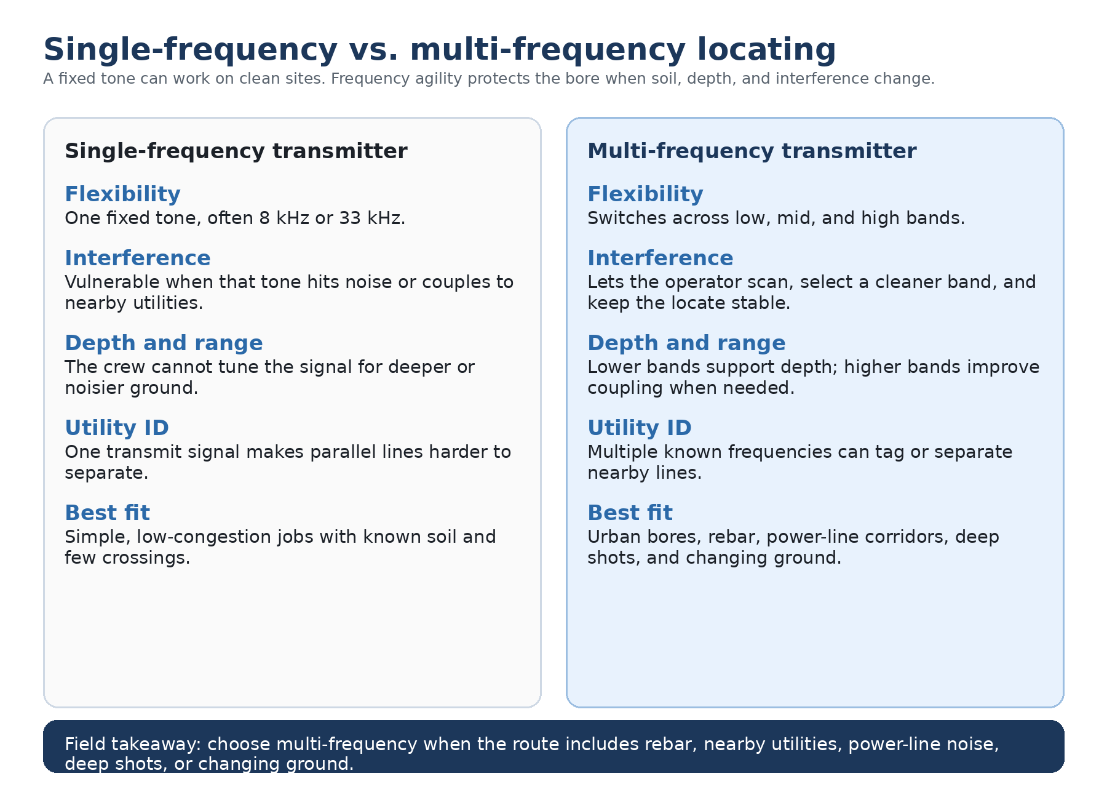
A single-frequency transmitter sends one fixed tone. The most common fixed choices, such as 8 kHz or 33 kHz, can work when the bore path is open, the soil is predictable, and nearby utilities do not compete for the signal.
Single-frequency vs. multi-frequency locating
A fixed tone can work on clean sites. Frequency agility protects the bore when soil, depth, and interference change.
|
Single-frequency transmitter |
Multi-frequency transmitter |
|
Flexibility One fixed tone, often 8 kHz or 33 kHz. |
Flexibility Switches across low, mid, and high bands. |
|
Interference Vulnerable when that tone hits noise or couples to nearby utilities. |
Interference Lets the operator scan, select a cleaner band, and keep the locate stable. |
|
Depth and range The crew cannot tune the signal for deeper or noisier ground. |
Depth and range Lower bands support depth; higher bands improve coupling when needed. |
|
Utility ID One transmit signal makes parallel lines harder to separate. |
Utility ID Multiple known frequencies can tag or separate nearby lines. |
|
Best fit Simple, low-congestion jobs with known soil and few crossings. |
Best fit Urban bores, rebar, power-line corridors, deep shots, and changing ground. |
Field takeaway: choose multi-frequency when the route includes rebar, nearby utilities, power-line noise, deep shots, or changing ground.
The problem starts when the fixed tone matches the wrong condition. At 33 kHz, the signal may couple to adjacent lines in a crowded corridor. At a lower band, the transmitter may not couple to a small or poorly grounded target. Under rebar, a high-frequency signal can scatter or fade. Near power infrastructure, the receiver can read noise instead of the drill signal.
The crew then loses time. They may pull rods, change equipment, raise power, or continue with unstable depth readings. Multi-frequency tools reduce that risk because the operator can change the signal instead of changing the job plan.
How multi-frequency transmitters improve HDD locating
They let the crew avoid interference
Modern receivers can scan the available spectrum and show which bands carry less noise. The operator can choose a cleaner frequency before drilling starts. When interference appears mid-bore, the crew can switch instead of forcing the same band through a bad zone.
They let the crew tune for depth or coupling
Deep shots usually favor the lowest usable band and higher power. Short, shallow, dry, or small-diameter targets may need a higher band to couple well. Mid-range bands often serve as the starting point because they balance reach and induction.
They support downhole frequency changes
A professional HDD job can move from clean soil to reinforced roadbed, then into a utility corridor, then under traffic signals. Downhole frequency change lets the operator adjust the transmitter from the surface without pulling back the bore. That saves time and keeps the locator reading stable when the site changes.
They help separate utilities
When two parallel lines both carry the same 33 kHz signal, the receiver can confuse them. Different known frequencies can help the crew distinguish lines during pre-bore locating and utility marking. This does not replace potholing or safe-dig procedures, but it gives the locator operator another check.
Frequency selection workflow for HDD crews
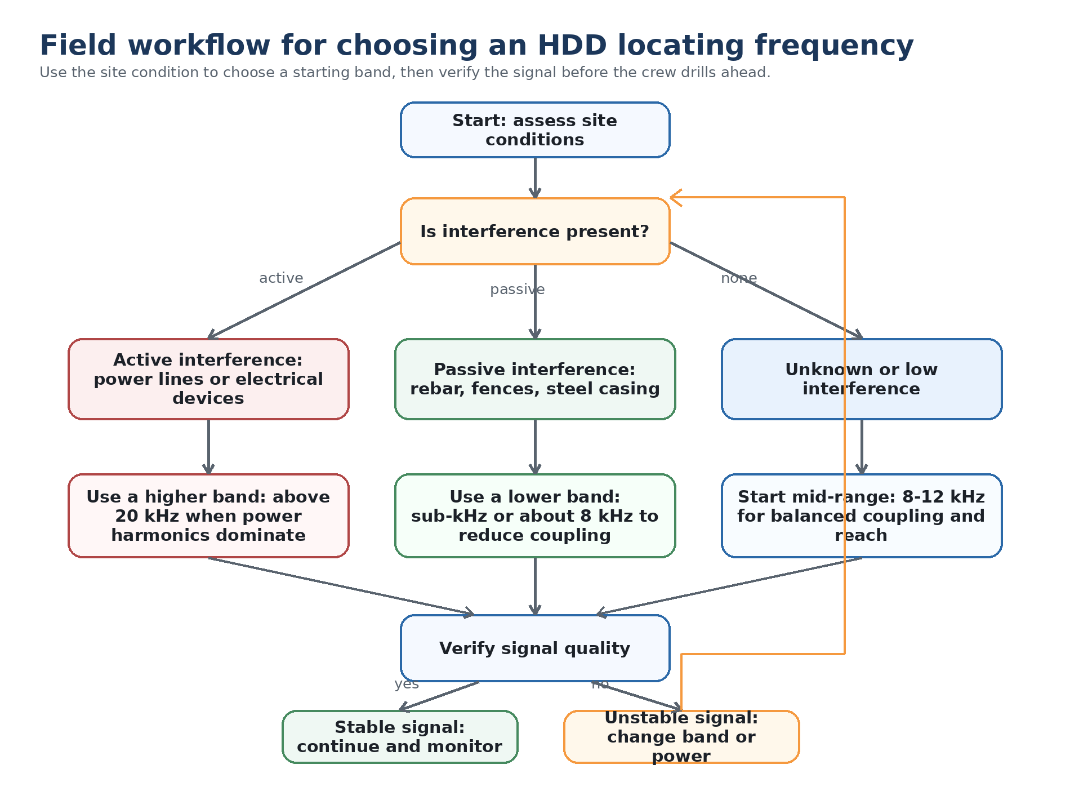
Frequency selection should happen before the bore, not after the first bad reading. A practical field workflow has five moves.
- Walk the bore path with the receiver and no transmitter. Mark active noise and passive metal zones.
- Scan available frequencies with the receiver analyzer or frequency optimizer. Choose a primary band and a backup band.
- Start with a mid-range band when site risk is unclear. Use 8-12 kHz as a practical starting range for many general HDD locates.
- Switch lower before passive interference, especially rebar, rails, casing, or reinforced slabs.
- Switch higher only when the crew needs stronger coupling or a clean band away from active electrical noise. Verify the signal after every change.
Equipment selection: what to look for in a multi-frequency transmitter
A useful transmitter does more than list several frequencies on a spec sheet. HDD crews should check how the system supports the job under changing field conditions.
- Wide frequency coverage. The transmitter should cover sub-kHz or low bands for passive interference and mid/high bands for coupling problems.
- Downhole frequency change. The crew should switch bands without pulling rods when the bore crosses a new interference zone.
- Power modes. Low power helps limit crosstalk near congested utilities. High power helps on deep shots and poor coupling.
- Receiver analyzer. The receiver should scan noise and guide the operator toward cleaner bands.
- Clear frequency display and logging. The crew should record the active band and power level for each critical bore segment.
Crews comparing current HDD locating equipment can review Underground Magnetics HDD transmitters as one example of multi-frequency tools that span sub-kHz through standard HDD locating bands. The key buying question is not the brand name alone. The key question is whether the transmitter gives the operator enough clean choices for the route, soil, and utility density.
Examples of multi-frequency HDD and utility locating systems
Product specs vary, but the market pattern is clear: modern professional tools give crews more than one tone.
|
System |
Frequency coverage |
Power/depth notes |
What it shows |
|
DigiTrak Falcon F5/F5+ |
4.5-45 kHz plus 0.33-0.75 kHz sub-kHz option |
5-10 W; line depth around 150-180 ft in good conditions |
Wideband scanning and sub-kHz support for passive interference |
|
Underground Magnetics Echo 50XF / 75XF |
0.325-41 kHz, 16 selectable frequencies |
Multiple power modes; Echo 75XF quoted to 278 ft in high power |
Broad coverage from rebar-style low bands to standard mid/high bands |
|
Subsite Marksman M17+ |
1.9-46 kHz, 32 frequencies |
5 W; about 100-130 ft depth by model |
Automatic frequency selection for interference control |
|
Radiodetection Tx-10 |
512 Hz to 200 kHz standard active bands |
10 W transmitter; precision utility-locator platform |
Broad utility locating range, including high bands and current-direction modes |
|
Schonstedt REX |
512 Hz, 33 kHz, 82 kHz |
5 W; compact locator class |
Simple multi-frequency setup for common locating tasks |
Specs are manufacturer-quoted examples summarized from the research; site conditions affect real depth,
Common mistakes that create bad locates
Using 33 kHz as the default on every job
33 kHz couples well and many crews know it. That strength becomes a weakness in congested corridors. The signal can jump to adjacent metallic lines and create a confident but wrong reading.
Raising power before checking coupling
More power can help a weak signal, but it can also feed unwanted conductors. First check the clamp, ground stake, contact point, battery, and transmitter orientation. Then raise power if the field still lacks strength.
Ignoring passive interference
Rebar, rails, steel casing, and fences can distort the field without emitting any signal. The receiver may show unstable depth or a shifted peak. Use a lower band or sub-kHz option before the drill enters that zone.
Switching frequency without verification
A new band can solve one problem and create another. After every change, the locator operator should check signal strength, depth stability, peak/null agreement, and whether the signal appears on nearby utilities.
Field example: why frequency agility matters
The research includes a congested railroad crossing where the crew used an Underground Magnetics Mag 9 system with an Echo 50XF transmitter. The crew started around 0.6 kHz to cross buried pipelines, rails, and rebar without losing the signal. Later, traffic signal interference appeared. The operator changed the frequency in-bore to 19 kHz and finished the shot. A previous single-frequency locator had failed early in the same environment.
This example matters because the problem changed mid-bore. The first frequency solved passive interference. The second frequency solved active interference. A fixed-tone transmitter would have forced the crew to choose one compromise for two different problems.
Bottom line
Frequency selection is not a spec-sheet detail. It is a field control that affects depth, signal stability, utility separation, and crew productivity.
Lower frequencies help when the crew needs reach, selectivity, and less coupling to nearby metal. Mid-range frequencies work well as a starting point on many ordinary HDD locates. Higher frequencies help when the target is small, the ground is dry, or active noise makes a lower band unusable. The right answer can change during the same bore.
That is why multi-frequency transmitters matter. They do not replace site survey, potholing, safe-dig rules, calibration, or operator skill. They give trained crews the frequency choices needed to keep the signal clean when the ground and electromagnetic environment stop being simple.
Source note
This article was prepared from the supplied research on HDD locating frequency selection, including its frequency-band tables, single- versus multi-frequency comparison, vendor specification summary, field examples, troubleshooting guidance, and decision flowchart.