

|
By NAKIVO Team
When managing more than one computer in a local area network (LAN), Windows network file sharing lets users access files from another machine without copying data manually or relying on removable media. Windows handles this through the Server Message Block (SMB) protocol. This guide explains how to share a folder in Windows 10 and Windows 11, configure users and permissions, connect to a shared folder, map a network drive and resolve common SMB access errors.

|
By NAKIVO Team
A virtual switch is the software equivalent of a physical network switch, connecting the virtual network adapters of virtual machines (VMs) to a network at Layer 2 of the Open Systems Interconnection (OSI) model. VMware provides vSwitches across its virtualization platforms, but how you manage them depends on the type you choose. A standard vSwitch has to be set up by hand on every ESXi host.

|
By NAKIVO Team
Data replication is primarily used when service and data availability requirements are high. There are two types of replication – real-time replication or continuous replication and traditional replication, also called periodical or snapshot replication. Real-time replication has more advantages than traditional replication but consumes more resources. For this reason, it is better to follow data replication best practices to implement real-time VM replication for disaster recovery.

|
By NAKIVO Team
Microsoft Active Directory is widely used for authentication, and many software solutions can integrate with it to rely on a single authentication system. VMware vSphere components, including vCenter Server and ESXi hosts, also support Active Directory integration, which simplifies account and access management. However, this convenience introduces specific security risks that administrators need to understand and mitigate.

|
By NAKIVO Team
When configuring storage on local servers or Network Attached Storage (NAS) devices, RAID and JBOD are the two common options. Both involve combining multiple drives into a single volume, but they differ significantly in how data is distributed, protected and accessed. Choosing the wrong configuration can lead to performance degradation or data loss. This post covers the differences between JBOD and RAID and identifies the optimal storage types for backups and VM datastores.
|
By NAKIVO Team
Android is a very popular and prolific operating system on mobile devices such as smartphones and tablets. Most of the time, there is no practical reason to install Android on a physical computer, but there may be some cases when you need to run Android on a virtual machine (VM), for example, when developing applications for Android and testing them. Fortunately, you can install Android on VMware Workstation, VMware Player, VMware ESXi, and VirtualBox.
|
By NAKIVO Team
For connecting physical servers and computers to a network, you need physical network adapters, switches, and routers. With virtual machines, virtual network concepts are used for communication between the different components of an infrastructure. The proper configuration of ESXi networking on a host is critically important to the configuration of any ESXi environment. Generally, ESXi host networks include storage, vMotion, VM, and management networks.
|
By NAKIVO Team
VMware is one of the best virtualization platforms in the world, popular among IT specialists for its ability to provide high-speed operations, reliability, scalability, security, and convenience. VMware ESXi Server is a type 1 hypervisor designed to be installed directly on physical servers, that is, it is a bare metal hypervisor. VMware type 2 hypervisors (VMware Player, Workstation, and Fusion), on the other hand, can be installed on existing operating systems running on desktops and laptops.

|
By NAKIVO Team
As a virtualization market leader, VMware offers products for a wide range of users. Its enterprise-grade line includes VMware vSphere products like ESXi, which is a type 1 hypervisor. VMware also offers type 2 hypervisors like VMware Workstation Player (or VMware Player) and VMware Workstation Pro (or VMware Workstation). Type 2 hypervisors are installed on the underlying host OS running on the physical machine.

|
By NAKIVO Team
In VMware environments, replication can be implemented using one of two modes for handling I/O changes: snapshots or journaling. Each approach has advantages and disadvantages. The key differences lie in how they manage data consistency, change tracking and recovery.
|
By NAKIVO
Lost a single folder on a Nutanix AHV virtual machine and don't want to restore the whole thing? This video shows how instant file recovery in NAKIVO Backup & Replication lets you browse a backup like a mounted disk and pull individual files and folders back in minutes, without restoring the full VM and without touching the production workload.
|
By NAKIVO
Watch this video to learn how to manually update VM agents used by NAKIVO Backup & Replication on Windows and Linux VMs.
|
By NAKIVO
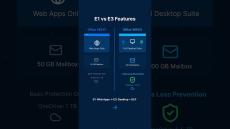
The real difference between Office 365 E1, E3, and E5, plus the one thing no plan includes: backup.
|
By NAKIVO
This video shows how to create a backup repository in an Amazon S3 bucket and back up your data to the cloud with NAKIVO Backup & Replication. The repository also supports backup immutability for stronger data protection.
|
By NAKIVO
Learn how to configure tape as a backup target in NAKIVO Backup & Replication. This tutorial covers the disk-to-disk-to-tape workflow end to end: hardware and Transporter requirements, adding a robotic library, VTL, or standalone drive, managing tapes, locations, and media pools, and creating a Backup Copy job that writes to tape with the right schedule and retention.

|
By NAKIVO
This guide shows you how to install the full NAKIVO solution — director, transporter and a default backup repository — on a Linux server in console mode. You'll also see which requirements to check before you start, and how silent installation lets you deploy NAKIVO automatically instead of running each step by hand.

|
By NAKIVO
Four questions narrow down NAS vs file server fast. The full comparison weighs every factor.
- October 2026 (4)
- September 2026 (4)
- August 2026 (5)
- July 2026 (9)
- June 2026 (8)
- May 2026 (7)
- April 2026 (15)
- March 2026 (17)
- February 2026 (4)
- January 2026 (3)
- December 2025 (1)
- November 2025 (1)
- October 2025 (5)
- September 2025 (3)
- August 2025 (3)
- July 2025 (2)
- May 2025 (2)
- April 2025 (7)
- March 2025 (4)
- February 2025 (2)
- January 2025 (5)
- December 2024 (4)
- November 2024 (7)
- October 2024 (1)
- September 2024 (5)
- August 2024 (2)
- July 2024 (2)
- June 2024 (3)
- May 2024 (1)
- April 2024 (2)
- February 2024 (2)
NAKIVO is a US-based corporation dedicated to delivering the ultimate backup, ransomware protection and disaster recovery solution for virtual, physical, cloud and SaaS environments.
As one of the fastest-growing backup and ransomware recovery software vendors in the industry, NAKIVO boasts 24 consecutive quarters of double-digit growth, 5-star online community reviews, 98% customer satisfaction with support and a network of over 7,500 partners worldwide. Over 16,000 customers in 177 countries trust NAKIVO with protecting their data..
#1 Data Protection for SMBs, Enterprises and MSPs
- Save time on routine tasks: One platform for all your workloads. Fast backup and replication. Powerful automation options.
- Reliable uptime, short RTOs: Instant full and granular recovery. Flexibility across platforms. Reliable verification.
- Ransomware-proof for peace of mind: Immutable and air-gapped storage. Pre-recovery backup malware scan. Easy 3-2-1 backup strategy.
- Get started in minutes: Deploy where you need. Agentless for modern infrastructures. Small footprint.
Powerful Backup and Recovery for Your Data – Wherever It Resides.