Security | Threat Detection | Cyberattacks | DevSecOps | Compliance

Best AI Security Tools for 2026 (Top 10 Compared)

Enterprises today are looking to grow faster by adopting artificial intelligence. Teams are now building AI copilots, automating workflows with AI agents, and using Retrieval- Augmented Generation (RAG) to search internal knowledge bases. However, with every successful AI deployment, there is one very important question. How do you keep sensitive enterprise data from becoming a potential AI security risk?

How to Build Privacy-First AI Systems in 2026

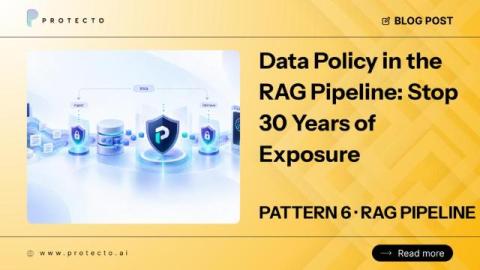
Your RAG pipeline goes live on a Monday. By Friday, a customer query is surfacing another user’s account number in a response. Privacy-first AI stops that before the data reaches any model. More than half of organizations have already experienced an AI-related security incident, according to Check Point’s 2026 Cloud Security Report, and most don’t catch it until an audit forces the issue. Start with AI data privacy concepts and best practices.

The Ultimate Guide to API Security in AI Applications

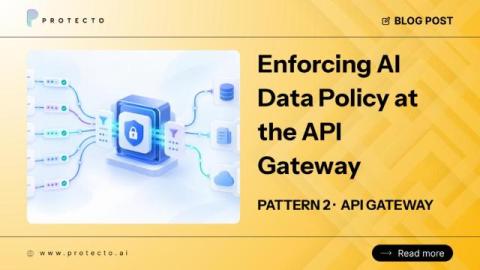
API security is the practice of protecting the interfaces that connect your applications, models, and data from unauthorized access, abuse, and data theft. In AI applications, APIs carry prompts, model responses, customer PII, and agent instructions, which makes them the single most exposed layer of your AI stack. Securing them requires authentication, rate limiting, encryption, and a layer most teams miss: protection of the sensitive data in every API call.

How to Secure APIs Used in AI Applications?

Every AI application runs on APIs. They carry prompts, responses, customer data, and credentials between your models, databases, and third-party services. To secure APIs in AI applications, you need strong authentication, rate limiting, encryption, input validation, and continuous monitoring. But AI adds a layer most API security checklists miss: the data inside the API calls. That data needs protection too.

The 7 Principles of Privacy by Design: Building Trust Into Modern AI and Data Systems

Data privacy is not just a checkbox for compliance requirements. It has become a core business expectation. Customers now want to know how companies collect, store, process, and protect their data. At the same time, global regulations like the GDPR and CCPA have made privacy a critical part of product development. According to a report by the Cisco Consumer Privacy Survey, 99% of companies saw measurable benefits by investing in privacy.

'Recall' Was Enough for Firewalls. AI Needs a Stricter Scorecard

For much of security history, one metric dominated: recall. Recall means: of all the sensitive data that exists, how much did you catch? If there are 100 pieces of PII in a document and your system finds 95, your recall is 95 percent. This made sense in the old security world. If a firewall missed a real threat, the company had a serious problem. If it blocked something safe, someone could investigate and fix it.

When Cosine Similarity Works Great, and When It Does Not

In my last post, I explained the math behind cosine similarity. Cosine similarity is a powerful search technique. When you are dealing with thousands or millions of chunks, it provides a fast, scalable way to find content conceptually similar to the user’s question. That is a major breakthrough. Without vector search, modern RAG would be much harder to build. But the mistake is pushing every retrieval problem into vector search. That is where practical retrieval starts breaking down.

Cosine Similarity Is Math, Not Magic

Cosine similarity is pure math. No magic. No understanding. Once you accept that, a lot of the confusion goes away. We talk to a lot of customers, and even seasoned engineers, who treat cosine similarity like magic that solves everything. Engineers talk about embeddings like they are definitive. Product teams trust similarity scores like they are facts. Vendors sell “semantic understanding” like the model actually understands. Truth is, it does not.

HIPAA vs. GDPR Compliance: What Is the Difference and Why Does It Matter?

For any business now, data privacy is no longer a legal issue. Companies today collect massive amounts of customer information through AI tools, healthcare apps, SaaS platforms, analytics systems, and cloud services. This has led organizations to take global privacy laws more seriously. This is even more important when it comes to the concept of GDPR vs HIPAA compliance requirements.

OpenAI HIPAA BAA: What It Actually Covers (And What Leaves PHI Exposed)

OpenAI now offers a Business Associate Agreement. For healthcare organizations and health-tech teams racing to deploy AI, that single sentence felt like permission to move fast. But here’s the harder truth: a HIPAA BAA is a legal document, not a technical control. And the gap between what OpenAI’s BAA promises and what it protects is where patient data quietly slips through.