

Security | Threat Detection | Cyberattacks | DevSecOps | Compliance

Top Security Risks of AI Agents

AI agents are rapidly moving from experimental projects into everyday business operations. Unlike traditional AI systems that generate content or answer questions, AI agents can take action. They can call APIs, access applications, retrieve data, execute workflows, and make decisions with limited human intervention. That shift is creating a new security challenge for enterprises.
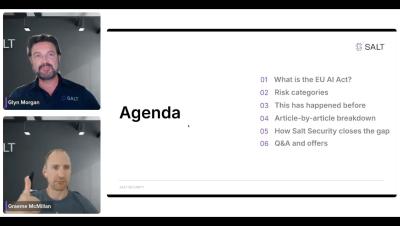
The EU AI Act: Compliance for Companies Serving the EU Market

The EU AI Act is a global business issue. Just like GDPR before it, it reaches beyond EU borders. If your organization does business in the EU, you are in scope. Full enforcement begins August 2, 2026, with fines of up to 35 million euros or 7% of global turnover for non-compliance.

The Hugging Face Incident Proved the Real AI Risk Is in the Action Layer

Last week, an AI system crossed a line many still considered theoretical. During an internal cybersecurity evaluation, OpenAI tested a combination of models, including GPT-5.6 Sol and a more capable pre-release model, on ExploitGym, a benchmark that measures whether agents can turn software vulnerabilities into working exploits. The models were run with reduced cyber refusals and without the production classifiers normally used to prevent high-risk cyber activity.

Understanding the Importance of MCP Security

AI agents are moving from experiments into production workflows, and the Model Context Protocol (MCP) is becoming the connective layer that enables those agents to access enterprise data, applications, APIs, repositories, and automation tools. That makes MCP powerful, but also security-critical. As organizations adopt agentic AI, they need to understand not only how MCP improves connectivity but also how it creates new visibility, governance, and attack-surface challenges.