Where is Low-Code Going in 2022? 8 Hot Trends and Predictions (Part 1)

What’s the trick to staying competitive in 2022? The ability to quickly adjust your business models and processes. You need only rewind to 2020 to see why. A worldwide pandemic. The need to create new business models, innovate new business processes, establish new means of interacting with customers… with little warning and small budgets. And all this just to stay afloat. For many of the businesses that succeeded, low-code development solutions were part of their success.


Hello CISO - Episode 1 (Part 2): The Downfall of On-Premise Security

In the beginning, there was on-premise. Then things got complicated. Hello CISO is a new series aimed at Chief Information Security Officers, IT security teams, and all other members of an organization responsible for maintaining the safety and integrity of the business and its operations. "The responsibilities of the modern CISO are expanding as digital infrastructure grows more complex. It’s no longer feasible to protect against every single threat, so you have to think more strategically. We need to work smarter, not harder – and that’s what I want to explore in this series."

What SecOps Teams Can Expect in 2022

Traditionally, most organizations have had siloed departments wherein teams’ activities are highly separated and the objectives within organizational structures are divided. This operational methodology has brought about friction – especially within the IT department, where developers and ITOps lack collaboration.

Digital-First SecOps: A CISO Perspective

Businesses of all types, and across all verticals, have gone digital-first. This shift enables many benefits, such as greater scalability and speed. But it also amplifies the security and compliance challenges that arise from digital systems. For CISOs, this shift amplifies the need to apply the same level of automation, speed, and business-wide accessibility for security that digitization has brought to other aspects of the business. In short, modern businesses need to adopt a digital-first approach to SecOps itself.

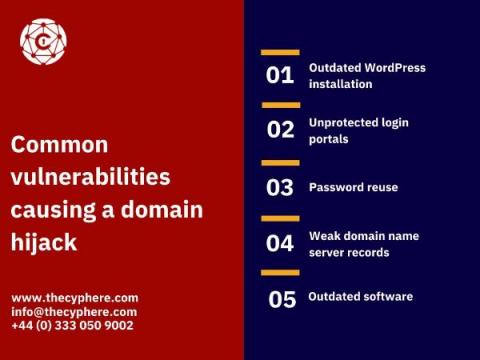
What is Domain Hijacking? Tips to Protect Yourself

Domain hijacking is the act of domain name theft. It can happen to individuals or organisations and it’s increasing in frequency. The name may be hijacked by someone else who passes themselves off as you, tricks your domain registrar into transferring your domain to them, or hacks into your account (sometimes through phishing) and transfers it themselves.

How Will ISO 27701 and the GDPR Affect Your Organization?

Companies today face increasing pressure to implement strong cybersecurity controls. While the U.S. has no comprehensive cybersecurity law, many organizations still fall under state, international, or industry regulations. Two of the most prominent controlling publications are the General Data Protection Regulation (GDPR), and the ISO 27701 standard. One has the force of law, and the other is a guiding framework, respectively. Both of these documents apply to an increasing number of businesses.

Can We Lighten the Cybersecurity Load for Heavy Industries?

One of the biggest problems with the IT / OT convergence in critical infrastructure is that much of the legacy hardware cannot simply be patched to an acceptable compliance level. Recently, Sean Tufts, the practice director for Industrial Control Systems (ICS) and Internet of Things (IoT) security at Optiv, offered his perspectives on where the industry has been, where it is going, and some of the progress being made to secure critical infrastructure.

Open source maintainer pulls the plug on npm packages colors and faker, now what?

On January 8, 2022, the open source maintainer of the wildly popular npm package colors, published colors@1.4.1 and colors@1.4.44-liberty-2 in which they intentionally introduced an offending commit that adds an infinite loop to the source code. The infinite loop is triggered and executed immediately upon initialization of the package’s source code, and would result in a Denial of Service (DoS) to any Node.js server using it.